
Wash your RV when road grime, bugs, bird droppings, sap, or visible buildup call for cleaning, and follow any wash interval in your RV or exterior-finish care instructions. For Salt Lake County owners, the practical schedule is exposure-based: clean contamination promptly, reassess after trips and outdoor storage, and do not treat washing as a substitute for finish protection or repairs.
TL;DR
How often should you wash an RV? Follow manufacturer guidance and actual exposure, not an unsupported fixed interval.
Remove bird droppings, bugs, and sap promptly using a method approved for your RV’s surfaces.
Trailhead-rv provides mobile RV washing for owners in Salt Lake County; confirm site permission and service arrangements before booking.
A clean exterior does not establish that wax, sealant, decals, or roof materials are in good condition.
By Seth Garecht
Why this matters
A dirty front cap after a highway trip and a clean RV under covered storage do not need identical wash schedules. The condition of the surface matters more than a date on the calendar. Waiting for a scheduled wash leaves fresh contamination in place; washing without checking care instructions risks using the wrong method.
For your 2026 care plan, separate routine washing from stain removal, finish protection, and repair. Those are different jobs. Trailhead-rv provides mobile RV washing, detailing, and tank cleaning, so describe the exterior problem when requesting service rather than asking for an undefined cleanup.
How often should you wash your RV in Salt Lake County?
Wash according to the RV manufacturer’s instructions, the exterior material’s care requirements, and what has accumulated since the last cleaning. There is no supported county-wide interval that fits every motorhome, fifth wheel, and travel trailer.
Use this comparison to decide what your RV needs. These are condition-based recommendations, not promises about a particular service package.
Prompt spot cleaning
Best for: Fresh, isolated bird droppings, bugs, or sap
Main benefit: Addresses contamination without waiting for a full wash
Limitation: Requires a surface-approved method and does not clean the whole RV
Full exterior wash
Best for: Widespread road film, dust, and dirty runoff streaks
Main benefit: Removes general exterior dirt
Limitation: Does not automatically correct oxidation, damaged decals, or failed protective finishes
Detailing assessment
Best for: Persistent stains, dullness, or residue remaining after washing
Main benefit: Helps define work beyond ordinary dirt removal
Limitation: Requires agreement on surface condition, methods, and exact scope
Choose the cleaning task from the problem, not from the calendar alone. If the RV looks dirty again soon after washing, review where it is parked and what it encountered rather than assuming the previous wash failed.
Before setting a recurring appointment, check the owner’s manual and any separate instructions for paint, fiberglass, roof membranes, decals, and applied coatings. Instructions for one surface do not automatically apply to another.
After a road trip: check contamination before parking
A return-home check is a useful washing trigger because it connects cleaning to actual use. Look at the front cap, windshield area, lower sidewalls, rear wall, and wheel-adjacent surfaces from ground level.
You are looking for attached debris and films, not just a loss of shine. Bugs concentrated on the front need different attention from loose dust across the sides. Avoid scrubbing either with a dry cloth, which can drag grit across the finish.
Use this sequence:
Check the surface. Identify dirt, attached residue, streaking, or an apparent finish defect without scraping at it.
Read care instructions. Confirm the cleaning method for the affected material, including decals and any coating.
Choose the scope. Decide whether isolated cleaning or a full exterior wash fits the condition.
Confirm the site. Check permission and access before arranging mobile service.
Record the result. Note anything still visible after cleaning so you can describe it accurately.
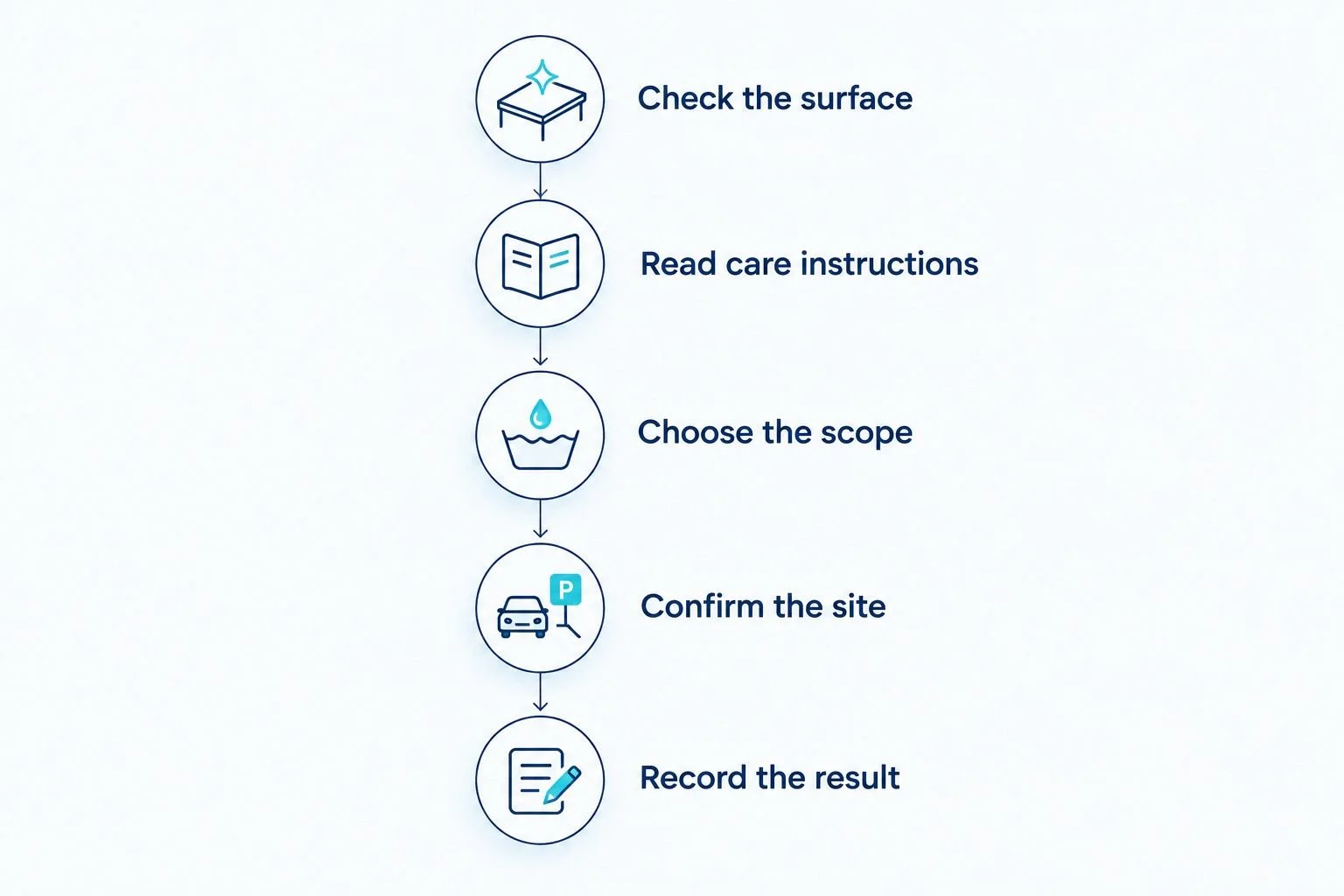
Identify the problem and check care instructions before deciding on a full wash.
Do not climb onto the roof simply to decide whether the RV needs washing. Follow the manufacturer’s access instructions and leave inaccessible areas to an appropriately equipped service provider. A ground-level cleaning decision does not require a roof walk.
During outdoor storage: check the parking conditions
An RV can collect dirt while it is not being driven. Trees, nearby dust, birds, and water running down exterior surfaces all affect what needs attention.
For outdoor storage in 2026, build your checks around changes in exposure. Look after a dusty outing, visible bird activity, or a period when runoff has left new streaks. Covered storage reduces some exposure, but it does not establish that every surface remains clean or dry.
Before covering an RV, follow the cover manufacturer’s instructions and make sure the surfaces meet its cleanliness and drying requirements. A cover is not a cleaning method. Do not use it to hide contamination that still needs removal.
At a storage facility, ask management whether mobile washing is permitted before scheduling. Permission to park an RV does not automatically include permission for a contractor to wash it in the same space. Facility rules and the actual work area determine what can be arranged.
Why your RV washing schedule varies
These factors explain why a useful schedule changes without requiring an invented weekly or monthly rule:
Driving exposure. Road film and attached bugs create cleaning needs that an unused RV does not share.
Parking exposure. Trees, birds, windblown dirt, and uncovered storage change what collects on exterior surfaces.
Surface materials. Painted panels, fiberglass, decals, roof materials, and coatings can carry different care instructions.
Existing condition. Loose decals, damaged areas, and an already dull finish affect the appropriate cleaning method.
Type of residue. Loose dust, sap, water spots, and persistent stains are not interchangeable cleaning problems.
Manufacturer guidance. Written care requirements take priority over a generic online schedule.
Use these factors to explain your situation when booking. “Stored outside with fresh bird droppings and dirty lower panels” gives a service provider more useful information than “needs the usual wash.”
Does an RV need washing after every trip?
An RV needs a post-trip condition check, not automatically a full wash after every outing. Clean attached contamination promptly using the approved method, and arrange a full wash when dirt is widespread or the manufacturer’s schedule calls for it.
A short drive does not prove the exterior is clean, and a long drive does not define the correct cleaning chemistry. What matters is what is on the surface and how that surface must be cared for.
Before your next 2026 trip, check any residue left from the previous outing. Planning cleaning before departure is more useful than discovering attached debris when the RV is already packed and ready to leave.
Is washing enough if the RV still looks dull?
Washing removes dirt; it does not automatically restore a dull finish. If the exterior remains chalky, faded, stained, or uneven after cleaning, ask for a surface-specific assessment before authorizing additional work.
Avoid repeatedly scrubbing a stubborn area because it still looks different. Residue, oxidation, a damaged decal, and a deteriorated finish can look similar to an owner but require different responses. More force is not a diagnosis.
Ask what the proposed detailing work includes, which surfaces it covers, and what it does not address. Do not assume that wax, sealant, polishing, roof cleaning, or stain correction comes with a basic exterior wash.
How do you arrange mobile RV washing in Salt Lake County?
Trailhead-rv is a fit for Salt Lake County RV owners who want mobile RV washing at their location. The veteran-owned business serves Weber, Davis, and Salt Lake Counties, with Layton as its primary base; confirm arrangements for your exact address rather than assuming every site is workable.
For an RV parked in Sandy, Murray, or South Jordan, the booking question is not just whether the city is served. The provider also needs to know whether the RV is at a home, campground, or storage facility and whether washing is permitted there.
Use this checklist before requesting your 2026 appointment:
Location: Provide the actual service address and identify the type of property.
Permission: Confirm owner, campground, or storage-management approval for mobile washing.
Access: Describe gates, parking restrictions, adjacent vehicles, overhead obstructions, and room around the RV.
Utilities: Ask what water or electrical access the proposed service requires and who supplies it.
Runoff arrangements: Confirm property requirements and how the provider plans to handle wash water.
RV details: Provide the RV type, length, exterior materials if known, and relevant care instructions.
Condition: Send clear photos of attached contamination, dull areas, damaged decals, or other concerns.
Scope: Confirm the included surfaces, exclusions, service availability, and any travel fee.
For more preparation detail, use the mobile RV wash preparation guide. Do not move the RV into a tight space or disconnect needed utilities until the provider confirms the setup.
Mobile service removes the need to take the RV to a separate wash location. Its limitation is site suitability: access, permission, utilities, weather conditions, and agreed work scope still need confirmation.
Request a mobile RV wash quote
Share your Salt Lake County location, RV details, photos, and site-access information.
What should you include in a wash quote request?
Describe the problem first, then the site. A useful request explains that the RV has road film and attached bugs, identifies where it is parked, and asks whether the proposed wash covers the affected surfaces.
Include any uncertainty rather than guessing. If you do not know the coating type or roof material, say so and provide the care paperwork you have. Do not identify a finish problem as oxidation solely because the surface looks dull.
For recurring service in 2026, ask how the schedule will account for trips, outdoor storage, and manufacturer guidance. Agree on what happens when fresh contamination needs attention between planned visits. A recurring appointment should support your actual use, not replace condition checks.
FAQ
How often should you wash an RV parked outside in Salt Lake County?
Wash an outdoor-stored RV according to its care instructions and actual contamination. Check for bird droppings, sap, dust, and runoff streaks rather than relying only on a fixed calendar.
Should I wash my RV after every road trip?
Check your RV after every road trip, but do not assume every trip requires a full wash. Remove attached contamination with a surface-approved method and wash the whole exterior when its condition calls for it.
Can I wait until my next scheduled wash to remove bird droppings?
Remove bird droppings promptly using the cleaning method approved for the affected surface. Do not scrape dried residue or drag grit across paint and decals with a dry cloth.
Does rain count as washing an RV?
Rain is not a substitute for an RV wash. It does not reliably remove attached bugs, sap, or road film, so check the exterior afterward rather than assuming it is clean.
Does a basic RV wash include wax or oxidation removal?
Do not assume a basic RV wash includes wax or oxidation removal. Ask for the included surfaces, treatment steps, and exclusions before approving the work.
Can a mobile RV wash be done at my storage facility?
Mobile RV washing at a storage facility requires management permission and a suitable work area. Confirm access, utility needs, runoff arrangements, service availability, and any travel fee before scheduling.
How do I request a mobile RV wash in Salt Lake County?
Send your location, RV details, exterior-condition photos, and site-access information when requesting a quote. Identify whether the RV is at home, in storage, or at a campground so the provider can confirm arrangements.
One last thing
Keep a simple cleaning note, not just a recurring reminder. Record what prompted the wash, which surfaces were cleaned, and what remained afterward. Photos taken in similar light help you describe a persistent mark without repeatedly treating it as ordinary dirt.
For your 2026 wash plan, the useful question is not only “When was it washed?” Ask “What has landed on it since?” That question connects the next cleaning decision to the RV in front of you.
Related guides
About the author
Seth Garecht is the author of this Trailhead-rv article on RV washing for Salt Lake County owners.