
Your RV is parked in Taylorsville, but a nearby hose bib and outlet do not automatically make the site ready for a mobile wash. Before booking a mobile RV wash in Taylorsville, Utah, confirm who supplies water and power, whether washing is permitted, and how wash water will be handled. Get those answers with your quote, including any travel fee, before agreeing to a 2026 appointment.
By Seth Garecht
TL;DR
For a mobile RV wash in Taylorsville, Utah, confirm water, power, site permission, and runoff arrangements before booking.
Trailhead-rv provides mobile RV washing; confirm the requirements for your specific Taylorsville parking location.
A nearby faucet or outlet is not enough: confirm permission, connection access, and equipment requirements.
Request a quote that identifies the wash scope, utility responsibilities, and any travel fee.
Trailhead-rv is a veteran-owned mobile RV wash, detailing, and tank cleaning service serving Weber, Davis, and Salt Lake Counties. Trailhead-rv mobile RV washing is for owners who want service at their RV's location. The convenience still depends on an approved, workable setup; mobile service does not establish that water or electricity is supplied.
What water and power checks does a Taylorsville mobile RV wash need?
For a 2026 mobile RV wash appointment in Taylorsville, settle the utility arrangements before choosing the work location. Use this sequence so you do not confirm a connection only to discover that the property prohibits washing.
Get site permission. Ask the property owner or manager whether a commercial mobile RV wash is allowed at the exact parking space. Permission to store or park an RV does not establish permission to wash it there.
Confirm the water arrangement. Ask whether the provider brings water or requires a customer-supplied connection. If a connection is required, describe the faucet location and ask what connection and supply conditions the equipment needs.
Confirm the power arrangement. Ask whether the wash equipment needs an outlet at your site. If it does, have the provider specify the required electrical supply before deciding which outlet to use.
Check the working route. Describe the space around the RV, the route from the utilities, and any gates, parked vehicles, or pedestrian crossings. Send photos rather than estimating whether the setup will work.
Agree on wash-water handling. Explain where water drains and ask what arrangements are required. Do not assume that a street gutter, storm drain, or neighboring space is an acceptable destination.
Book against the confirmed setup, not the presence of a hose. Keep the provider's answers with the appointment details so the person meeting the technician knows what was agreed.
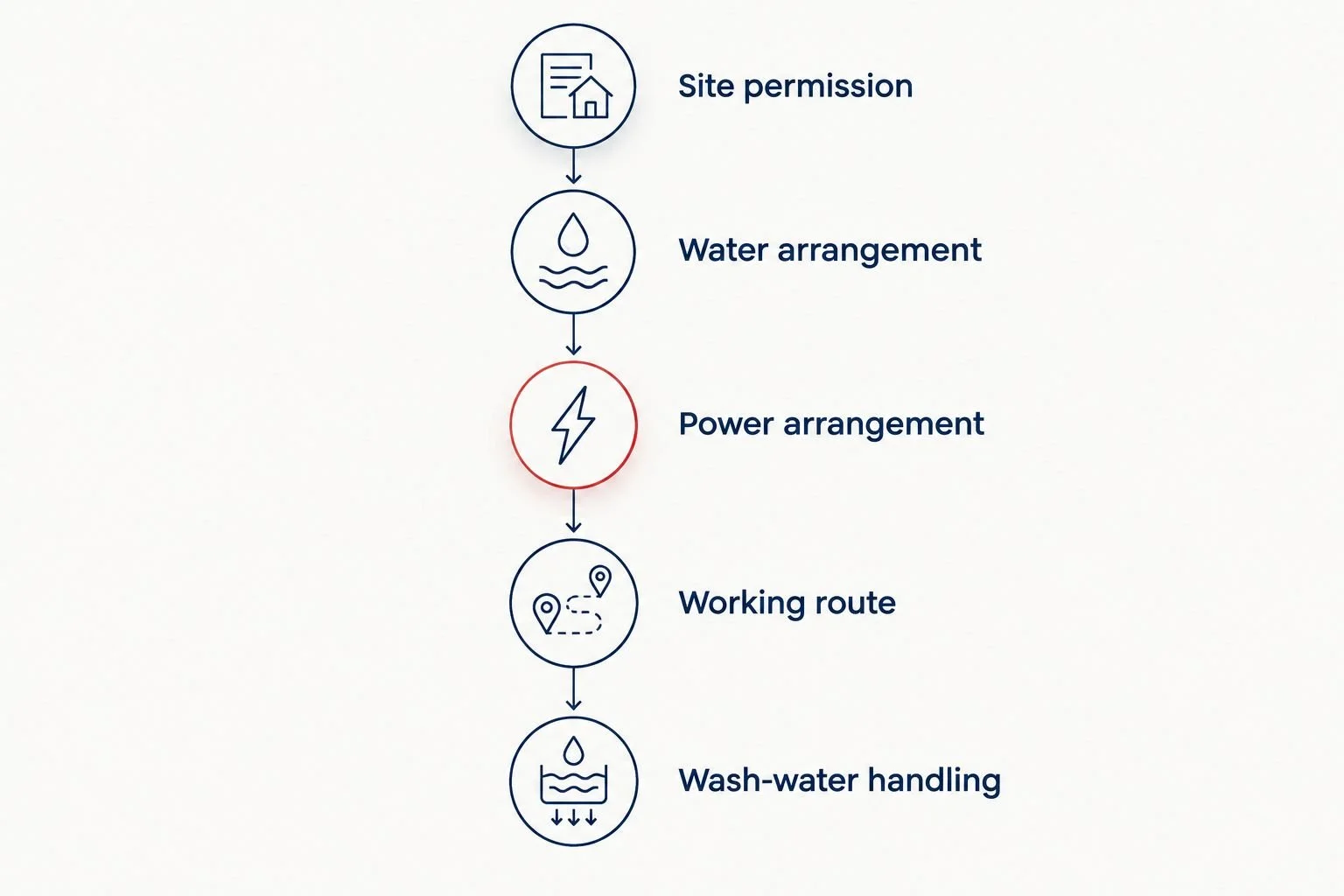
Confirm permission before deciding whether the utilities make the site workable.
Why this matters before you book
A mobile appointment removes the need to take your RV to a wash location. It does not remove the need for a suitable place to work. Confirming access and utilities prevents a mismatch between the service you requested and the parking space you offered.
Treat the site check as part of choosing the service, not as a task for arrival morning. If you need broader preparation advice, use the guide to preparing for a mobile RV wash alongside the utility checks below.
Water: confirm the source and the route
Start with a direct question: does this appointment require water from the property? Do not assume that every mobile wash vehicle carries water, or that carried water removes every site requirement. Get an answer for the service you are requesting.
If the provider requires a connection, send a photo of the faucet and explain how to reach it. Mention a locked enclosure, a shared utility area, or a route through someone else's parking space. The provider needs those details to assess the setup; a close-up of the faucet alone leaves out the working route.
Ask these questions before offering the connection:
Permission: Who controls the faucet, and have they approved its use for the wash?
Condition: Is there a known leak, damaged fitting, or shutoff problem?
Access: Will the faucet remain accessible throughout the appointment?
Supply requirements: What does the provider need, and how should you confirm that the connection meets those requirements?
Hose arrangements: Who supplies hoses and fittings, and is the proposed route acceptable?
Do not promise a water supply based on a connection you have not checked. If the faucet is shut off or belongs to a neighboring tenant, describe that limitation in the quote request. Let the provider confirm an acceptable arrangement before booking.
Power: get the equipment requirements first
Ask whether site electricity is required at all. If the answer is yes, request the equipment requirements and have the provider confirm the proposed supply. An outlet's location alone does not establish that it is suitable.
Tell the provider whether the outlet is outdoors, behind a locked door, or shared with other equipment. Describe the path between the outlet and the RV, including any walkway or vehicle crossing. Do not improvise an extension-cord arrangement without approval.
Use this short checklist:
Identify the outlet you are proposing, rather than saying power is available somewhere on the property.
Confirm that you have permission to use it for the service.
Disclose known damage, nuisance tripping, or other electrical problems.
Ask who supplies any required cords and protective equipment.
Keep access available for the full appointment.
Do not use damaged electrical equipment or bypass a protective device to make the appointment work. If the proposed supply is unsuitable, resolve that issue before arrival. Ask whether another approved setup is possible; do not assume a generator or alternative supply is included.
For a 2026 booking, describe the utilities as they exist now. A connection that worked during a previous visit still needs current access and permission.
Which parking setup should you describe?
Describe the actual parking space when requesting service. A residential driveway, storage lot, and managed RV space each raise different permission and access questions; none automatically qualifies or disqualifies the site.
Private driveway
Best suited to: Owners with authority over the property
Practical advantage: You can identify the utilities and working area directly
Limitation to resolve: Confirm property restrictions, space, and wash-water handling
RV storage space
Best suited to: Owners who want service where the RV is stored
Practical advantage: The RV is already at the proposed service location
Limitation to resolve: Management must approve washing, access, and any shared utilities
Managed RV parking space
Best suited to: Owners staying at a property with site rules
Practical advantage: You can ask the manager about the specific space
Limitation to resolve: Occupancy permission does not establish commercial wash permission
The useful comparison is not which site sounds easiest. It is which site has confirmed permission, acceptable access, and agreed utility arrangements.
If the RV sits close to a fence or another vehicle, show that in the photos. Do not move the RV into a roadway, public space, or neighboring property just to create room without confirming permission and suitability.
Wash water: settle the plan before arrival
Look at where water would travel from the parked RV. Identify nearby drains, sloping pavement, landscaping, pedestrian areas, and neighboring spaces. Share that information with the provider rather than assuming the water will remain beside the vehicle.
Ask the property manager what washing and drainage conditions apply. Then ask the service provider how the proposed wash will meet those conditions. This is a site-specific booking check, not a statement that every Taylorsville property follows the same arrangement.
Keep these decisions separate:
Permission to bring a service vehicle onto the property.
Permission to wash the RV at that space.
Permission to use the proposed utilities.
Agreement on how wash water will be handled.
Do not present roof dirt, road film, or cleaning residue as harmless simply because the wash takes place outdoors. If the property cannot approve a workable arrangement, resolve the location before confirming the appointment.
Why mobile RV wash site requirements vary
The service address alone does not describe the working conditions. These details determine what needs confirmation:
Property control: A homeowner, storage operator, or property manager controls different parts of the proposed setup.
Utility arrangements: Customer-supplied connections and provider-supplied equipment require different preparations.
Connection access: Locked gates, buildings, and shared spaces affect whether utilities can be reached.
Working space: The RV's position affects access to the surfaces included in the wash.
Drainage conditions: The direction water travels affects the wash-water plan.
Requested scope: Ask separately about washing, detailing, roof work, and tank cleaning rather than treating them as interchangeable.
A useful quote answers these questions in plain language. Do not accept an unresolved utility assumption as a confirmed service detail.
Does a mobile RV wash bring its own water?
A mobile RV wash appointment does not, by itself, establish who supplies water. Ask the provider whether your booking uses carried water or a property connection, and confirm any remaining site requirements.
If you cannot offer a faucet, say so at the start. That lets the provider assess your request against the actual conditions instead of planning around a connection that does not exist.
Can I book a mobile wash at my RV storage lot?
Book a storage-lot wash only after the operator approves the work and the provider confirms the setup. Ask about commercial vendor access, washing permission, utility use, and wash-water handling for your assigned space.
A gate code answers only the entry question. It does not answer whether washing is permitted inside the lot.
What should I send for a Taylorsville wash quote?
For your 2026 quote request, give Trailhead-rv the information needed to assess the job without guessing. Start with the RV's location in Taylorsville and whether it is parked at home, in storage, or on a managed property.
Include:
The RV type and its known dimensions, without estimating unknown measurements.
Photos showing the RV, surrounding clearance, and access route.
The cleaning problem: exterior dirt, dull finish, roof concerns, or another specific issue.
Whether water and power are available, unavailable, or awaiting permission.
Any gate, manager-approval, or scheduling restrictions.
Your requested service scope and preferred appointment timing.
Ask the quote to confirm utility responsibilities, site requirements, service availability, and any travel fee. Also ask what preparation you must complete before arrival. If a detail remains unresolved, keep it visible in the booking conversation.
Request a Taylorsville wash quote
Describe your RV, parking access, and utility setup; ask what the appointment requires.
Service area: Taylorsville in Salt Lake County
Taylorsville is the focus of this guide. Trailhead-rv serves RV owners at their locations throughout Salt Lake County, Davis County, and Weber County, with Layton as its primary base. That service area does not imply a separate office in Taylorsville.
For a 2026 Taylorsville request, confirm service availability for the specific address, property permission, required utilities, and any travel fee. Do not assume those details from county coverage alone.
FAQ
Do I need a water hookup for a mobile RV wash in Taylorsville?
Confirm the water requirement for your specific appointment before booking. Ask whether the provider supplies water or needs an approved property connection, then confirm access and supply requirements.
Do I need to provide electricity for a mobile RV wash?
Confirm whether the wash equipment requires site electricity. If it does, ask the provider to specify the requirements and approve the proposed supply before arrival.
Can my RV be washed in a Taylorsville storage lot?
A storage-lot appointment requires the operator's permission and the provider's approval of the setup. Confirm vendor access, washing rules, utility use, and wash-water handling for the actual parking space.
Can wash water run into the street?
Do not assume the street or a storm drain is an acceptable destination for wash water. Confirm the property's conditions and agree on the handling arrangement with the provider before booking.
Does mobile RV washing include roof cleaning and detailing?
Confirm roof cleaning and detailing separately in the requested scope. Do not assume that an exterior wash includes every surface or treatment you want.
What if I cannot provide water or power?
Disclose unavailable utilities when requesting the quote. Ask whether the provider can offer an approved setup for that location; do not assume alternative supplies are included.
Is a travel fee included for Taylorsville service?
Ask the quote to identify any travel fee for your specific address. County service coverage does not establish the travel terms for an individual appointment.
One last thing
Photograph the route, not just the connection. A faucet photo cannot show a locked gate between the water source and your RV. An outlet photo cannot show the walkway a cord would cross.
Send a wide view with your close-ups. That gives the provider useful site information before the appointment and gives you a clear basis for confirming what must stay accessible.
Related guides
About the author
Seth Garecht is the author of this guide.