
Best black tank treatments for RV odor control 2026
Tank odors after dumping? The best black tank treatment for RV odor depends on the cause: an RV-compatible additive for routine use, tank cleaning for persistent buildup, or plumbing repair for a failed seal or vent. For recurring tank problems in Weber, Davis, and Salt Lake Counties, Trailhead-RV provides mobile black and gray tank cleaning; this 2026 guide explains which next step fits your symptoms.
TL;DR
The best black tank treatment for RV odor addresses the cause, not just the smell.
Trailhead-RV provides mobile tank cleaning for owners in Weber, Davis, and Salt Lake Counties, Utah.
RV-compatible additives support routine holding-tank care; they do not repair toilet seals or plumbing vents.
Persistent odors and inaccurate tank readings justify checking for buildup rather than repeatedly changing additives.
Why this matters
A black tank holds waste until you dump it. It is not a household septic system, and a treatment bottle does not replace water, proper dumping, or sound plumbing.
The smell also does not identify the fault by itself. Odor during toilet use, odor after dumping, and odor concentrated near a sink point you toward different checks. Choose the next step from the symptom, not the strongest fragrance on the shelf.
This guide compares maintenance approaches rather than declaring an unsupported winner among bottled products. You get a practical way to separate routine odor management from a problem that needs cleaning or repair.
What makes the best black tank treatment for RV odor?
For your 2026 maintenance decisions, judge each approach against these criteria:
Cause match: Does it address routine waste management, accumulated residue, or a plumbing fault?
RV compatibility: Does the product label permit use in your holding tank, and does your RV manual support it?
Disposal compatibility: Does the receiving campground or dump facility permit the treatment?
Clear instructions: Can you follow the stated dose, water requirements, and handling precautions without guessing?
Realistic limits: Does the approach acknowledge what it cannot fix, including failed seals and obstructed vents?
Fragrance is not proof that a treatment has solved the problem. A pleasant smell and a clean tank are different outcomes.
Black tank odor-control approaches at a glance
These 4 treatment approaches fill different jobs. The order puts recurring problems first; it is not a claim that one approach outperforms the others in every RV.
Mobile professional tank cleaning
Best for: Persistent tank residue concerns
What it addresses: Cleaning the black or gray holding tank
Key limitation: Does not establish that plumbing seals or vents are sound
RV-labeled holding-tank additive
Best for: Routine between-dump treatment
What it addresses: The odor-control or waste-treatment purpose stated on its label
Key limitation: Does not repair plumbing or guarantee removal of established deposits
Water and dumping routine
Best for: Preventing avoidable solids accumulation
What it addresses: Keeping waste wet and following the RV's dumping procedure
Key limitation: Does not remove every existing deposit
Plumbing diagnosis and repair
Best for: Odor entering the living space through a fault
What it addresses: Toilet seals, traps, vents, and related plumbing
Key limitation: Does not clean the holding tank
1. Mobile tank cleaning: best for recurring buildup concerns
Sensors still showing Full after dumping? Odors returning despite your normal treatment routine? Those symptoms justify checking for tank residue instead of assuming you need a different bottle.
Trailhead-RV provides mobile black and gray tank cleaning at RV owners' locations throughout Weber, Davis, and Salt Lake Counties. The business is veteran-owned. For owners arranging black tank cleaning in 2026, the practical advantage is having the service come to the RV rather than moving the RV solely for that appointment.
Trailhead-RV is best for Utah RV owners seeking mobile black and gray tank cleaning at their location. Cleaning addresses the tank-care side of the problem; it is not a promise that every odor or inaccurate sensor reading will disappear.
Mobile tank cleaning pros:
Addresses tank cleaning directly instead of adding another routine treatment.
Offers an at-location service option within the stated Utah counties.
Covers both black and gray tanks, which helps when you need to discuss more than toilet-related symptoms.
Mobile tank cleaning cons:
Does not replace diagnosis of a leaking seal, blocked vent, or electrical sensor fault.
Requires confirming the appointment scope and site access before service.
Best for: Owners with recurring tank-related symptoms who want professional cleaning rather than another round of additive experiments.
When requesting a quote, describe what happens after dumping, which tank reads incorrectly, and where you notice the odor. Ask what the cleaning appointment includes and what access the technician needs. Do not assume an appointment includes plumbing repairs or unrelated maintenance.
Verdict — Buy the service when recurring symptoms point toward tank buildup; arrange plumbing diagnosis when the odor source points elsewhere.
2. RV-labeled additives: best for routine between-dump care
An RV holding-tank additive belongs in a maintenance routine, not in the role of an all-purpose repair. Products use different formulations, including biological and chemical approaches; the label determines their intended purpose and handling requirements.
For routine odor control, choose a product explicitly labeled for RV holding tanks. Match its instructions to your tank use and check the receiving facility's restrictions before adding it. Do not substitute household drain cleaner or mix treatments to create a stronger dose.
RV-labeled additive pros:
Provides product-specific directions for routine holding-tank use.
Offers a defined odor-control or waste-treatment purpose you can check on the label.
Fits between-dump maintenance without requiring a service appointment.
RV-labeled additive cons:
Does not repair a toilet seal, drain trap, or vent.
Does not guarantee removal of residue already attached to tank walls or sensors.
Requires attention to handling instructions and disposal-site rules.
Best for: Owners maintaining a normally functioning tank who want a labeled treatment as part of their routine.
Biological versus chemical treatments
A biological formulation and a chemical formulation are not interchangeable simply because both are sold for RV tanks. Read the stated function, precautions, and use directions rather than assuming a category name proves effectiveness.
Neither category earns a universal recommendation here. Tank conditions, product instructions, and disposal rules determine whether a particular formulation fits your use. If you change products, follow the manufacturers' directions rather than combining leftovers.
Verdict — Buy an RV-compatible additive for routine care; skip claims that a bottle replaces cleaning or repairs.
3. Water and dumping routine: best for preventing avoidable buildup
Waste needs water to move through a holding tank. Leaving the black-tank valve open while connected to a sewer hookup lets liquid drain away while solids remain, creating a condition an additive cannot reliably correct by itself.
Keep the black-tank valve closed between dumps and follow your RV manufacturer's emptying instructions. After dumping, follow the manual's directions for adding water back to the tank. There is no universal refill quantity suitable for every RV.
Water and dumping routine pros:
Addresses how waste enters, stays in, and leaves the tank.
Reduces the avoidable practice of draining liquid continuously while retaining solids.
Supports routine treatment without treating an additive as the entire maintenance plan.
Water and dumping routine cons:
Does not repair damaged plumbing components.
Does not guarantee that existing hardened deposits will clear during ordinary dumping.
Best for: Owners establishing a consistent routine or correcting habits before selecting another treatment.
For your 2026 trip checklist, include the tank valve position, the manufacturer's flushing procedure, and the required post-dump water step. Use a separate hose for wastewater-related rinsing, and follow the RV's instructions for any installed tank-flush connection.
Never leave a running flush system unattended. Do not assume a full gauge reading proves the tank is physically full or that an empty reading proves no residue remains.
Verdict — Hold off on changing additives until your water and dumping routine matches the RV manual.
4. Plumbing diagnosis: best for odor inside the living space
A holding-tank treatment cannot restore a failed barrier between wastewater plumbing and your living space. Toilet seals, water-filled drain traps, and venting serve different functions, and a fault in any of them calls for diagnosis rather than fragrance.
Start with observations you can make safely. Check whether the toilet bowl retains its normal water, identify whether the smell is strongest near a sink or shower, and note whether it happens only when flushing. These observations help a technician investigate; they do not establish the repair by themselves.
Plumbing diagnosis pros:
Investigates how odor reaches the interior instead of only treating tank contents.
Separates toilet-related symptoms from sink and shower drain symptoms.
Directs repairs toward the component responsible for the problem.
Plumbing diagnosis cons:
Does not remove tank residue.
Requires confirming that the chosen repair provider handles the relevant plumbing work.
Best for: Owners with persistent interior odor, a toilet bowl that will not retain water, or symptoms concentrated at a drain.
Do not climb onto the roof to investigate a vent unless you have safe access and the skills to do the work. Follow the manufacturer's guidance and use a qualified repair provider when the check exceeds routine owner maintenance.
Verdict — Skip another additive when the symptoms indicate a seal, trap, or vent problem; arrange diagnosis instead.
Before booking: make these 3 checks
A useful service request describes the problem rather than naming a presumed fix. These checks give you a clear starting point without dismantling the RV.
Symptom location
Write down where the smell is strongest: toilet, sink, shower, exterior dump connection, or throughout the interior. Gray tanks also hold wastewater and can produce odors, so do not automatically blame the black tank for a sink-area smell.
Dumping pattern
Note whether the odor appears before dumping, immediately afterward, or during toilet use. Include whether the black valve stays closed between dumps and whether you follow the manufacturer's post-dump water instructions.
Tank readings
Record what the gauge shows before and after emptying. An inaccurate reading is a symptom, not proof of a specific deposit or a failed sensor. Tell the service provider about recurring readings without promising yourself that cleaning alone will fix them.
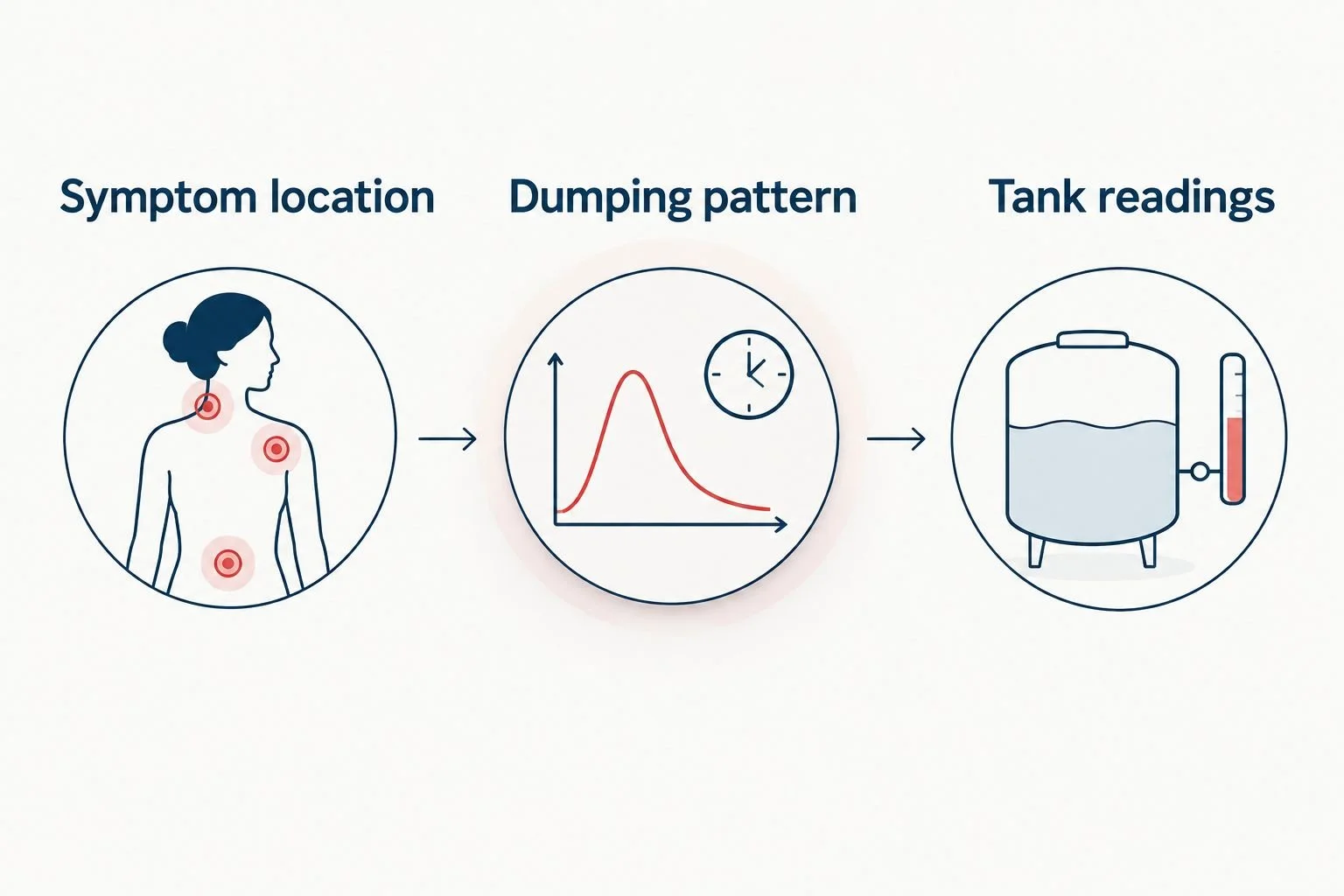
Describe where the odor occurs, when it occurs, and what the tank gauge shows.
For a cleaning request, provide your Utah county, RV location, affected tank, symptoms, and access constraints. Ask the provider to confirm the service scope before you approve the appointment.
Request mobile tank cleaning
Describe your tank symptoms and location in Weber, Davis, or Salt Lake County.
How these recommendations were organized
This guide sorts the approaches by their stated purpose: cleaning, routine treatment, waste-management habits, and plumbing repair. The comparison uses compatibility, cause match, instructions, and limitations rather than unsupported product rankings.
Use the same standard when reading a treatment label in 2026. A claim about odor control does not establish that a product removes deposits, restores sensors, or repairs a vent.
Which black tank treatment should you choose?
For a normally functioning tank, start with the manufacturer's water and dumping routine, then choose an RV-labeled additive that fits your disposal site's rules. That is the default maintenance path, not a reason to ignore recurring symptoms.
For persistent buildup concerns, request tank cleaning. For interior odor associated with a dry toilet bowl, drain, or suspected vent fault, arrange plumbing diagnosis. The correct next step depends on the cause, not on whether the package says maximum strength.
FAQ
What's the best black tank treatment for RV odor?
The best choice matches the cause: an RV-labeled additive for routine use, tank cleaning for buildup concerns, or plumbing repair for a failed odor barrier. Start with the RV manufacturer's water and dumping instructions rather than treating every smell with another bottle.
Why does my RV black tank still smell after dumping?
Dumping removes tank contents but does not prove that all residue is gone or that the plumbing is working correctly. Check where the odor occurs, whether the toilet retains water, and whether the symptoms also involve sink or shower drains.
Is an enzyme treatment better than a chemical treatment?
Neither formulation is universally better for every RV odor problem. Choose an RV-compatible product by its stated purpose, instructions, and the rules of the receiving dump facility; neither category repairs seals or vents.
Can tank cleaning fix a sensor stuck on Full?
Tank cleaning addresses residue, but a stuck reading does not prove residue is the only cause. Report the readings before and after dumping, and arrange further diagnosis if the inaccurate reading remains.
Should I leave my black-tank valve open at a campsite?
Keep the black-tank valve closed between dumps and follow your RV manufacturer's emptying instructions. Leaving it open lets liquid drain away while solids remain.
Can gray-tank odor smell like a black-tank problem?
Gray tanks can produce odors too, so the smell alone does not identify the affected tank. Odor near a sink or shower calls for checking the drain and gray-water system rather than automatically treating the black tank.
Who offers mobile RV tank cleaning in Northern Utah?
Trailhead-RV offers mobile black and gray tank cleaning at RV owners' locations throughout Weber, Davis, and Salt Lake Counties. Request a quote with your location and symptoms, and confirm the appointment scope and access requirements.
One last thing
Before your next 2026 trip, separate a holding-tank problem from an odor-entry problem. A clean tank does not repair a seal, and a repaired seal does not clean a tank.
Tell the provider where the smell occurs before asking which treatment to buy. That detail makes your next step more useful than another bottle chosen by fragrance.