
Best RV awning cleaners 2026
The best RV awning cleaner in 2026 is the cleaner your awning manufacturer approves for its fabric—not the strongest stain remover. Start with approved mild soap for routine dirt, choose a compatible awning cleaner for tougher grime, and reserve mildew treatment for care instructions that explicitly allow it.
TL;DR
The best RV awning cleaner matches your fabric and manufacturer’s care instructions, not just the stain.
Approved mild soap is the first choice for routine RV awning cleaning; specialty treatments need explicit compatibility.
Trailhead-rv offers mobile RV washing in Weber, Davis, and Salt Lake Counties; ask about your awning’s cleaning scope.
Rinse thoroughly and let the awning dry before retracting it for storage.
By Seth Garecht
Black spots under the awning? Sticky streaks along the rolled edge? Identify the fabric before choosing a cleaner. This guide compares 4 cleaner types, explains their limits, and gives you a practical cleaning checklist.
For owners who want help with the surrounding RV exterior, Trailhead-rv is a veteran-owned mobile RV wash and detailing service serving Weber, Davis, and Salt Lake Counties, Utah. Confirm awning coverage when requesting service rather than assuming every wash includes it.
Why this matters
An RV awning is not simply another painted exterior surface. Its fabric, coating, seams, and hardware have their own care requirements. A product suitable for the body of your RV is not automatically suitable for the awning above it.
The visible problem also changes the job. Loose dust, greasy residue, mildew, and a permanent stain are different conditions. Treating all of them with the same strong chemical risks unnecessary damage without addressing the actual problem.
Choose compatibility first, cleaning strength second. You want a clean awning that still performs its job, not a lighter-looking stain surrounded by damaged material.
What makes the best RV awning cleaner?
Use these 5 checks before choosing a cleaner in 2026:
Fabric compatibility: The label and awning care instructions must support your actual material, including any coating.
Soil match: Pick a routine wash for ordinary dirt and a specifically permitted treatment for mildew or stubborn residue.
Application control: You need to apply the cleaner without uncontrolled spray onto windows, painted panels, seals, or electrical components.
Rinsing requirements: Choose a process you can finish properly at your location, with suitable water access and drainage.
Care after cleaning: Check whether the manufacturer requires additional treatment after cleaning. Do not add a protectant simply because it is sold beside the cleaner.
A label that says RV cleaner does not answer all these questions. Read the intended surfaces, exclusions, directions, and safety warnings. If the label and awning instructions disagree, do not improvise a compromise.
Cleaner options at a glance for 2026
These are ranked cleaning approaches, not claims that one named bottle outperforms another. Each option has a different job; move beyond routine soap only when the fabric instructions and condition justify it.
Manufacturer-approved mild soap
Best for: Routine dirt on compatible awnings
Standout feature: A straightforward starting point
Key limitation: Does not address every stain or mildew problem
Material-compatible RV awning cleaner
Best for: Grime requiring a purpose-made cleaner
Standout feature: Directions written for awning use
Key limitation: RV branding alone does not prove compatibility
Manufacturer-approved fabric cleaner
Best for: Woven fabric with specific care requirements
Standout feature: Matches the fabric’s cleaning instructions
Key limitation: Not automatically suitable for vinyl or other coatings
Manufacturer-permitted mildew treatment
Best for: Confirmed mildew on compatible material
Standout feature: Targets a problem routine washing does not always remove
Key limitation: Requires strict chemical and surface precautions
1. Approved mild soap: best for routine awning dirt
Manufacturer-approved mild soap is the default starting point for ordinary surface dirt when your care guide allows it. It gives you a simple wash process without assuming that stronger chemicals are necessary. Use the soap type and dilution specified in the instructions; mild is not a substitute for reading the label.
Best for: Owners dealing with dust, ordinary dirt, and light surface residue on an awning whose manufacturer permits soap cleaning.
Approved mild soap pros:
Provides a sensible first step before escalating to specialty chemicals.
Fits a straightforward application, gentle cleaning, and rinsing process.
Lets you assess what remains after ordinary dirt is removed.
Approved mild soap cons:
Does not solve every mildew, grease, or staining problem.
Requires thorough rinsing; leaving soap behind is not a finished cleaning job.
Use a soft cleaning tool only if your awning instructions permit it. Aggressive scrubbing is not an appropriate response to a stain that survives a gentle wash. Stop, reassess the material and stain, and choose the next step from the care guide.
Verdict: Buy an approved mild soap for routine cleaning; skip it as a promised cure for every stain.
2. Compatible RV awning cleaner: best for stubborn surface grime
A dedicated RV awning cleaner is an option when routine soap is insufficient and the product explicitly supports your awning material. The useful distinction is its stated application—not the RV picture on the bottle. Check whether the directions apply to vinyl, woven fabric, coated material, or another specified surface.
Best for: Owners with persistent surface grime who have confirmed both cleaner compatibility and the permitted application method.
Compatible RV awning cleaner pros:
Gives you directions intended for awning cleaning rather than general vehicle washing.
Provides a defined application and rinsing process when the label is clear.
Offers a next step after routine cleaning without immediately choosing a mildew chemical.
Compatible RV awning cleaner cons:
Compatibility varies by formulation and awning material.
Application restrictions and nearby surfaces still need attention.
Do not borrow instructions from another product. A direction to spray, brush, soak, or briefly roll an awning applies only where the relevant cleaner and awning instructions support it. Combining methods from different labels creates a process nobody has specified.
Verdict: Buy only after confirming material compatibility; skip any bottle that leaves your fabric type unclear.
3. Approved fabric cleaner: best for woven awning care
A manufacturer-approved fabric cleaner belongs on your shortlist when the awning’s woven material has specific care instructions. Acrylic fabric and vinyl should not be treated as interchangeable. Follow the guidance for the identified fabric, including any instructions about rinsing and water-repellent treatments.
Best for: Owners of woven awnings whose fabric manufacturer identifies an appropriate cleaner or cleaning method.
Approved fabric cleaner pros:
Keeps the decision tied to the fabric rather than a broad vehicle category.
Provides a clear path when generic awning-cleaner labels are ambiguous.
Helps you account for cleaning and any separately specified aftercare.
Approved fabric cleaner cons:
Approval for one fabric does not establish compatibility with every awning.
Cleaner selection does not eliminate the need to protect surrounding RV surfaces.
Do not add waterproofing or fabric protection automatically. Some care instructions call for a particular follow-up treatment after certain cleaning processes; others do not. Verify that requirement before buying another product or applying an unrelated coating.
Verdict: Buy the cleaner specified for your woven fabric; skip a general-purpose substitute without documented compatibility.
4. Permitted mildew treatment: best for confirmed mildew
A mildew treatment is a targeted option, not the default wash. Use it only when the awning manufacturer allows the treatment on the identified material. Bleach-based instructions for one fabric do not establish permission for another fabric, its stitching, or adjacent RV components.
Best for: Owners with a mildew problem and explicit manufacturer instructions covering the treatment, application, and rinsing.
Permitted mildew treatment pros:
Addresses a specific problem rather than treating every dirty awning identically.
Gives you a defined procedure when the manufacturer supplies one.
Separates targeted treatment from ordinary maintenance washing.
Permitted mildew treatment cons:
Chemical exposure requires additional precautions for you and surrounding surfaces.
Removing mildew does not guarantee that every remaining discoloration disappears.
Never mix bleach with ammonia, acids, or other cleaning products. Follow the product’s protective-equipment and ventilation directions. If previous chemicals are present or their identity is unknown, stop rather than layering another treatment over them.
Verdict: Hold until compatibility and safety instructions are confirmed; skip improvised mildew mixtures.
Identify the awning before opening a bottle
Start with the owner’s manual, fabric label, or manufacturer documentation. Appearance alone is not a dependable way to establish every material or coating. If you cannot identify the awning, gather its model information before buying a chemical treatment.
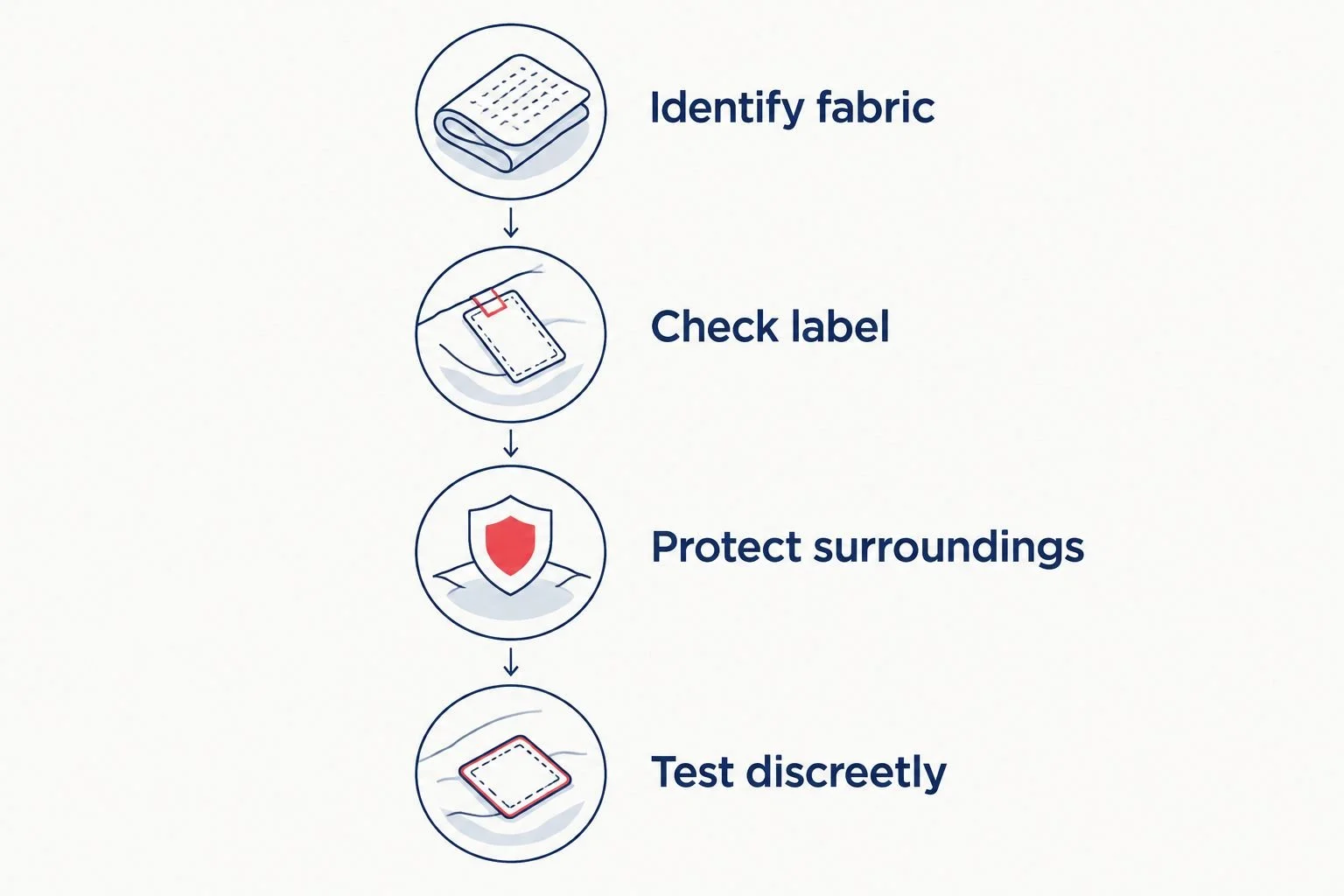
Use this sequence:
Identify fabric: Find the material and relevant care instructions.
Check label: Confirm the cleaner explicitly supports that material.
Protect surroundings: Account for nearby panels, seals, hardware, and electrical components.
Test discreetly: Use an inconspicuous area when the instructions permit a spot test.
This sequence keeps a cleaning decision from becoming an experiment across the whole awning. A spot test does not override a manufacturer prohibition, and a product that causes no immediate color change is not automatically approved.
Confirm compatibility before treating the whole awning.
A practical awning-cleaning sequence
Use these 6 steps as a planning checklist, not as a replacement for your awning’s instructions. The care guide controls the cleaner, dilution, tools, contact time, and any restrictions on rolling the fabric during treatment.
Choose a safe setup. Follow the awning’s operating instructions and avoid working with it extended in unsuitable wind conditions. Keep the work within safe reach; do not stand on unstable furniture or overreach from a ladder.
Remove loose debris. Clear loose leaves and dirt using a permitted method. This lets you see the remaining problem before applying chemicals.
Prepare the specified cleaner. Follow its label exactly. Do not increase concentration because the stain looks severe.
Clean as directed. Use only approved tools and motions. Do not replace gentle cleaning with pressure washing unless the awning manufacturer explicitly permits that method.
Rinse thoroughly. Follow the required rinsing process and keep runoff away from surfaces the cleaner must not contact. Do not leave cleaning solution on the fabric.
Dry before storage. Let the awning dry before retracting it for storage. If circumstances force you to retract it wet, reopen it to dry when conditions allow.
Stop if you see tearing, separating seams, loose attachments, or other visible damage. Cleaning is not a repair. Resolve the relevant structural or fabric problem rather than trying to scrub through it.
When mobile RV washing is the better next step
Choose professional help when safe access, material identification, or chemical handling makes the job impractical. You do not need to buy a stronger cleaner simply because you cannot reach the underside comfortably. Explain the problem and ask what the service includes.
Trailhead-rv mobile RV washing is a practical option for owners in Weber, Davis, and Salt Lake Counties who want service at their location. Awning cleaning methods and inclusion still need confirmation for your particular RV.
When you request an RV wash quote in Utah, provide:
Your location and RV type.
Awning material or model information, if known.
Photos of the overall awning and problem areas.
Any cleaners already applied.
Access constraints and visible damage.
That information makes the request specific. Ask whether the quote includes the awning, which surfaces receive treatment, and what preparation you need to complete. Do not assume detailing, tank cleaning, and awning care are interchangeable services.
How these options are ranked
The 2026 ranking follows compatibility, soil type, application control, rinsing, and aftercare. Mild soap comes first as a routine-cleaning starting point where permitted; the remaining options serve narrower conditions. This is not a product-testing leaderboard or a claim of measured cleaning performance.
Each recommendation has a stopping point. Unidentified fabric, conflicting directions, unsafe access, or visible damage is a reason to pause—not permission to choose the strongest available chemical.
Which RV awning cleaner should you choose?
For routine cleaning in 2026, choose manufacturer-approved mild soap unless your awning’s instructions specify another approach. Use a compatible specialty cleaner only for a clearly identified need. Reserve mildew treatment for explicit, material-specific permission.
If you would rather arrange help, ask Trailhead-rv about mobile RV washing and the scope appropriate to your awning. Give the service provider the material information and photos before agreeing to the job.
FAQ
What's the best RV awning cleaner in 2026?
The best RV awning cleaner is one your awning manufacturer approves for the specific fabric. Approved mild soap is a starting point for routine dirt; specialty treatments require separate compatibility checks.
Can I use dish soap on my RV awning?
Use dish soap only if your awning's care instructions permit that soap type. Do not assume every household detergent qualifies as the mild soap described in the manual.
Is an RV awning cleaner better than a fabric cleaner?
Neither category is automatically better; the correct choice depends on the awning material and its care instructions. Compare explicit surface compatibility rather than the product category name.
Can I use bleach to clean mildew from an RV awning?
Use bleach only when the awning manufacturer explicitly permits it and supplies relevant cleaning instructions. Never mix bleach with ammonia, acids, or other cleaning products, and protect surrounding surfaces as directed.
Can I pressure wash my RV awning?
Do not pressure wash an RV awning unless its manufacturer explicitly permits the method. Use the specified tools and cleaning process instead of substituting pressure for an approved treatment.
Should I roll up my awning while the cleaner is on it?
Roll an awning with cleaner on it only when both the applicable product directions and awning care instructions support that process. Do not copy contact times or methods from another cleaner.
Does Trailhead-rv provide mobile RV washing in Northern Utah?
Trailhead-rv provides mobile RV wash and detailing services at owners' locations throughout Weber, Davis, and Salt Lake Counties. Ask whether awning cleaning is included and confirm the method and scope for your RV before booking.
One last thing
A clean-looking awning can still be wet when you put it away. Check the underside and rolled edge rather than judging only the sun-facing surface. Finish the drying step before storage; stain removal is not the whole job.
Related guides
About the author
Seth Garecht is the author of this article for Trailhead-rv. The company is veteran-owned and provides mobile RV wash, detailing, and tank cleaning services in Weber, Davis, and Salt Lake Counties, Utah.