
Best tank treatments to stop RV sensor false readings 2026
Sensors still show Full after dumping? The best tank treatment for RV sensors is one labeled for your tank and sensor system—not simply an odor treatment; this 2026 guide compares sensor cleaners, maintenance treatments, flushing, and professional cleaning by the problem each addresses.
TL;DR
The best tank treatment for RV sensors matches the residue problem and your RV manufacturer’s instructions.
Sensor-cleaning products and odor-control treatments serve different purposes; read the stated use before choosing.
Trailhead-RV provides mobile RV tank cleaning for owners in Weber, Davis, and Salt Lake Counties, Utah.
Persistent false readings need a cleaning-versus-electrical diagnosis, not repeated changes of tank chemicals.
By Seth Garecht
A full indicator does not prove that your tank is full. Residue can interfere with some sensor systems, while wiring, connections, or monitoring equipment can also produce inaccurate readings. Choose your next step from the symptoms rather than the strongest claim on a bottle.
Trailhead-RV is a veteran-owned mobile RV wash, detailing, and tank cleaning service serving Weber, Davis, and Salt Lake Counties. Trailhead-RV tank cleaning is a service option for Utah owners who want someone to address tank buildup at their RV’s location. Cleaning is not a promise to repair a faulty monitor.
Why this matters
A false reading creates two different problems: you cannot trust the displayed capacity, and you do not know whether the cause is residue or equipment. Treating every inaccurate reading as a chemical problem leaves the second question unanswered.
For your 2026 tank-care routine, separate cleaning, odor control, and fault diagnosis. A product intended to manage odor does not automatically clean sensor surfaces. A clean tank does not automatically mean its wiring and monitor work correctly.
Black and gray tanks also collect different material. Black tanks receive toilet waste and toilet paper; gray tanks receive wastewater from sinks and showers, including soap and grease. Choose a treatment that explicitly covers the tank you intend to treat.
What makes the best tank treatment for RV sensors?
Use these criteria before comparing treatment categories:
Stated purpose: Look for sensor cleaning or residue removal on the label. Do not substitute an odor-control claim.
Tank compatibility: Confirm whether the product is intended for black tanks, gray tanks, or both.
System compatibility: Follow the RV and sensor manufacturer’s instructions, including restrictions on cleaners.
Usable directions: Check the required water, dose, contact time, and disposal instructions before starting.
A clear stopping point: Decide when repeated false readings call for professional cleaning or equipment diagnosis.
The best choice is the one you can use correctly for the identified problem. A treatment requiring conditions you cannot provide is not a practical choice, regardless of its packaging.
Tank treatment options at a glance
The order below follows the decision process, not a tested performance ranking. No named retail product has a verified specification here, so the comparison stays at the treatment-category level.
RV sensor-cleaning treatment
Best for: A label-directed attempt to remove sensor-related residue
Distinct role: Explicitly targets sensor cleanliness when stated on the label
Key limitation: Does not repair wiring or monitor faults
Enzyme or bacterial holding-tank treatment
Best for: Ongoing care when the label matches your intended use
Distinct role: Addresses the waste-treatment purpose stated by its manufacturer
Key limitation: Is not automatically a sensor cleaner
Manufacturer-approved water flushing
Best for: Routine rinsing without adding another treatment
Distinct role: Uses the RV’s approved flushing procedure
Key limitation: Does not prove that all deposits are removed
Professional tank cleaning
Best for: Persistent buildup concerns after routine care
Distinct role: Provides a service-based cleaning option
Key limitation: Does not replace electrical diagnosis
1. Sensor-cleaning treatment: best for a targeted cleaning attempt
An RV sensor-cleaning treatment is the most directly relevant product category when its label specifically identifies sensor residue as an intended use. Check that claim on the actual product, not just a retailer’s category heading.
Before using it, establish what you observed: which tank was emptied, what the panel displayed afterward, and whether the reading changed during normal use. That record gives you a useful comparison after treatment.
Sensor-cleaning treatment pros:
Gives you a stated cleaning purpose to compare with your problem.
Provides directions for the particular formulation rather than a homemade recipe.
Lets you make a controlled cleaning attempt before changing other parts of your routine.
Sensor-cleaning treatment cons:
A sensor-cleaning label does not establish compatibility with every RV.
Results do not diagnose a wiring or monitor problem.
Ignoring the required water or contact time makes the attempt difficult to assess.
Best for: Owners whose manufacturer permits the product and whose symptoms justify a residue-cleaning attempt.
Use the specified dose and procedure. Do not add extra product to make the treatment stronger, shorten the stated contact time, or combine cleaners unless the manufacturers explicitly permit it.
Verdict: Buy only when the label explicitly covers sensor cleaning and your system permits its use.
2. Enzyme or bacterial treatment: best for label-matched routine care
Enzyme and bacterial holding-tank treatments are not interchangeable labels for a guaranteed sensor fix. Their intended uses and directions depend on the formulation. Some products describe waste breakdown, odor management, or cleaning; check exactly what the product you are considering states.
Choose this category for the maintenance purpose on its label. If the label does not mention sensor cleaning, do not treat that benefit as established.
Enzyme or bacterial treatment pros:
Offers a defined holding-tank maintenance routine when supported by its directions.
Lets you select a formulation intended for the tank being treated.
Provides a repeatable procedure instead of changing household-cleaner recipes.
Enzyme or bacterial treatment cons:
The category name alone tells you little about sensor-cleaning performance.
A maintenance treatment is not proof that existing deposits have been removed.
It cannot correct an electrical defect.
Best for: Owners choosing an ongoing tank-care product for its stated purpose, rather than expecting an immediate monitor repair.
For a 2026 shopping decision, read the use instructions before the front-label claims. Confirm the treatment’s intended tank, application procedure, and any restrictions involving other chemicals.
Keep routine care and troubleshooting separate. If the odor improves but the display remains unchanged, those are different observations—not proof that you need a larger dose.
Verdict: Buy for verified maintenance uses; skip it as a sensor fix unless the label supports that purpose.
3. Approved water flushing: best for routine rinsing
Water flushing is a procedure, not a bottled treatment. It belongs in this comparison because adding another chemical is not always the first useful step after dumping.
Use your RV manufacturer’s procedure for the installed flushing equipment. Do not assume that instructions for another RV apply to yours, and never leave water entering a holding tank unattended.
Approved water flushing pros:
Adds no new treatment chemical to the tank.
Uses an existing maintenance procedure when your RV provides one.
Gives you a consistent starting point for observing the monitor after dumping and rinsing.
Approved water flushing cons:
A rinse does not establish that every internal surface is clean.
Clear discharge does not prove that the sensors are clean or functional.
Flushing equipment does not identify electrical faults.
Best for: Owners carrying out routine post-dump care according to their RV’s instructions.
Review the distinction between black tank flushing and professional cleaning before repeating the same rinse and expecting a different diagnosis. Routine flushing and a cleaning service are different choices; neither should be described as a guaranteed sensor repair.
Record what happens after the approved procedure. A reading that changes, stays fixed, or behaves inconsistently gives you different information to share when requesting help.
Verdict: Use approved flushing for routine care; do not treat it as proof that the tank or monitoring system is fault-free.
4. Professional tank cleaning: best for persistent buildup concerns
Professional tank cleaning is the service option when routine care has not resolved the concern and you want help addressing the tank interior. It is not a retail treatment, and it should not be sold as one.
Trailhead-RV provides mobile black and gray tank cleaning in Weber, Davis, and Salt Lake Counties. You can request service at your RV’s location rather than treating a trip to a shop as the only option.
Professional tank cleaning pros:
Gives you a service-based option for addressing tank buildup.
Lets you explain the symptoms and previous cleaning attempts before booking.
Provides mobile convenience within the stated service area.
Professional tank cleaning cons:
Cleaning does not guarantee accurate readings afterward.
Wiring, sensor hardware, or monitor faults require a separate diagnosis.
You need to confirm the exact service scope and site requirements before booking.
Best for: Utah owners with persistent tank-cleanliness concerns who prefer a mobile cleaning service over another DIY treatment attempt.
When requesting a quote, say whether the problem involves the black tank, gray tank, or both. Describe the display after dumping, any odors or drainage concerns, and the treatments already used.
Verdict: Book cleaning for a cleaning problem; seek equipment diagnosis when the remaining concern is the monitoring system.
Match the next step to the symptom
Use this checklist before buying another treatment. It separates observations you can report from conclusions that need diagnosis.
Residue concern: The tank has been emptied, but the display remains high. Check approved cleaning options without assuming residue is the only cause.
Odor concern: Identify where and when the odor appears. Do not use the monitor reading as an odor diagnosis.
Drainage concern: Describe the drainage behavior separately. A monitor reading does not establish whether the outlet is obstructed.
Electrical concern: An implausible or erratic display needs equipment diagnosis, especially when cleaning has not changed it.
Cleaning and diagnosis answer different questions. Keep them separate when you speak with a service provider so that a request to clean a tank does not become an assumed promise to fix the panel.
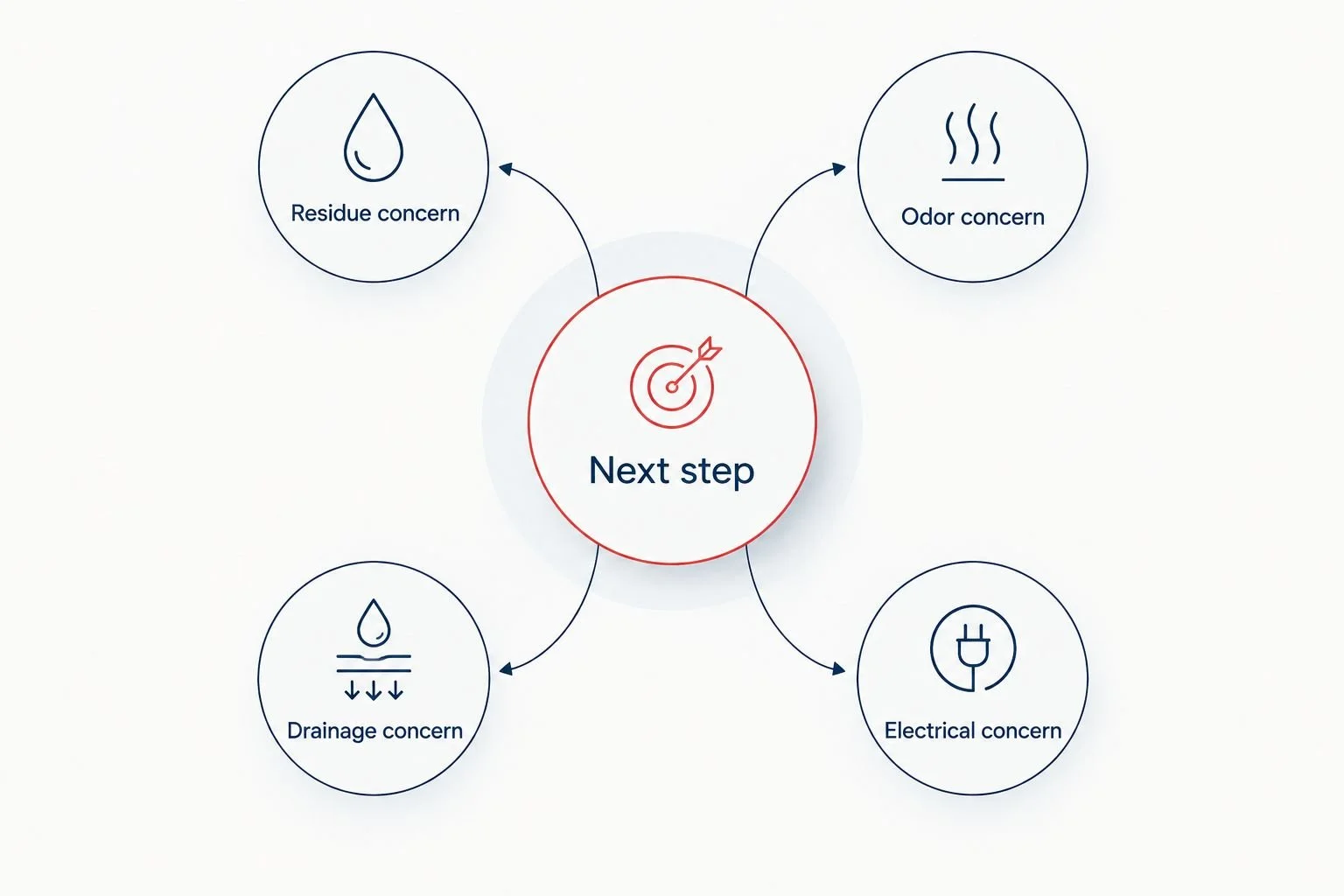
Describe the symptom before choosing a cleaner or requesting diagnosis.
Before you request mobile tank cleaning
A useful service request describes the RV, location, affected tank, and symptoms. You do not need to identify the cause yourself; you do need to explain what you have observed.
Include these details:
Location: Give the county and where the RV is parked.
Affected tank: Identify black, gray, or both.
Display behavior: Explain what the monitor shows before and after dumping.
Previous treatments: Name the products used and provide their directions if requested.
Access questions: Ask what space, connections, and site permissions the service requires.
Confirm the current scope and quote before booking. Do not assume that tank cleaning includes sensor replacement, electrical repair, winterization, or an inspection.
Request mobile tank cleaning
Describe your tank symptoms and location in Weber, Davis, or Salt Lake County.
How these options were compared
This 2026 guide compares intended purpose, compatibility, usable directions, and the point at which cleaning should give way to diagnosis. It does not rank retail brands by unverified results or claim that any formulation works with every sensor design.
The practical distinction is simple: choose a sensor-cleaning product for a supported cleaning use, a maintenance product for its stated routine purpose, and professional help for the problem that remains.
Which tank treatment should you choose?
For your 2026 decision, start with the RV manufacturer’s instructions and the product’s stated use. If a compatible treatment explicitly targets sensor residue, it is a reasonable targeted cleaning option. If it only promises odor control, it is not an established answer to false readings.
If approved routine care has not resolved your buildup concern, request cleaning rather than cycling through unrelated additives. If the panel remains inaccurate after cleaning, stop treating the display as a chemical problem and arrange equipment diagnosis.
FAQ
What’s the best tank treatment for RV sensors?
The best tank treatment for RV sensors is a compatible product explicitly labeled for sensor cleaning. Follow both the product directions and your RV manufacturer’s instructions; an odor-control claim alone does not establish sensor-cleaning ability.
Why does my RV tank still read Full after dumping?
Residue or a monitoring-system fault can cause an RV tank to read Full after dumping. The display alone cannot distinguish buildup from a wiring, connection, sensor, or monitor problem.
Will an enzyme treatment fix my RV tank sensors?
An enzyme treatment is not automatically a sensor-cleaning treatment. Use it for the purposes stated on its label, and do not expect it to repair electrical faults.
Can I use the same treatment in black and gray tanks?
Use the same treatment in both tanks only when its label permits both applications and your RV manufacturer allows it. Black and gray tanks receive different waste, so check the directions rather than assuming compatibility.
Is water flushing enough to clean RV sensors?
Water flushing does not prove that RV sensors are clean or working correctly. Follow the approved flushing procedure, then assess the display and any remaining symptoms separately.
Does professional tank cleaning guarantee accurate sensor readings?
Professional tank cleaning does not guarantee accurate sensor readings. Cleaning addresses tank cleanliness; faulty monitoring equipment requires a separate diagnosis.
Can Trailhead-RV come to my RV for tank cleaning?
Trailhead-RV provides mobile RV tank cleaning at owners’ locations throughout Weber, Davis, and Salt Lake Counties in Utah. Describe your location and symptoms when requesting a quote, and confirm the service scope and site requirements.
One last thing
Write down the monitor reading immediately after your next approved dump-and-rinse procedure. Add which tank you emptied and what treatment you used. That short record is more useful for troubleshooting than remembering that the panel has seemed wrong for a while.
Related guides
About the author
Seth Garecht is the author of this guide.