
Yes—RV detailing can remove surface oxidation from fiberglass gelcoat when the work includes suitable polishing or compounding, not just washing and waxing. For an RV in Ogden, Utah, the deciding factors are the finish type and its condition; detailing does not repair cracks, delamination, or failed clear coat. Ask for a small test area before approving correction across the RV.
TL;DR
Can RV detailing remove oxidation? Yes, suitable correction can remove weathered gelcoat; washing alone cannot.
Trailhead RV offers mobile RV detailing in Ogden; confirm oxidation-correction scope before booking.
A test area helps separate correctable fiberglass oxidation from damage that needs repair.
Confirm site permission, utilities, access, service availability, and any travel fee before the appointment.
By Seth Garecht | Updated for 2026
Can RV detailing remove fiberglass oxidation in Ogden, Utah?
Yes, if the dullness comes from oxidation in a gelcoat surface that still has enough sound material for correction. Polishing and compounding remove a thin amount of weathered surface material. Washing removes dirt, while wax or sealant provides protection; neither step alone performs the same job as abrasive correction.
Start your request with Trailhead RV by describing the chalkiness, affected panels, and parking location. Ask whether the proposed detailing work includes oxidation correction, rather than assuming every exterior detail includes it.
The distinction matters because fiberglass RV exteriors do not all have the same outer finish. Gelcoat, painted panels, clear coat, and vinyl graphics require different treatment. An abrasive process suitable for exposed gelcoat is not automatically suitable for neighboring decals.
A sensible correction process
Identify the finish. Establish whether the affected area is gelcoat, paint, clear coat, or a graphic before choosing the treatment.
Clean the surface. Remove dirt and contamination so the finish can be evaluated without polishing grit into it.
Complete a test area. Use a limited section to check whether appropriate correction improves the finish without unacceptable damage.
Agree on the result. Compare the test area with the surrounding surface and discuss remaining discoloration, texture, or uneven gloss.
Correct and protect. Proceed only with the agreed treatment, then use protection compatible with the corrected finish.
These are decision steps to discuss with a detailer, not a statement that a particular package includes every step. Get the actual scope in writing.
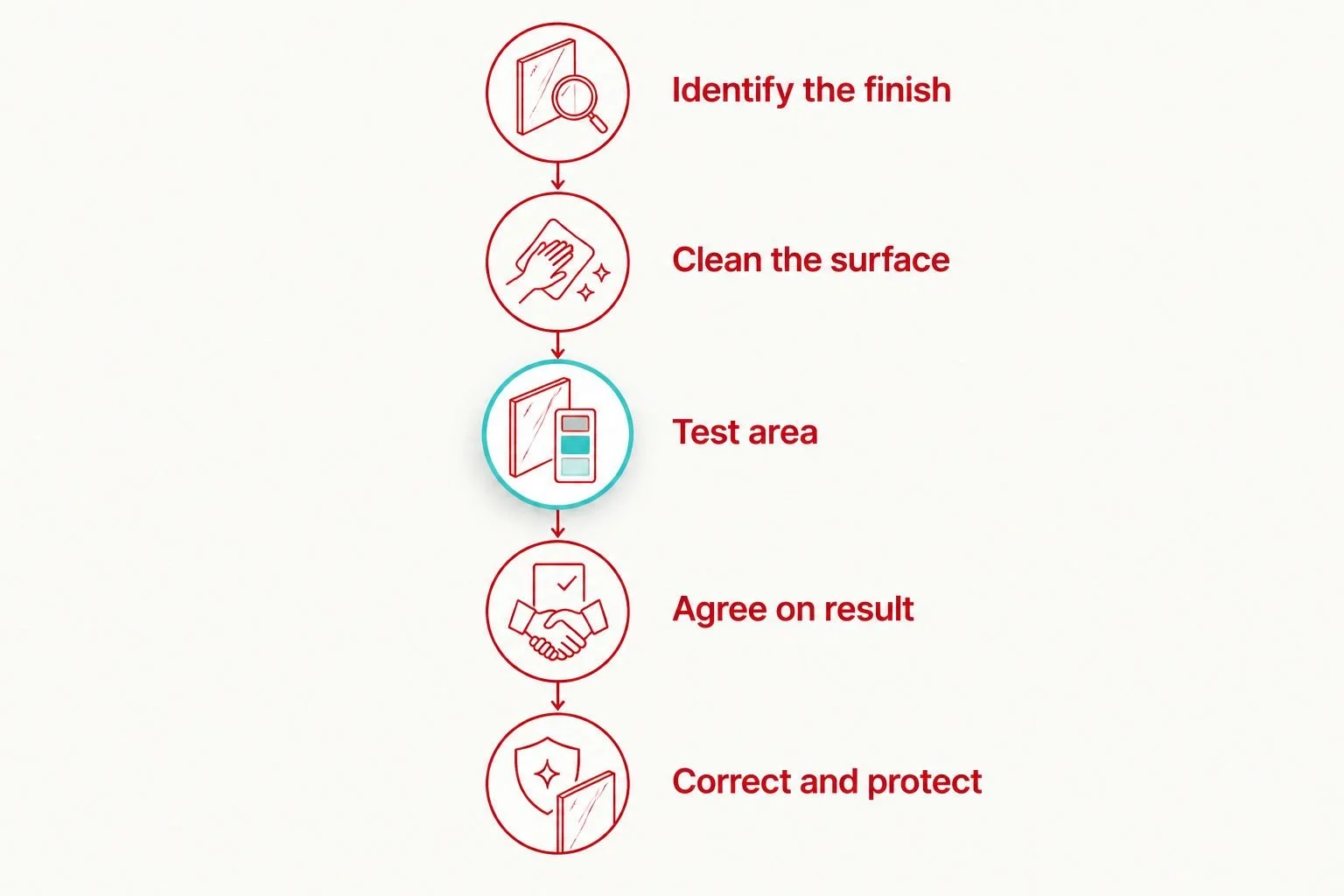
Agree on the test-area result before approving work across the RV.
Why this matters before you book
A dull RV does not automatically need aggressive polishing. Dirt, mineral deposits, oxidation, and coating failure can all affect appearance, but they do not respond to the same treatment. Choosing a service by the word detailing alone leaves too much undefined.
For your 2026 booking, describe the problem rather than requesting the strongest treatment. Say whether the surface looks chalky, has distinct water spots, or shows peeling. Clear photos help the provider decide what needs an in-person assessment.
Book for the finish problem, not the package name. A wash-and-protect service and oxidation correction serve different purposes, even when both appear under exterior detailing.
Washing, polishing, and repair: which fits your RV?
Use the table to frame the conversation. These are service approaches, not verified inclusions in any provider's package.
Exterior washing
Best for: Dirt and loose contamination
What it does: Cleans the exterior so its condition is easier to assess
Main limitation: Does not remove oxidized gelcoat by itself
Wax or sealant application
Best for: Protecting a suitably prepared finish
What it does: Adds a protective layer compatible with the surface
Main limitation: Does not substitute for correction of weathered material
Polishing or compounding
Best for: Correctable oxidation on suitable gelcoat
What it does: Removes weathered surface material to improve clarity and gloss
Main limitation: Removes material and requires care around edges and graphics
Finish or body repair
Best for: Peeling coatings, cracks, or delamination
What it does: Addresses damage outside ordinary cosmetic correction
Main limitation: Is separate from a routine exterior detail
Choose the least aggressive approach that addresses the actual defect. More abrasive work is not automatically better, especially where the finish has already been corrected previously.
Do not approve a whole-RV process solely because a shaded section looks glossy. Ask to see the test area under lighting that also shows the surrounding dullness. You need a useful comparison, not a wet surface that temporarily looks darker.
Light surface haze: evaluate before correcting
A lightly dull gelcoat surface is a candidate for a controlled polishing test. The useful question is whether the cleaned surface responds to an appropriate, limited correction process—not whether a product label promises restoration.
Best for: owners whose main complaint is reduced gloss without visible peeling or structural damage. The advantage is a focused approach that avoids starting with unnecessary abrasion; the limitation is that surface haze alone does not establish the finish's condition.
Tell the detailer about previous polishing, coatings, or repairs if you know the history. Do not guess when you do not. Unknown history is a reason to evaluate carefully, not to assume the surface can tolerate aggressive correction.
Heavy chalking: set expectations with a test area
Pronounced chalkiness can require more correction than light haze. That does not mean every heavily weathered surface can be restored to a uniform appearance. Available sound material, prior work, and the type of damage still control the result.
Best for: owners considering corrective detailing after ordinary cleaning has left the fiberglass visibly dull. The benefit is a direct assessment of what correction can achieve; the limitation is that deeper deterioration or uneven weathering can remain visible.
Ask the provider to explain what remains after the test. Separate an improvement in gloss from a promise to erase every stain, shadow, scratch, or color difference. Approve a demonstrated result, not an undefined promise of looking new.
Peeling or damaged finishes: separate repair from detailing
Peeling clear coat is not the same problem as exposed gelcoat oxidation. Neither are cracks, lifted graphics, or fiberglass delamination. Abrasive detailing does not replace the failed coating or restore a separated wall assembly.
Best for: owners who need to decide whether to seek cosmetic correction or a repair evaluation first. Making that distinction prevents a cleaning appointment from becoming a substitute for work it cannot perform.
If a panel has both dullness and visible damage, photograph both. Ask which areas can be detailed, which need to be avoided, and which require a separate repair discussion. Keep those decisions distinct in the written scope.
Why oxidation-removal results vary
The same detailing description does not produce the same result on every RV. Discuss these factors before choosing the work:
Outer finish: gelcoat, paint, clear coat, and graphics need compatible methods. Identify each affected surface rather than treating the entire exterior as bare fiberglass.
Deterioration depth: surface oxidation is different from damage extending beyond the material that can reasonably be corrected.
Previous correction: abrasive polishing removes material. Known correction history helps the provider judge how cautiously to proceed.
Uneven exposure: panels and areas shielded by trim or graphics can weather differently, leaving appearance differences after correction.
Existing defects: scratches, staining, cracks, and coating failure need separate expectations; improved gloss does not mean every defect disappears.
Working conditions: surface temperature, shade, and access affect how the provider plans the work. Confirm the site's suitability before arrival.
For a 2026 quote, ask the provider to separate cleaning, correction, and protection in the description. That makes the proposed work easier to understand without relying on broad package labels.
Can a wash and wax remove chalky fiberglass oxidation?
A wash and wax alone does not remove oxidized gelcoat. Washing cleans contamination, and a protective product can change the surface's appearance, but actual correction requires a suitable process that addresses the weathered material.
Some products combine cleaning, polishing, and protection. Ask what the proposed process actually does rather than judging it only by the words wash and wax.
Can detailing fix faded RV decals too?
Gelcoat correction does not restore deteriorated vinyl graphics. Decals are a separate material, and abrasive work around them requires care.
Ask how graphics will be treated and whether their condition limits the surrounding work. Do not assume a correction quote includes graphic replacement or repair.
Will oxidation stay gone after detailing?
Oxidation correction is not a permanent exemption from weathering. Compatible protection, appropriate washing, and storage conditions remain part of finish care after correction.
Request aftercare instructions for the actual finish and protective product used. Avoid accepting a fixed protection lifespan unless the provider supports it with the applicable product information and maintenance conditions.
Booking mobile RV detailing in Ogden
Trailhead RV is a veteran-owned mobile RV wash, detailing, and tank cleaning service serving Weber, Davis, and Salt Lake Counties, with Layton as its primary base. Trailhead RV mobile RV detailing suits Ogden owners who want service at their RV's location. Confirm whether oxidation correction is included in the work proposed for your RV.
Ogden is the focus here. If your RV is parked nearby in Roy or West Haven, provide that actual location rather than using Ogden as a general label. Site access and the proposed work still need confirmation for the specific address.
Before arranging a visit in 2026, confirm:
Service availability: ask whether the provider can perform the requested work at your location and on your preferred date.
Site permission: if the RV is in storage or at a managed property, obtain permission for mobile detailing and the planned washing activity.
Utilities: ask what water and electrical access the job requires and who supplies each. Do not assume the mobile setup includes everything.
Working space: describe obstacles, neighboring vehicles, overhead restrictions, and access around the affected panels.
Site conditions: discuss shade, surface temperature, and how wash water will be handled under the property's requirements.
Travel fee: confirm whether any travel fee applies before accepting the quote.
These are booking questions, not claims about Ogden regulations or a particular storage facility's rules. Check your property's requirements directly.
What to send with your quote request
Send a full-side photo, a close-up of the dull area, and a photo showing where the RV is parked. Include the RV's length if known, the affected surfaces, and any peeling, cracks, or damaged decals.
A useful request reads: My RV is parked in Ogden, and the fiberglass remains chalky after washing. Please confirm whether you offer oxidation correction for this finish, how you evaluate a test area, and what access and utilities you need.
Ask for the scope, exclusions, site requirements, and any travel fee together. Confirm the test-area process before authorizing correction across every panel.
Request an Ogden detailing quote
Describe the chalkiness and parking location; confirm correction scope, site needs, and any travel fee.
FAQ
Can RV detailing remove oxidation from fiberglass?
Yes, suitable polishing or compounding can remove surface oxidation from fiberglass gelcoat. The finish must be suitable for correction; cracks, delamination, and failed clear coat need a separate assessment.
Is washing enough to fix a chalky RV exterior?
Washing alone does not remove oxidized gelcoat. It removes contamination so the underlying finish can be evaluated for correction.
Should I ask for a test spot before RV oxidation removal?
Yes, request a small test area before approving broad correction. Compare the improvement and remaining defects with the detailer before agreeing to the full scope.
Can polishing fix peeling clear coat on an RV?
Polishing does not replace failed or peeling clear coat. Ask for a repair evaluation rather than treating coating failure as ordinary oxidation.
Can I book mobile RV detailing at an Ogden storage facility?
Confirm the facility's permission and the provider's site requirements before booking mobile detailing. Service availability, utilities, working space, and any travel fee also need confirmation.
Does oxidation removal include protection afterward?
Do not assume protection is included in oxidation correction. Ask the provider to identify the finishing protection and aftercare instructions in the proposed scope.
What should I include in a 2026 RV detailing quote request?
Include your RV's location, affected surfaces, photos, known finish history, and site-access details. Ask specifically whether the quote includes oxidation correction and a test-area evaluation.
One last thing
Gloss is not the same as repair. A corrected panel can reflect light better while still showing old graphic outlines, deeper staining, or damage. Before approving work, identify which remaining defects you can accept.
The most useful question is not simply whether the RV will shine. Ask what the provider expects to remain visible after the agreed correction.
Related guides
About the author
Seth Garecht is the author of this guide.