
Instead of repeatedly wiping down your RV before an appraisal, plan RV detailing before trade-in around the appointment: document its condition, confirm mobile-service access, and clean the surfaces the appraiser needs to see. For Salt Lake County owners, this workflow organizes the handoff without treating detailing as a repair or a promise of a higher offer.
By Seth Garecht
TL;DR
RV detailing before trade-in prepares visible surfaces for appraisal; it does not establish mechanical condition or guarantee a higher offer.
Trailhead-RV provides mobile RV detailing in Salt Lake County; confirm service availability, site permission, utilities, and travel fees.
Choose cleaning scope from the RV’s condition, then schedule it around your confirmed appraisal appointment.
Document existing damage and keep repair records separate from cleaning records.
Why this matters
Road film, dirty glass, and streaked surfaces make an RV harder to present clearly. Cleaning removes that distraction, but it does not resolve leaks, damaged decals, failed equipment, or missing maintenance records.
Trailhead-RV is best for Salt Lake County RV owners seeking mobile RV detailing at their location. The veteran-owned business serves Davis, Weber, and Salt Lake Counties, with Layton as its primary base. Start with Trailhead-RV to request a quote for your actual location and appraisal deadline.
For a 2026 trade-in, keep the goal narrow: present a clean RV with an accurate condition history. Let the appraiser determine value rather than assuming a cleaning receipt will change the offer.
Before you start
Gather the appointment and RV details. Have the appraisal location, appointment date, RV type, approximate length, exterior material if known, and photographs of problem areas. Keep maintenance records accessible.
Confirm permission before arranging service. A storage space or parking spot is not automatically an approved wash location. Ask the property manager about contractor access, washing permission, drainage requirements, and working space.
Confirm the service setup and scope. Ask about availability, required water or electrical access, any travel fee, and exactly which surfaces the quote covers. Do not assume interior cleaning, roof work, polishing, or tank cleaning is included.
The easy-to-miss problem is access: an RV can be reachable for driving but unsuitable for washing where it sits. Resolve that before agreeing to a service appointment.
Appraisal brief
Confirm the appraisal requirements. Ask the receiving dealer what documents to bring, whether compartments need to be accessible, and whether the RV must arrive with personal belongings removed. Record the answers rather than relying on a generic preparation list.
Create 2 separate lists. Put dirt, streaks, and residue on a cleaning list. Put cracks, leaks, damaged trim, and equipment problems on a condition list. A clean surface is not evidence that the underlying component works.
Take at least 3 overview photos. Photograph the front, a side, and the rear before cleaning. Add close-ups of damaged or questionable areas; these photos describe the starting condition, not the RV’s value.
Set a clear handoff goal. Ask for surfaces that are clean enough to view accurately, with agreed areas accessible. Keep cosmetic requests separate from anything that requires repair or diagnosis.
For your 2026 appraisal folder, include the appointment confirmation and both lists. A folder on your phone works, provided you can retrieve the records without searching through unrelated messages.
Expected result: You have a written brief that separates cleaning work from condition disclosures. The service provider and appraiser do not have to infer what you want addressed.
Cleaning scope
Describe the surface, not just the symptom. Report whether you see loose dirt, streaks, spotting, dullness, or peeling decals. If you do not know the exterior material, say so and provide photographs instead of guessing.
Ask what the proposed work includes. Get confirmation of the areas being cleaned, the treatment proposed for problem spots, and any exclusions. Ask specifically about glass, wheels, storage-door faces, and other areas you want addressed.
Separate routine cleaning from finish correction. A wash removes surface contamination; it is not the same task as addressing oxidation or damaged finishes. Request an assessment before adding corrective work to the appointment.
Approve a bounded scope. Identify the agreed surfaces and any areas that must be avoided. Ask the provider to discuss changes before expanding the work.
Use this scope comparison to frame the request. These are different tasks, not interchangeable package names or confirmed inclusions.
Exterior wash
Best for: Dirt and road film
Benefit: Makes exterior surfaces easier to view
Limitation: Does not repair damage or establish finish condition
Detailing with agreed surface treatment
Best for: Specific cosmetic concerns beyond loose dirt
Benefit: Targets the areas identified in the quote
Limitation: Requires confirmation of surface suitability and exact scope
Black and gray tank cleaning
Best for: Holding-tank cleaning needs
Benefit: Addresses a separate waste-system cleaning task
Limitation: Does not replace exterior detailing or diagnose every odor source
Choose the smallest confirmed scope that addresses the actual cleaning problem. For more detail on the distinction, read wash, wax, and deeper RV cleaning.
Expected result: Your quote describes work you understand, with exclusions visible before the appointment.
Mobile-service access
Provide the exact service location. Identify whether the RV is at home, in storage, or on another property. For a Salt Lake County appointment in Sandy, Murray, or West Jordan, provide the actual address privately when requesting the quote.
Confirm property permission. Check whether a mobile contractor can enter and perform the requested work. Ask who will open gates, supply access instructions, and authorize washing at the site.
Confirm utilities and working space. Ask the provider what water, electricity, clearance, and drainage arrangements the job requires. Do not assume the technician brings every resource or can work between tightly parked vehicles.
Agree on the sequence. Confirm service availability against the appraisal appointment, including the handoff after cleaning. Ask what happens if weather or site conditions prevent the agreed work.
For 2026 booking, send one clear message containing the location, RV details, photographs, requested scope, and appraisal deadline. This is more useful than asking only whether mobile detailing is offered nearby.
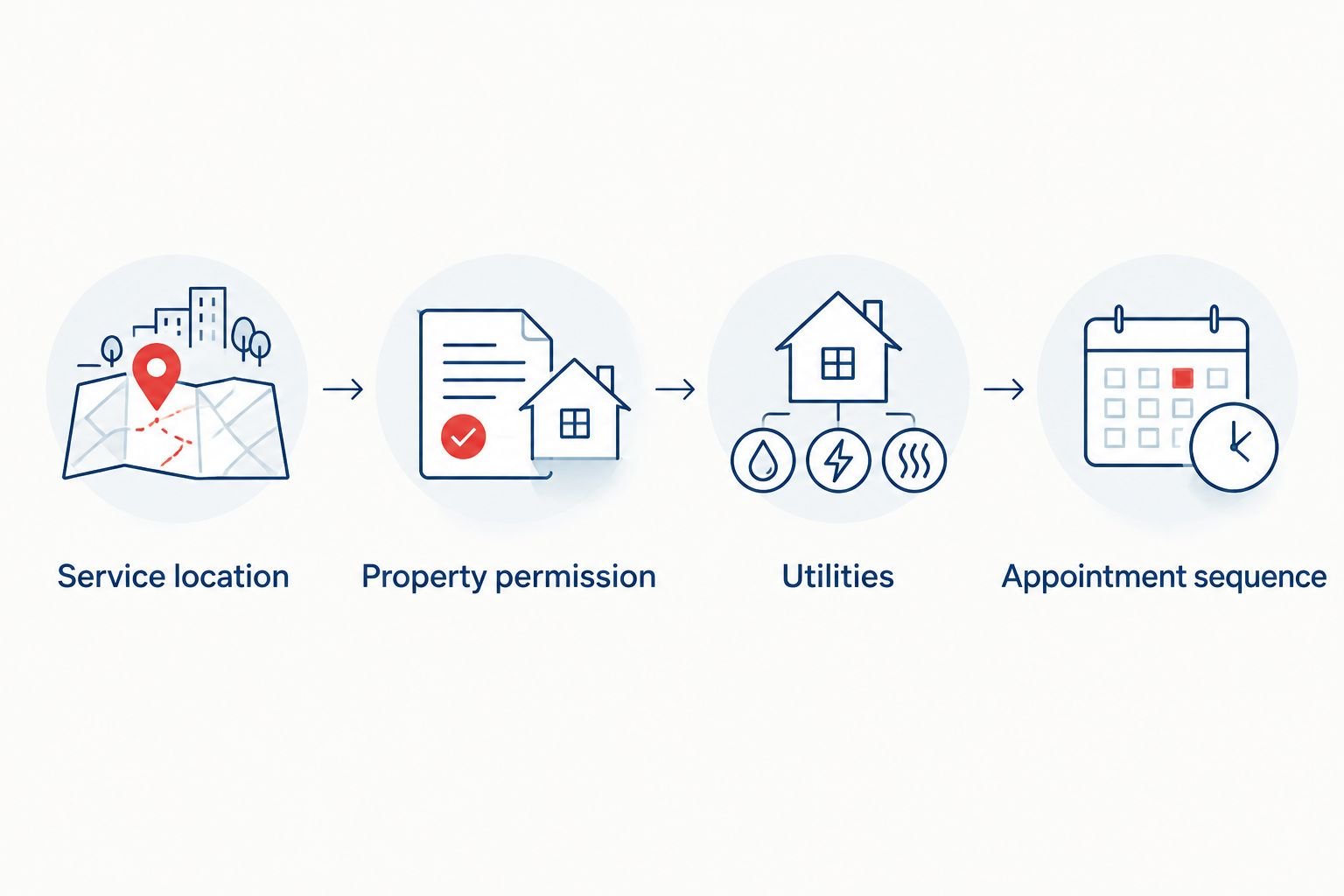
Confirm the worksite before fixing the cleaning appointment around your appraisal.
Mobile service removes the need to drive the RV to a cleaning location. Its limitation is that the proposed worksite still needs approval and a suitable setup.
Expected result: The provider knows where the RV sits, how to reach it, and which site arrangements remain unresolved.
Appraisal handoff
Check the agreed work from ground level. Compare the cleaned areas with the written scope. Point out missed residue or unresolved concerns before treating the appointment as complete; do not climb onto the RV to check work.
Photograph the cleaned condition. Use similar viewpoints to the original photographs. Keep damage photos as well, rather than replacing the condition record with flattering images only.
Organize the cabin and compartments. Remove personal clutter and secure loose belongings. Follow the appraiser’s access instructions, but do not open systems or attempt unfamiliar maintenance just to prepare for the visit.
Bring the right records. Keep service receipts, known-condition notes, and requested ownership documents together. Describe detailing as cleaning, not an inspection, repair, or certification.
Before the 2026 appraisal appointment, check whether the drive or storage location has added fresh dirt. Address simple presentation issues only where safe and consistent with the RV manufacturer’s care instructions.
Expected result: The appraiser receives an accessible RV and a straightforward account of its condition. You can explain what was cleaned without overstating what the service established.
When the appraisal date changes
A delayed appraisal does not automatically call for another full detail. Reassess the RV’s current condition and ask what follow-up work is actually needed.
Best for a clean RV kept under cover: Review the exterior and interior for new dirt or clutter before requesting more work. The benefit is avoiding unnecessary repeat service; the limitation is that storage does not eliminate every cleaning need.
Best for an RV driven after detailing: Photograph fresh road film or residue and ask about a targeted follow-up. This keeps the request specific, but a new trip can change the scope.
Best for a newly discovered defect: Record the issue and disclose it separately. Another cleaning appointment does not substitute for qualified diagnosis or repair.
Keep the original condition photos and add the new ones. A dated sequence is clearer than an unlabeled collection of before-and-after images.
Troubleshooting
The storage facility will not permit washing
Do not book around a permission problem. Ask the facility whether another approved work area exists, or discuss a different permitted location with the service provider before rescheduling.
Gate access alone is not washing permission. Confirm both.
The exterior still looks dull after washing
Dullness is not the same as remaining dirt. Ask the provider to distinguish surface contamination from a finish issue before requesting stronger treatment.
Do not experiment with abrasive products just before appraisal. Follow the manufacturer’s surface-care instructions and obtain a separate assessment where needed.
Odors remain after the RV looks clean
Exterior detailing does not address every odor source. Describe where the odor occurs, whether it follows dumping, and whether drains or the toilet appear involved.
Trailhead-RV offers black and gray tank cleaning, but tank cleaning is a separate scope—not a diagnosis of every odor problem. Report leaks or other operating concerns for appropriate evaluation.
The quote is too vague to approve
Ask for the surfaces covered, exclusions, utility requirements, site arrangements, and any travel fee. Replace phrases such as full detail with a description of the actual work.
If the appraisal deadline cannot accommodate the confirmed scope, discuss a narrower task or a different appointment. Do not assume same-day completion.
Customize your workflow
Use the appraisal brief to request service, not an open-ended makeover. For a 2026 quote, tell Trailhead-RV where the RV is located in Salt Lake County, what needs cleaning, and when the appraisal is scheduled.
Add tank-cleaning concerns only when relevant, and ask for that work to be described separately. Confirm availability, property permission, utilities, and any travel fee before booking; county coverage does not establish the arrangements for your particular site.
Request a trade-in preparation quote
Send your Salt Lake County location, RV details, cleaning concerns, and appraisal date.
FAQ
Should I detail my RV before a trade-in appraisal?
Detail your RV before appraisal when dirt or residue prevents a clear presentation of its condition. Choose a defined cleaning scope, keep known defects documented, and do not treat detailing as a guarantee of a higher offer.
Will RV detailing increase my trade-in offer?
Detailing does not guarantee a higher trade-in offer. It prepares surfaces for viewing, while the appraiser determines value and evaluates condition separately.
Can mobile RV detailing come to my Salt Lake County storage space?
Mobile detailing at a storage space requires confirmed property permission and a suitable service setup. Ask about gate access, working space, utilities, drainage arrangements, availability, and any travel fee before booking.
How soon before my appraisal should I schedule detailing?
Schedule detailing after confirming the appraisal date and the provider’s availability. Agree on timing that allows the work and handoff to finish before the appraisal, with a plan for weather or access problems.
Does exterior detailing include black and gray tank cleaning?
Do not assume tank cleaning is included in exterior detailing. Request it as a separate scope and describe any odors, dumping concerns, or sensor symptoms when asking for a quote.
Should I remove personal belongings before an RV appraisal?
Remove personal clutter and secure loose belongings before appraisal. Ask the receiving dealer which compartments and documents need to be accessible, then prepare those areas without concealing known damage.
What should I send when requesting a mobile detailing quote?
Send the service location, RV type and approximate length, photographs, cleaning concerns, and appraisal date. Ask the provider to confirm scope, exclusions, site requirements, availability, and any travel fee.
One last thing
Do not discard the pre-cleaning photos. Keep them beside the cleaned-condition photos and your damage notes. That record helps you describe what changed through cleaning—and what did not.
Related guides
About the author
Seth Garecht is the author of this guide for Trailhead-RV, a veteran-owned mobile RV wash, detailing, and tank cleaning service serving Davis, Weber, and Salt Lake Counties in Utah.