
Rental fleet host RV detailing is scheduled cleaning and surface care that prepares your rental RVs for the next guest without treating every return as the same job. For Salt Lake County hosts facing dirty exteriors, tight handoffs, or tank odors, the practical fix starts with separating routine turnover work from deeper detailing and tank cleaning.
TL;DR
RV detailing for rental fleet hosts should follow vehicle condition and booking gaps, not one fixed cleaning package.
Trailhead RV fits Salt Lake County owners seeking mobile RV washing, detailing, and tank cleaning.
Confirm site permission, utilities, access, service availability, and any travel fee before booking.
Keep exterior cleaning, guest-ready interior preparation, and tank cleaning as separate scope decisions.
By Seth Garecht
Why RV detailing matters for rental fleet hosts
A dirty rental return creates several different jobs. Road grime needs washing, a dull finish needs assessment before choosing surface care, and an odor complaint needs troubleshooting rather than fragrance. Booking one vague detail leaves too much open to interpretation.
Trailhead RV is best for Salt Lake County RV owners who want mobile washing, detailing, and tank cleaning at their location. Trailhead RV is veteran-owned and serves Davis, Weber, and Salt Lake Counties, with Layton as its primary base. Confirm the exact scope for a rental fleet rather than assuming every turnover task is included.
For your 2026 rental schedule, make cleaning an explicit booking dependency. A service request is not a confirmed appointment, and a washed exterior does not establish that the interior, tanks, or mechanical systems are ready for a guest.
The mobile approach removes the need to drive an RV to a cleaning location. Its limitation is site readiness: the technician still needs an approved, workable place to perform the agreed service.
Build a rental-fleet detailing process
1. Document each RV's return condition
Start with a shared checklist and phone photos. Record what changed during the rental, what was already present, and what requires cleaning rather than repair. Keep that record attached to the individual RV, not buried in a conversation covering the whole fleet.
For a practical photo baseline, take 3 exterior views: the front, the driver's side, and the passenger's side. Add close-ups wherever dirt obscures a surface or existing damage needs a clear record. These are documentation targets, not a substitute for checking the vehicle.
Make observations specific. Write down where the residue, odor, or stain appears instead of labeling the whole RV dirty.
Photograph exterior condition before cleaning begins.
Note bugs, road film, water spotting, and visibly dull areas separately.
Record interior spills and odors as their own tasks.
Note tank readings and the renter's description of any dumping problem.
Flag loose trim, damaged decals, or suspect seals for separate attention.
2. Define the scope before requesting service
Use a written task list first. Decide whether the RV needs a routine exterior wash, additional detailing, tank cleaning, or several separately described services. Avoid asking for everything when you have not defined what a completed job looks like.
A detail is not automatically an interior turnover, a repair, or a tank service. Ask the provider to identify included surfaces, exclusions, and any condition-dependent work before accepting the quote. That distinction matters when the next guest expects a clean living space as well as a presentable exterior.
For your 2026 service brief, name the problem and desired scope rather than choosing work solely from the appearance of a package name.
Separate exterior washing from additional surface-care requests.
Ask whether interior cleaning is offered; do not assume inclusion.
Identify roof and awning requests explicitly, including any access concerns.
Request black and gray tank cleaning separately when needed.
Keep repair, inspection, and winterization requests outside the agreed detailing scope unless confirmed.
3. Confirm that the mobile worksite is usable
Check access yourself before scheduling. A storage space that fits a parked RV does not automatically provide working room, permission to wash, or acceptable wastewater arrangements. Ask the property manager what work is allowed and share those conditions with the provider.
Trailhead RV's mobile washing and detailing lets Salt Lake County owners request service where their RVs are located. Confirm the address, availability, required utilities, and any travel fee first. Do not assume a location in Salt Lake City, Murray, or West Jordan has the same access conditions as another property.
Use the mobile RV wash preparation guide when organizing the information for your request. Resolve access questions before the appointment, not when the technician reaches a locked gate.
Get property permission for the specific work requested.
Explain gate access, parking restrictions, and available working space.
Ask which water and power connections the service requires.
Confirm acceptable wash-water handling with the provider and property manager.
For tank cleaning, confirm the required dump access and disposal arrangements.
Ask whether the location carries a travel fee.
4. Schedule around confirmed handoffs
Start with a calendar containing the actual return and departure commitments for each RV. Add cleaning only after you know when the vehicle will be accessible. Do not promise a guest that an unconfirmed service will be finished before pickup.
Keep 2 separate records: the rental handoff schedule and the confirmed service schedule. Linking them makes conflicts visible without confusing a requested appointment with an accepted one. If a return moves, tell the service provider before changing the guest-facing commitment.
A mobile appointment avoids a separate cleaning-location trip, but it does not eliminate time spent making the RV accessible or checking completed work. Build those tasks into your own turnover plan.
Provide the earliest confirmed access time and the next pickup deadline.
Ask the provider to confirm timing for the actual scope and condition.
Keep keys and gate instructions available through an agreed method.
Identify who can approve a scope change while work is underway.
Arrange time to check the RV before releasing it to the next guest.
The handoff process should move through these checkpoints: Document condition, Define scope, Confirm access, Schedule service, Check handoff. Complete each checkpoint before treating the RV as ready.
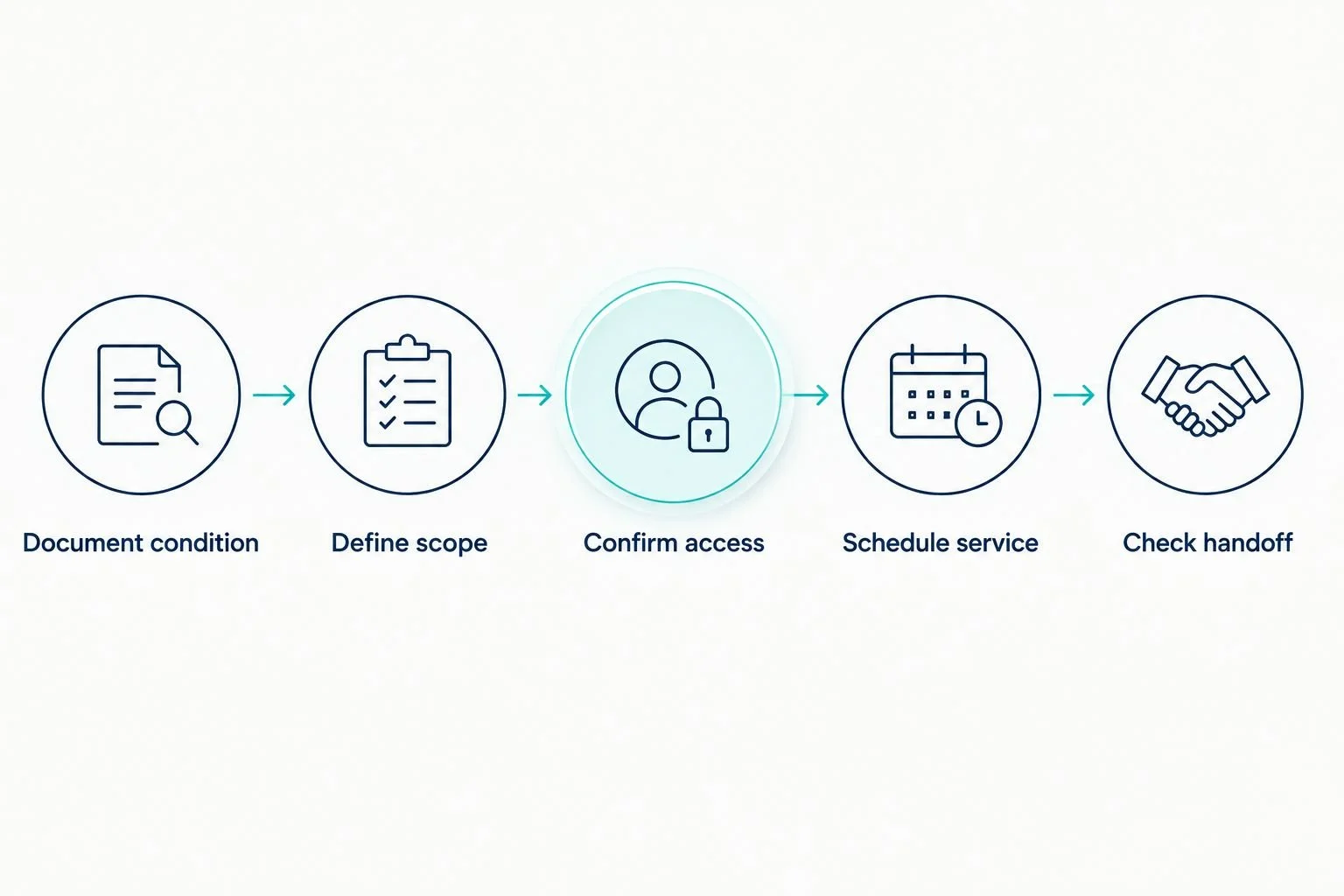
Confirm the worksite and service appointment before committing to the next handoff.
5. Check the agreed work before releasing the RV
Use the original task list for the completion check. Compare the same exterior views, note any remaining concerns, and distinguish an unfinished cleaning task from a condition that was excluded from the quote.
Do not treat a freshly washed vehicle as proof that every system works. Detailing, tank cleaning, and mechanical readiness answer different questions. If a tank reading remains unexpected, record it and discuss the next diagnostic step rather than promising that cleaning guarantees accurate sensors.
Keep the completion record simple enough to use after every appointment. Your 2026 fleet log needs clear observations, not a long narrative nobody reads before handing over the keys.
Compare the agreed scope with the completed work.
Photograph unresolved marks or condition concerns.
Confirm whether any requested work was deferred or excluded.
Check for remaining odors without masking them first.
Record follow-up work separately from the guest-ready cleaning checklist.
6. Set the next service from condition and use
Begin with your own return records rather than an arbitrary calendar interval. An RV returning from one trip can need different work from another, even when both have been away for the same period. Record the condition that triggered each service so the next decision has a clear basis.
For rental fleets, RV detailing frequency belongs in a condition-based maintenance plan, not a promise that every return needs identical work. Separate routine cleaning from deeper surface care and tank concerns; each has a different reason for being scheduled.
Use 1 quote-request template per RV so its materials, condition notes, location, and access requirements stay together. Reuse the structure throughout 2026, but update the condition and next handoff before every request.
Review the RV's condition after each rental return.
Follow manufacturer instructions for exterior materials and protective products.
Record recurring spotting, residue, dullness, and odor complaints.
Schedule deeper work during a confirmed opening in the rental calendar.
Reconfirm the scope whenever the condition or worksite changes.
Compare your fleet-cleaning options
Choose the option that matches the task, not the one with the broadest label. A simple wash can be appropriate for routine dirt; it is not interchangeable with additional detailing or tank cleaning.
The options below describe ways to organize the work, not verified local competitor offerings. Confirm the exact service before booking.
Host-managed routine washing
Best for: Hosts with approved space and time between rentals
Main advantage: You control the checklist and timing
Key limitation: You handle labor, material selection, utilities, and site requirements
Mobile exterior washing
Best for: RVs needing routine exterior cleaning at an approved location
Main advantage: Avoids a separate trip to a cleaning location
Key limitation: Does not automatically include deeper surface care, interiors, or tanks
Mobile detailing
Best for: RVs needing work beyond a routine wash
Main advantage: Lets you request condition-specific surface care
Key limitation: Included surfaces and corrective work must be confirmed
Separate tank cleaning
Best for: RVs with holding-tank buildup or concerns needing cleaning assessment
Main advantage: Keeps tank work distinct from appearance work
Key limitation: Is not a guarantee against plumbing faults, vent issues, or sensor defects
Trailhead RV offers mobile washing, detailing, and tank cleaning. The benefit is access to those service categories at your location; the boundary is that fleet scheduling, interior work, exact methods, utilities, and any travel fee still require confirmation.
Common mistakes rental fleet hosts make
Treating every return as the same cleaning job
A single checklist can organize your process, but it should not force identical work onto every RV. Separate routine dirt from surface-condition concerns, interior preparation, and tank symptoms. Request only the work the condition supports.
Booking before obtaining storage-site permission
Permission to store an RV does not establish permission to wash or service it there. Ask about the proposed activity, utility use, working space, and wastewater arrangements. If the property cannot accommodate the work, discuss another approved location before booking.
Using exterior appearance as the readiness test
A clean sidewall says nothing about a refrigerator spill, a remaining odor, or an unresolved mechanical concern. Keep exterior completion, interior turnover, and operational readiness as separate checks. Assign responsibility for each before the next guest arrives.
Assuming several RVs share one scope
Fleet vehicles can have different materials, conditions, tank configurations, and access needs. Send an individual description for each unit, even when requesting coordinated service. Ask the provider to confirm which work and timing apply to each RV.
Request a Salt Lake County mobile-service quote
Send Trailhead RV your RV's type and size, current photos, requested work, exact location, and next confirmed handoff. State whether the RV is at a residence, storage property, or another approved site, and explain any gate or working-space restrictions.
Service extends from the Layton base throughout Davis, Weber, and Salt Lake Counties. Confirm service availability, site permission, utilities, scheduling, and any travel fee before committing. For a 2026 fleet request, identify each RV separately rather than asking for one undefined fleet detail.
Request your mobile-service quote
Share each RV's condition, Salt Lake County location, access details, and next handoff.
FAQ
What's the best way to arrange RV detailing for rental fleet hosts?
Use a condition record, a written scope, and a confirmed appointment for each RV. Coordinate the work with the next handoff and confirm that the location permits the requested service.
Does mobile RV detailing include cleaning the rental interior?
Interior turnover is not automatically included in mobile RV detailing. Ask which interior tasks, if any, the provider offers and keep guest-ready housekeeping separate unless it is expressly included.
Can a mobile RV detailer work at my Salt Lake County storage space?
Storage-site service requires both property permission and provider confirmation. Share access restrictions, available working space, utilities, and wastewater requirements before scheduling.
Should every rental return get a full RV detail?
Choose the cleaning scope from the RV's return condition rather than automatically requesting a full detail. Record exterior dirt, surface concerns, interior tasks, and tank symptoms separately.
Will tank cleaning fix every odor or inaccurate tank reading?
Tank cleaning does not guarantee that every odor or inaccurate reading will disappear. Plumbing, venting, and sensor faults can require separate diagnosis, so describe the symptoms before requesting work.
Does Trailhead RV serve rental owners outside Layton?
Trailhead RV provides mobile washing, detailing, and tank cleaning throughout Davis, Weber, and Salt Lake Counties. Confirm availability at the exact location, the requested scope, utilities, and any travel fee.
What should I send when requesting a fleet-detailing quote?
Send each RV's type and size, condition photos, requested tasks, service location, and next confirmed handoff. Include property permission and access details so the provider can assess the worksite and schedule.
One last thing
Keep an odor complaint separate from an appearance complaint. Photographing a clean exterior cannot document whether an odor remains. Add a written odor check to the handoff record so a good-looking RV does not hide an unfinished task.
Related guides
About the author
Seth Garecht is the author of this guide.