
For RV tank cleaning in Farmington, Utah, confirm an approved wastewater disposal arrangement, access to the RV’s dump connection, and permission to work at the parking location before booking. Also confirm utility requirements, service availability, and any travel fee; a nearby dump station does not automatically make your parking spot suitable for cleaning. Use this 2026 booking checklist to settle those details before scheduling a mobile visit.
TL;DR
RV tank cleaning Farmington Utah bookings need confirmed dump access, site permission, and utility arrangements before scheduling.
Trailhead RV offers mobile tank cleaning for RV owners in Farmington and the surrounding Davis County service area.
An accessible dump valve and an approved wastewater destination are separate requirements to discuss.
Confirm service availability and any travel fee before accepting a mobile-service quote.
By Seth Garecht
What dump access does RV tank cleaning in Farmington, Utah need?
Your booking conversation needs to establish where wastewater will go, how the technician can reach the RV’s connection, and whether the property permits the work. Do not treat a sewer connection, a shared dump station, and an ordinary driveway as interchangeable service locations. Each presents different access questions.
Start with these steps:
Identify the parking location. Explain whether your RV sits at home, in storage, or at a campground.
Describe the dump connection. Send a clear photo showing the outlet, valves, and surrounding working space.
Identify wastewater disposal. Explain whether there is a designated RV sewer connection or a separate dump station.
Confirm site permission. Ask the property operator whether mobile tank cleaning is allowed at that location.
Confirm utilities and access. Ask the provider what the planned service requires before moving the RV or preparing hookups.
For the broader service-area context, see the guide to mobile RV tank cleaning in Davis County. For your specific appointment, describe the actual setup rather than simply saying that your RV has full hookups.
Why this matters
Sensors stuck on Full? Odors after dumping? Those symptoms explain why you want service, but they do not establish whether the location works for the appointment. The provider still needs to understand the connection, disposal arrangement, and access restrictions.
A mobile visit brings service to your location. It does not automatically include permission to work there, unrestricted use of a shared dump station, or an alternative way to transport wastewater.
For a 2026 booking, settle the site questions before concentrating on an appointment date. A suitable location is part of the service plan, not a detail to resolve after arrival.
Which parking setup do you have?
Use the table to describe your situation when requesting service. These are booking considerations, not confirmation that every location qualifies.
RV at a site with a designated sewer connection
Best for: Owners who can provide an approved disposal connection where the RV sits
Practical advantage: Keeps the RV and disposal point together
Limitation to resolve: Confirm connection suitability, work permission, and working space
RV near a shared dump station
Best for: Owners who can arrange authorized use of the station
Practical advantage: Provides an identified place to discuss wastewater disposal
Limitation to resolve: Confirm whether cleaning is permitted there and whether access can be coordinated
RV in a driveway without a sewer hookup
Best for: Owners seeking service at home
Practical advantage: Avoids assuming the RV must leave home before discussing the job
Limitation to resolve: The provider must confirm a workable disposal arrangement before booking
RV in a storage facility
Best for: Owners whose RV remains in storage
Practical advantage: Allows the access discussion to start with the current parking location
Limitation to resolve: Gate access, vendor permission, utilities, and disposal all need confirmation
Do not move the RV solely because one setup sounds more convenient. First ask which arrangement the provider can use for the requested work, then obtain permission from whoever controls the property.
RV at home: confirm disposal before booking
A driveway gives you access to the RV, but it does not prove that an appropriate wastewater connection is available. Describe what is actually present and let the provider explain whether the site works.
If you see a capped pipe nearby, do not assume it is an authorized RV disposal connection. Identify its purpose with the property owner or a qualified professional before proposing it for service.
Keep these details ready:
Where the RV is parked and whether it can be repositioned.
Which side has the dump outlet and whether that side is accessible.
Whether a designated RV sewer connection is available.
Whether hoses would cross a sidewalk, driveway entrance, or another occupied space.
Any parking or property restrictions that affect outside service providers.
Do not substitute a street gutter or storm drain for an approved wastewater destination. If no suitable disposal arrangement is confirmed, ask about an alternative service location before scheduling.
RV in storage: get permission before arranging access
Storage access and permission to perform tank cleaning are different questions. Being able to enter the facility does not establish that a mobile provider can work beside your RV or use water and sewer facilities there.
Ask the storage operator about outside vendors, permitted work locations, and any restrictions on wastewater handling. Describe tank cleaning specifically; permission for a quick vehicle pickup does not answer the same question.
Then explain the entry process to the provider. Discuss gate access, appointment coordination, and whether someone must meet the technician. Share entry credentials through the agreed booking channel, not in a public comment or review.
If neighboring RVs block the dump connection, arrange access before the appointment. Do not assume the technician can move another owner’s vehicle or work through an obstructed space.
Shared dump station: confirm that cleaning is allowed
A dump station’s permission to receive RV waste does not automatically establish permission to perform a cleaning service there. The station operator controls how the facility can be used.
Ask whether a mobile provider may carry out the proposed work, whether an appointment is needed, and how the work would fit around other users. Give the provider the operator’s instructions before agreeing on the location.
A shared station also creates a coordination issue: the RV, technician, and permitted working area must be available together. Confirm who handles any separate station arrangement and whether its terms affect your service quote.
Do not arrive expecting to occupy a shared dump lane for cleaning without prior approval. A confirmed plan protects your appointment and keeps other RV owners from being drawn into an access problem.
Why dump access requirements vary
The right questions depend on the RV and the property, not just the city on the booking request. These factors explain why a provider needs more than a Farmington address:
Parking location: A private driveway, storage space, and campground site have different people controlling access and permission.
Disposal arrangement: An on-site connection and a separate shared dump station require different coordination.
Connection access: A visible outlet is easier to assess than one hidden behind stored items or a neighboring vehicle.
Tank configuration: Describe the black and gray tanks you want serviced, including separate outlets or controls you know about.
Utility arrangements: Confirm what water or electrical access the planned service requires and who supplies it.
Site restrictions: Gates, operating hours, parking rules, and limits on outside vendors affect appointment planning.
For your 2026 request, send facts rather than assumptions. A photo of the actual connection and a clear explanation of the disposal setup give the provider something useful to assess.
What should you send with a mobile-service quote request?
Start with the owner problem, then describe the site. You do not need to diagnose the tank yourself or identify a particular cleaning method before asking for help.
Use this checklist:
Describe symptoms. Explain whether the concern is odor, an inaccurate level reading, drainage, or routine cleaning.
Show the connection. Include a clear photo of the dump outlet and the space around it, without opening or dismantling anything.
Explain disposal. Identify the designated sewer connection or describe the shared dump arrangement you want assessed.
Confirm permission. State who controls the property and whether that person has approved mobile tank cleaning.
Request confirmation. Ask about service scope, utilities, availability, site preparation, and any travel fee.
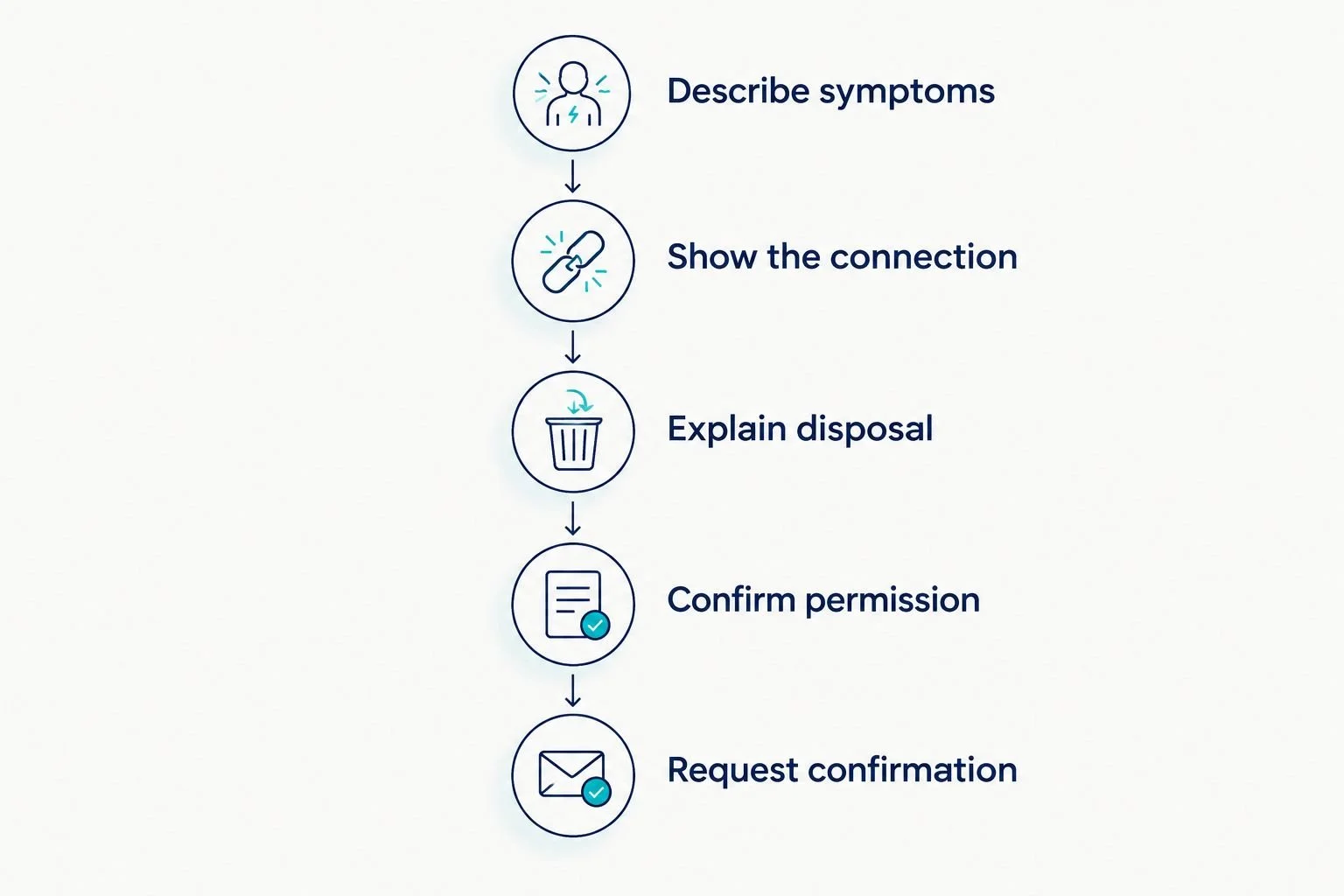
Send the tank symptoms and the site details together so the provider can assess the proposed visit.
Include problems that affect access, such as a damaged valve handle, a visible leak, or an outlet you cannot reach safely. Do not force a stuck valve to improve the photo. Ask whether the reported condition changes the service plan.
Can mobile tank cleaning happen without a sewer hookup?
A sewer hookup is not the only detail that determines whether a booking works. Without one at the parking location, you need the provider to confirm an acceptable disposal arrangement before scheduling.
Do not assume a mobile service vehicle includes wastewater hauling or that any nearby dump station can be used. Ask directly how the proposed appointment would handle wastewater and where the work would take place.
Should I empty the tanks before the appointment?
Follow the provider’s preparation instructions rather than emptying, filling, or adding treatment automatically. The requested work and the condition you report should guide those instructions.
When booking, explain the current tank readings and whether you have recently dumped. If a valve will not operate or drainage has stopped, report that before attempting further preparation.
Does a false Full reading mean the sensor needs replacing?
A false Full reading does not, by itself, establish that a sensor needs replacement. Residue can interfere with some tank-level sensing systems, while other faults require separate diagnosis.
Ask what the tank cleaning service covers and what happens if the reading remains inaccurate afterward. Cleaning is not a promise to repair damaged sensors, valves, plumbing, or wiring.
Request service in Farmington and the surrounding area
Trailhead RV is a fit for Farmington RV owners seeking mobile tank cleaning at their location. The veteran-owned business provides mobile RV washing, detailing, and tank cleaning throughout Davis, Weber, and Salt Lake Counties, including Farmington and nearby Layton and Kaysville.
Trailhead RV tank cleaning brings the service to your location, subject to confirmation of the site and appointment. That convenience does not establish availability on a particular day or remove the need to confirm permission, utilities, disposal, and any travel fee.
For a 2026 mobile-service quote, contact Trailhead RV with your Farmington location, tank symptoms, connection photos, and disposal details. Ask for the agreed scope and preparation instructions before accepting the appointment.
Request a Farmington tank cleaning quote
Share your tank symptoms, parking location, and dump access details to discuss a mobile visit.
FAQ
Can I book RV tank cleaning at my Farmington storage space?
Confirm the storage facility’s permission, dump access, utilities, and vendor-entry rules before booking. Give the provider those details so the proposed location can be assessed.
Can an RV tank cleaning service use a shared dump station?
A shared dump station needs the operator’s approval for the proposed cleaning work. Confirm that approval and the access arrangements with the provider before scheduling.
Does mobile RV tank cleaning include wastewater hauling?
Do not assume mobile RV tank cleaning includes wastewater hauling. Ask the provider to confirm the disposal arrangement and exact service scope for your appointment.
What photos should I send for an RV tank cleaning quote?
Send clear photos of the dump connection, surrounding working space, and any designated sewer connection. Avoid opening fittings or operating a damaged valve just to obtain a photo.
Can Trailhead RV clean both black and gray tanks?
Trailhead RV offers black and gray tank cleaning. Describe your RV’s configuration and confirm which tanks and connections the requested service will cover.
What should I confirm before accepting a tank cleaning quote in 2026?
Confirm service scope, availability, site permission, wastewater disposal, utility requirements, and any travel fee. Also request the provider’s instructions for preparing the RV.
One last thing
Photograph the space around the dump outlet, not just the outlet itself. A close-up can show the fitting while hiding the fence, parked vehicle, or storage barrier that prevents access. Include a wider view so the provider can assess the working area before you book.
Related guides
About the author
Seth Garecht is the author of this guide to RV tank cleaning access and booking preparation for Farmington owners.