
If your RV’s fiberglass stays chalky or dull after washing, it needs assessment for oxidation correction—not just another coat of wax. For RV oxidation removal in Sandy, Utah, confirm the exterior material, request a small test area, and agree on the correction scope before booking; peeling coatings, damaged decals, and structural problems need a different approach.
TL;DR
RV oxidation removal in Sandy, Utah, starts with identifying the finish—not choosing the strongest compound.
Trailhead RV offers mobile RV detailing; confirm oxidation-correction scope before booking.
Wash away contamination before judging fiberglass oxidation, water spots, or coating damage.
Confirm Sandy site permission, working space, utilities, service availability, and any travel fee before scheduling.
By Seth Garecht | Updated for 2026
When does RV detailing in Sandy, UT, need more than a wash?
Your RV needs more than washing when a clean, dry surface still looks chalky, faded, or uneven. Washing removes surface contamination. It does not reverse deterioration in the exposed finish, and adding protection alone does not remove an oxidized layer.
For a 2026 detailing appointment in Sandy, start with the symptom rather than requesting an aggressive treatment. Tell the provider whether you see powdery residue, isolated spots, peeling, or uneven gloss. Those descriptions help separate routine cleaning from correction work.
Trailhead RV provides mobile RV washing and detailing in Salt Lake County. Ask whether the proposed service includes oxidation assessment and correction for your particular exterior; the word detailing does not establish that scope by itself.
Exterior washing
Best for: Dirt, road film, and surface contamination
What it addresses: Cleaning the exterior so its condition is visible
Main limitation: Does not remove deteriorated finish
Wax or sealant application
Best for: A clean, sound surface needing protection
What it addresses: Adding a compatible protective layer
Main limitation: Does not substitute for oxidation correction
Oxidation correction
Best for: An oxidized finish suitable for polishing
What it addresses: Removing deteriorated surface material to improve appearance
Main limitation: Removes material and requires a suitable finish and careful technique
Repair assessment
Best for: Peeling coatings, cracking, or suspected panel damage
What it addresses: Determining whether repair is needed before cosmetic work
Main limitation: A detailing appointment does not resolve structural damage
These are different jobs, not competing packages with interchangeable results. Book the work your surface needs, not the name that sounds most thorough.
Why this matters before you book
Dullness alone does not identify the problem. Dirt can hide a sound finish, mineral deposits can interrupt gloss, and aging gelcoat can look faded even after cleaning. An RV can also have painted panels, gelcoat, vinyl graphics, and plastic trim on the same side.
That mixed exterior matters because a process appropriate for one material can damage another. Treating the entire RV as one polishing surface risks sacrificing decals or an already compromised coating to improve the surrounding gloss.
Your goal is a clear explanation of what can be cleaned, what can be corrected, and what should be left alone. A useful quote makes those boundaries visible before work begins.
How can you tell oxidation from dirt or water spots?
Start with a washed, dry area viewed in consistent light. Surface appearance is a screening tool, not a reliable way to identify every coating or determine how much material remains.
Loose dirt and road film: A suitable wash removes contamination and reveals the finish underneath. Judge the result after drying rather than through a wet surface.
Water spots: Deposits often follow droplet outlines or appear as isolated marks. Some marks involve etching rather than removable residue, so appearance alone does not establish the treatment.
Oxidized gelcoat: Persistent chalkiness, faded color, and reduced gloss can indicate surface deterioration. A controlled test helps establish whether polishing improves that particular area.
Peeling or cracking: Flaking layers, lifting edges, or cracks call for a repair discussion before polishing. Abrasive work does not put a failed coating back together.
If spots are the main complaint, distinguish that problem from broad chalkiness before requesting correction. The guide to water spot removers for RV exteriors covers a separate cleaning concern; a spot-removal treatment is not automatically an oxidation treatment.
Avoid diagnosing the whole RV from its shiniest or dullest panel. Sun exposure, previous work, repairs, and different materials can leave neighboring areas in different condition.
What should an oxidation-correction assessment include?
Ask for a process that establishes the surface condition before committing to full-panel work. The sequence below gives you practical questions for a 2026 quote without assuming every RV needs the same treatment.
Clean
The surface needs appropriate cleaning before anyone judges correction results. Otherwise, dirt removal and actual finish improvement are difficult to separate.
Ask how the provider will handle nearby decals, trim, sealant, and roof materials. Cleaning the sidewall does not make every adjacent component suitable for the same chemicals or equipment.
Identify
Establish whether the affected area is gelcoat, painted fiberglass, a clear-coated surface, or another material. Check the RV manufacturer’s care information where available, and disclose any known repainting or previous coating work.
Do not assume fiberglass construction means exposed gelcoat everywhere. The finish over the fiberglass determines what can safely happen at the surface.
Test
Request a small, representative test area before broad correction. The test should show the achievable appearance and help the provider choose an appropriate process.
Ask to evaluate the area clean and dry. A wet surface or polishing residue can make a temporary improvement look more convincing than the finished result.
Protect
After appropriate correction, discuss compatible protection and its maintenance requirements. Protection belongs on a properly prepared surface; it does not replace the correction step.
Ask which areas are included and whether graphics receive a different treatment. Follow the selected product’s care instructions rather than assuming every wax, sealant, or coating has identical requirements.
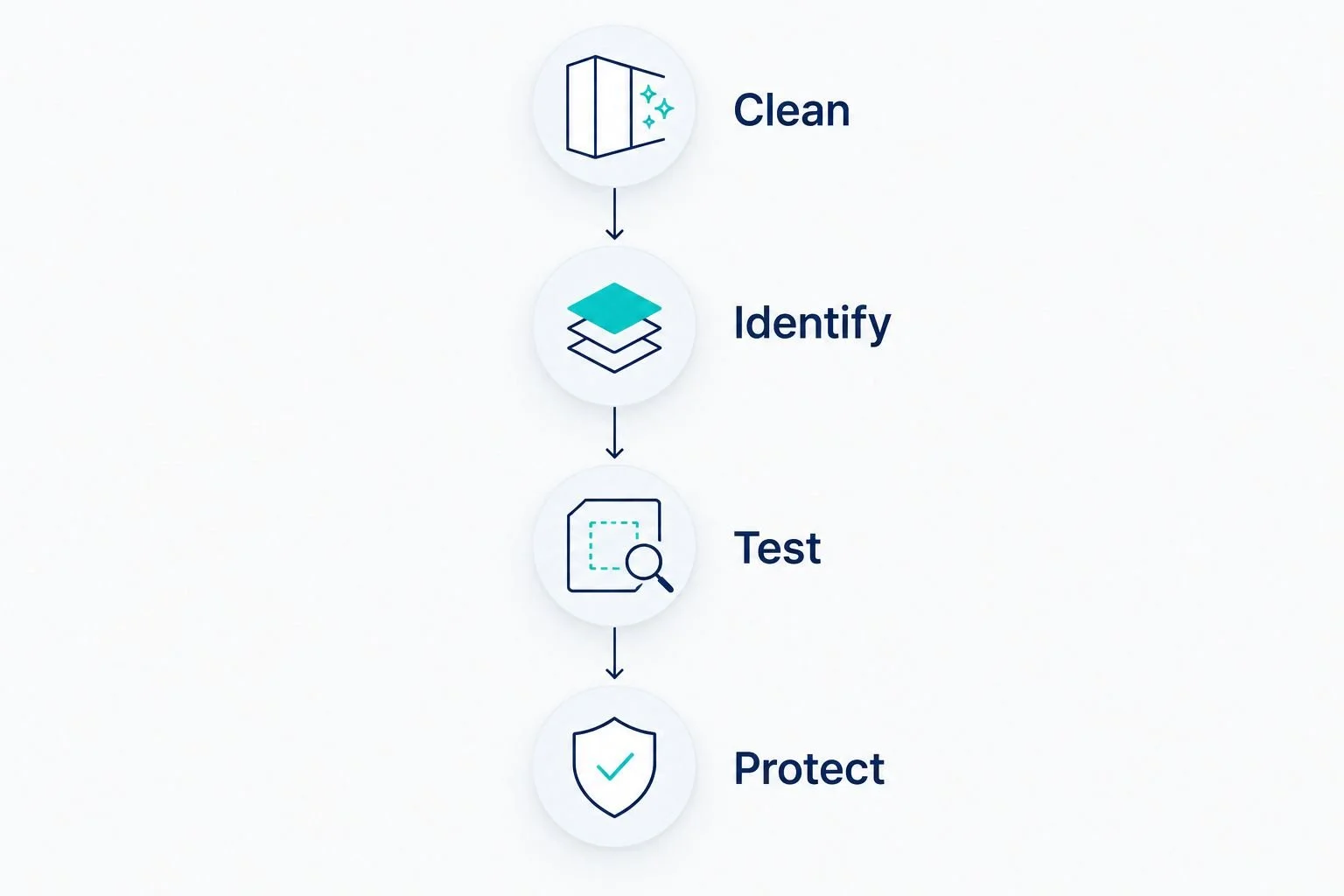
A test area comes before broad correction, not after it.
A test area is not a promise that every panel will match. It establishes a reference for discussing the remaining work and any areas that need different treatment.
Why does RV oxidation-removal work vary?
The scope depends on the surface and the condition of the RV, not simply its location in Sandy. These factors explain why a wash description alone cannot define an oxidation-correction job:
Finish type: Gelcoat, paint, clear coat, graphics, and trim require material-appropriate treatment.
Extent of deterioration: Light surface dullness and deeply weathered material do not present the same correction task.
Previous work: Earlier polishing, repainting, or applied coatings affect what the provider needs to establish before proceeding.
Panel condition: Cracks, peeling, and damaged edges limit what cosmetic work can address.
Access: Available working space, safe access around the RV, and site restrictions affect whether the proposed work is practical.
Expected result: Improving a weathered surface is different from agreeing to uniform gloss across mixed materials and repaired panels.
Ask for the intended result in plain language. “Improve chalky gelcoat on the sidewalls” is a clearer scope than “make the RV look new.” Have the provider identify exclusions rather than leaving them implicit.
Can wax alone fix chalky RV fiberglass?
Wax alone does not remove an oxidized surface layer. Some products combine cleaning or polishing ingredients with protection, but that does not make every wax application an oxidation-correction service.
A protective product can change how a surface looks without resolving the underlying condition. Ask what preparation is included, whether any abrasive correction is proposed, and how the provider will evaluate the result before applying protection.
For your 2026 maintenance plan, separate appearance correction from ongoing care. Once the surface is in suitable condition, compatible washing and protection support maintenance; they do not justify repeating aggressive polishing whenever the RV looks dirty.
Can every dull RV finish be polished back to gloss?
Not every dull RV finish is suitable for polishing. Failed coatings, badly deteriorated surfaces, and damaged graphics can require repair or replacement rather than additional abrasive work.
Ask the provider to stop and explain if the test area exposes a limitation. Accepting a limited improvement can be a better decision than removing more material in pursuit of a finish the surface cannot support.
No quote should treat hidden damage or unknown coating history as a guaranteed cosmetic outcome. Your useful benchmark is an agreed test result and a clearly described scope—not a promise of factory-new appearance.
What must you confirm for mobile detailing in Sandy?
Mobile service brings the work to your RV’s location, but the location still has to support the job. For Sandy owners booking in 2026, confirm access before setting an appointment, particularly at shared storage properties or managed RV sites.
Use this checklist when requesting service:
Site permission: Ask the property owner or manager whether mobile washing and detailing are permitted. Do not assume a parking agreement includes permission for service work.
Working space: Explain what is parked beside the RV and whether the provider can reach the affected sides. Send photos that show the surrounding space, not just the dull finish.
Utilities: Confirm whether water or electrical access is required and who provides it. Do not assume a mobile provider brings every utility needed for every service.
Wash-water arrangements: Ask how water and cleaning residue will be managed at the site, subject to property requirements and applicable rules.
Scheduling conditions: Ask how weather, direct sunlight, and the working surface affect the proposed process and appointment.
Travel and availability: Confirm service availability for your address and whether any travel fee applies before accepting the quote.
Trailhead RV’s mobile RV detailing serves owners in Davis, Weber, and Salt Lake Counties, with Layton as the primary base. Sandy is the focus here; confirm arrangements for your actual location, including nearby Draper or Midvale, rather than assuming identical access at every property.
Trailhead RV is best for RV owners seeking mobile washing and detailing within its three-county Utah service area. The convenience is having service come to your location; the limitation is that site suitability and the requested correction scope still need confirmation.
What should you send with a quote request?
Send photos of the whole affected side, a closer view of the dull area, and any peeling, cracking, or damaged graphics. Include the RV make and model, approximate length, Sandy service address, parking situation, and known history of repainting or polishing.
Describe what happens after washing. “The sidewall stays chalky when dry” tells the provider more than “needs detailing.” State whether you want appearance improvement for continued use or preparation for sale, without assuming either goal requires the same scope.
Ask for written confirmation of the affected areas, proposed preparation, correction work if offered, protective treatment, exclusions, access requirements, and any travel fee. Confirm the appointment only after those details match your needs.
Request a Sandy detailing quote
Describe the dull finish and confirm correction scope, site access, utilities, availability, and any travel fee.
FAQ
How do I know whether my RV needs oxidation removal in Sandy, Utah?
Persistent chalkiness or dullness after washing warrants an assessment for oxidation correction. Confirm the finish type and request a representative test area before approving full-panel work.
Will an RV wash and wax remove oxidation?
A wash and wax does not automatically include oxidation removal. Ask whether the service includes corrective polishing or only cleaning and protection.
Can polishing damage my RV decals?
Abrasive polishing can damage vinyl graphics and other sensitive exterior materials. Have the provider explain how graphics, trim, and adjacent surfaces will be treated or avoided.
Does Trailhead RV offer mobile detailing in Sandy?
Trailhead RV provides mobile RV washing and detailing throughout Salt Lake County, which includes Sandy. Confirm address-specific availability, oxidation-correction scope, site permission, utilities, and any travel fee before booking.
Do I need water and electricity for mobile RV detailing?
Utility requirements depend on the provider and the agreed work. Confirm whether water and electricity are needed and who will supply them before the appointment.
Can oxidation removal fix peeling clear coat?
Oxidation removal does not repair peeling clear coat. A failing coating needs a repair assessment rather than a promise that polishing will restore it.
How should I compare RV oxidation-removal quotes?
Compare the included surfaces, preparation, corrective work, protection, exclusions, and site requirements. Confirm that each quote addresses the same condition rather than comparing a basic wash with finish correction.
One last thing
Judge the test area dry. Water can temporarily disguise dullness, so a wet panel is a poor basis for approving the appearance of completed correction work.
Before accepting a 2026 detailing scope, ask to see the proposed result under comparable lighting. That simple check keeps the discussion focused on the finish you will actually live with after the appointment.
Related guides
About the author
Seth Garecht is the author of this Trailhead RV article. Trailhead RV is a veteran-owned mobile RV wash, detailing, and tank cleaning service serving Davis, Weber, and Salt Lake Counties in Utah.