
Before booking RV tank cleaning in Roy, Utah, report stuck sensor readings, odors after dumping, slow drainage, and whether the black tank, gray tank, or both are affected. Include any leaks or backed-up fixtures, plus your parking location and dump access, so the service request distinguishes cleaning needs from problems that require repair.
TL;DR
RV tank cleaning Roy Utah: report sensor readings, odors, drainage changes, and the affected tank before booking.
Trailhead RV provides mobile tank cleaning in Weber County; confirm site permission, utilities, service availability, and travel fees.
A tank monitor reading alone does not establish whether a holding tank is empty.
Report leaks and backed-up fixtures before scheduling cleaning; cleaning does not replace plumbing repair.
By Seth Garecht | 2026 owner checklist
RV tank cleaning in Roy, UT: what symptoms should you report?
Describe what happens before, during, and after dumping—not just that the tank needs cleaning. A monitor that stays on Full after discharge tells a different story from a tank that barely drains. Report both if both happen.
For a 2026 mobile-service request, start with the affected tank and the symptom you can actually observe. Use this checklist rather than guessing at the cause.
Monitor stays on Full after dumping
What to report before booking: Tank involved, displayed reading, and whether waste discharged normally
What the symptom does not establish: A full reading alone does not prove the tank still contains waste
Odor remains after dumping
What to report before booking: Where you smell it and when it appears
What the symptom does not establish: Odor alone does not identify buildup as the cause
Discharge slows or stops
What to report before booking: Whether flow starts normally, slows gradually, or never starts
What the symptom does not establish: Slow flow does not distinguish buildup from a valve or plumbing problem
Water backs up into a fixture
What to report before booking: Which fixture, recent use, and whether the associated tank was dumped
What the symptom does not establish: A backup does not confirm that cleaning is the appropriate service
Liquid appears beneath the RV
What to report before booking: Location and whether it appears during use or dumping
What the symptom does not establish: A leak should not be treated as a routine cleaning symptom
Trailhead RV is a veteran-owned mobile RV wash, detailing, and tank cleaning service serving Roy within Weber County. Trailhead RV mobile RV tank cleaning is best suited to owners seeking service at their RV’s location within the stated service area. Mobile service still depends on a workable, authorized site; it does not remove access or wastewater-disposal requirements.
Why this matters before you book
A useful symptom report helps separate a cleaning request from a repair concern. Deposits can interfere with some tank sensors, but electrical faults can also produce incorrect readings. Likewise, holding-tank odors do not automatically mean the tank needs a deeper clean.
Your role is to describe the behavior, not diagnose it. Instead of saying the sensor is broken, say that the black-tank monitor still reads Full after discharge and that the discharge appeared normal.
Keep safety separate from scheduling convenience. Stop adding water when a fixture is backing up, and report an active leak before arranging routine cleaning. Do not keep filling a tank to test a reading you already distrust.
Sensor stuck on Full: what details help?
A stuck reading is useful information only when paired with what happened during dumping. Note which tank the display identifies, the reading before discharge, and the reading afterward. Say whether the display changes at all during ordinary use.
Do not assume the monitor measures the entire interior condition of the tank. A reading is a signal from the monitoring system, not a view inside the tank.
Before booking, gather these observations:
Affected tank: Black, gray, or a separately labeled holding tank.
Displayed reading: Copy the wording or indicator shown on your panel.
Discharge behavior: Describe whether flow looked normal, weak, intermittent, or absent.
Recent change: Explain whether the reading became unreliable suddenly or has stayed unchanged across repeated use.
Previous action: List any rinse, treatment, or repair already attempted.
Report the reading without promising yourself that cleaning will fix it. Removing deposits and repairing a sensor circuit are different tasks. Ask what the proposed cleaning covers and what happens if the reading remains unchanged afterward.
A photo of the panel helps communicate the displayed reading. Keep that photo alongside your notes rather than relying on memory during the booking conversation.
Odors after dumping: where does the smell appear?
Describe the location before describing the strength. An odor near the toilet, beneath a sink, outside at the termination connection, or throughout the interior points the conversation toward different parts of the waste system.
Black tanks receive toilet waste. Gray tanks receive wastewater from fixtures such as sinks and showers, and that wastewater can also leave odor-producing residue. Do not label every holding-tank odor a black-tank problem.
Tell the service provider whether the odor appears:
After dumping or while the RV sits unused.
During toilet flushing or sink use.
Inside the RV, outside, or in a particular cabinet.
Only with ventilation equipment running.
Alongside slow drainage, a leak, or a backed-up fixture.
These observations support the service discussion without proving a cause. Tank cleaning addresses tank contents and buildup; it does not replace troubleshooting a failed seal, plumbing vent, or drain trap.
Avoid adding another treatment simply to cover the smell before the visit. Report what you have already used, follow the product label, and never mix cleaning chemicals.
Slow drainage: describe the flow, not just the delay
Say whether the problem occurs while a sink or shower drains into the gray tank, or while the holding tank discharges through the dump connection. Those are different locations in the system. A slow sink does not establish that the holding tank itself needs cleaning.
For a discharge problem, describe what happens when you operate the valve normally. Does flow begin strongly and taper off, remain weak throughout, or fail to start? Report resistance at the handle without forcing it.
Do not dismantle a termination fitting or force a valve to create a better symptom report. If you suspect retained waste behind a closed or obstructed valve, tell the provider before anyone opens the system.
Photos taken from outside the connection area can show valve placement, clearance, and visible obstructions. You do not need to expose yourself to wastewater to document the issue.
Why the right service varies
The same complaint can involve different parts of an RV waste system. A cleaning appointment should match the reported problem, the tank configuration, and the worksite—not just the phrase tank trouble.
Tank involved: Black- and gray-tank complaints need separate descriptions, even when they share a termination connection.
Symptom pattern: A stuck reading without drainage trouble differs from a backup or active leak.
Tank configuration: Report the labeled tanks and outlets on your RV rather than assuming all tanks share a connection.
Previous treatments: Identify products and attempted fixes so the provider knows what has already entered the system.
Physical access: Valve location, stored equipment, and parking clearance affect access to the connection.
Disposal arrangements: Confirm the wastewater arrangements required for the proposed work before the appointment.
These factors determine what needs discussion before booking. They do not establish a diagnosis or guarantee that cleaning will resolve the complaint.
Is routine flushing enough, or should you request cleaning?
Routine flushing, professional tank cleaning, and plumbing repair serve different purposes. Choose the next conversation from the symptom, not from an assumption that a more involved cleaning must solve everything.
Routine flushing
Best for: Owners following their RV manufacturer’s maintenance instructions
Useful role: Rinses the tank using the RV’s approved procedure
Limitation: Does not establish that deposits are removed or sensors work correctly
Professional tank cleaning
Best for: Owners reporting persistent tank-related buildup concerns
Useful role: Focuses the service request on cleaning the holding tank
Limitation: Does not replace valve, wiring, seal, or plumbing repair
Repair assessment
Best for: Owners reporting leaks, damaged components, or continuing faults
Useful role: Investigates a component or plumbing problem
Limitation: Does not automatically include tank cleaning
Read the guide to RV black tank cleaning: flushing versus professional service if you are deciding whether another rinse addresses your concern.
For a 2026 booking, ask the provider to explain the proposed scope in plain language. Confirm whether the request concerns the black tank, gray tank, or both, and whether any reported symptom falls outside that scope.
How do you prepare a useful mobile-service request in Roy?
Use the following sequence to organize the request. It keeps the problem description separate from the worksite details, making each easier to confirm.
Identify tank. Copy the tank label from your monitor or RV documentation. Say when you are unsure which tank serves a fixture.
Describe symptoms. Include the reading, odor location, drainage behavior, and any leak or backup.
List prior actions. Name treatments, rinsing attempts, and relevant recent repairs without guessing what they accomplished.
Confirm access. Describe the parking site, valve location, gate arrangements, and any permission requirements.
Request scope. Ask what service is proposed, what preparation is required, and which concerns need separate repair attention.
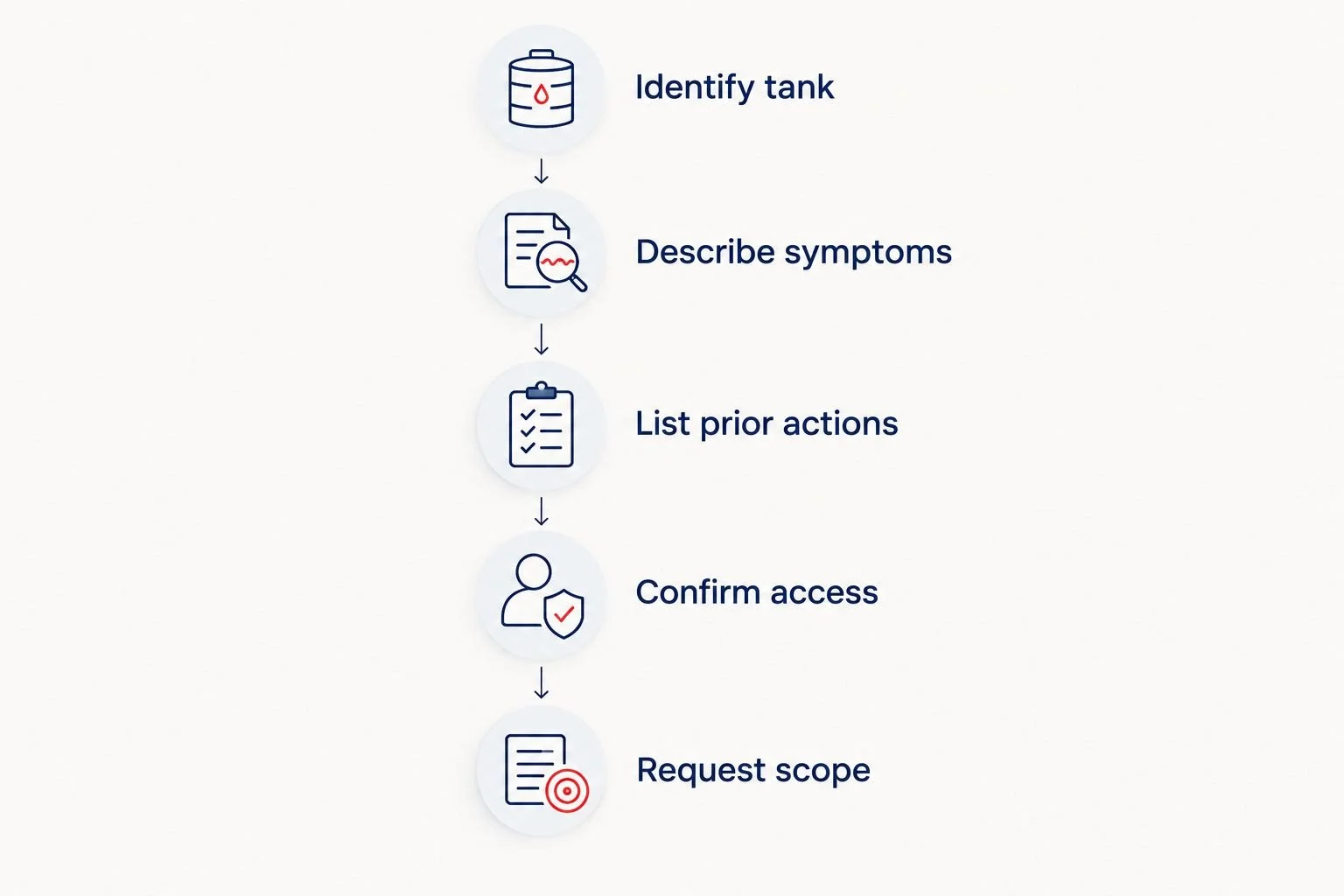
Describe the symptoms before confirming the worksite and proposed service.
You can send the information as a short message rather than a technical report. Include your RV make and model if known, the Roy location, the affected tank, what happens after dumping, and any urgent concerns.
Leave out conclusions you cannot verify. Saying that the tank drains slowly is more useful than declaring a blockage at a location you cannot see.
What must you confirm at your Roy parking location?
Roy is the primary location for this checklist. Trailhead RV’s stated mobile service area covers Weber, Davis, and Salt Lake Counties in Utah, with Layton as its primary base; nearby Weber County owners in Riverdale or West Haven should also confirm their specific site before booking.
Mobile means the service comes to the RV; it does not mean every parking location is suitable. A storage space, driveway, and campground can have different access conditions and property rules.
Before requesting a 2026 appointment, confirm:
Site permission: Ask the property owner or manager whether mobile tank service is allowed at the parked RV.
Access: Explain gates, appointment-entry requirements, obstacles, and clearance around the waste connection.
Utilities: Ask which utilities the proposed service requires and confirm whether they are accessible at the site.
Wastewater arrangements: Confirm the required disposal connection or other approved arrangements with the provider and property manager.
Service availability: Confirm the requested work and scheduling directly.
Travel fee: Ask whether a travel fee applies to your location; county coverage does not establish the fee.
Do not describe a shared dump point as usable until permission and access are confirmed. Also ask whether the RV must move before work begins. That question matters when the vehicle is stored behind other equipment or cannot readily be repositioned.
What should you ask when requesting a quote?
Ask for the proposed work, required preparation, and exclusions—not just an appointment slot. Trailhead RV mobile RV tank cleaning serves owners within the stated counties, but your request still needs confirmation of the individual site and service scope.
For your 2026 quote request, include this practical summary: your Roy location, affected tank, symptoms after dumping, prior treatments, connection photos, and known site restrictions. Ask whether cleaning is appropriate for the reported symptoms and whether a repair concern needs attention first.
Request a mobile tank-cleaning quote
Share your Roy location, tank symptoms, and access details; confirm scope, utilities, and any travel fee.
FAQ
What should I report before booking RV tank cleaning in Roy?
Report the affected tank, sensor reading, odor location, drainage behavior, and any leak or backup. Include your Roy parking location, prior treatments, and known access restrictions.
Does a Full reading after dumping mean my RV tank is still full?
A Full reading after dumping does not by itself prove the tank remains full. Report whether waste discharged normally and whether the monitor changed; deposits and monitoring-system faults require different consideration.
Can gray tanks cause odors after dumping?
Gray tanks can produce odors from wastewater residue. Describe where and when the smell appears, because an odor does not identify the tank or establish cleaning as the complete fix.
Should I book tank cleaning if wastewater is backing up?
Report a wastewater backup before booking routine tank cleaning and stop adding water to the affected system. The provider needs to understand the condition before confirming whether cleaning is appropriate.
Can Trailhead RV clean a tank where my RV is parked in Roy?
Trailhead RV provides mobile tank cleaning within Weber County, which includes Roy. Confirm service availability, site permission, required utilities, wastewater arrangements, and any travel fee for your specific location.
What should I ask before confirming a mobile tank-cleaning appointment in 2026?
Ask what the proposed tank cleaning includes, what preparation is required, and which reported problems fall outside the scope. Confirm access, utilities, disposal arrangements, scheduling, and any travel fee before booking.
One last thing
A better symptom description is more useful than a confident diagnosis. Before your 2026 service request, photograph the monitor and accessible connection area, then write down what happened during the last normal dump. Do not repeat a questionable dumping procedure just to gather evidence.
Keep that note for the booking conversation. The distinction between a false reading, restricted discharge, and an active leak belongs at the start of the request—not after an appointment is arranged.
Related guides
About the author
Seth Garecht is the author of this RV tank-cleaning booking checklist for owners in Roy, Utah.