
Which RV roof cleaning service protects against UV damage?
A dirty RV roof needs cleaning, but cleaning alone does not provide UV protection. For an RV in Layton, choose a service that identifies the roof material, follows its manufacturer's care instructions, and uses a separate UV treatment only when that manufacturer permits it; do not assume a roof wash includes a compatible protectant.
TL;DR
RV roof cleaning removes contamination; UV protection requires a separate, manufacturer-approved approach when applicable.
Trailhead-RV offers mobile washing and detailing in Layton; confirm roof work and treatment scope before booking.
Choose roof-material compatibility over an unsupported UV-protection promise.
Confirm site permission, utilities, service availability, and any travel fee before your appointment.
By Seth Garecht
Which RV roof cleaning service protects against UV damage?
Choose a roof-compatible cleaning service, not a generic wash advertised as UV protection. The useful distinction is between removing dirt and applying a treatment intended to protect a particular surface. A clean roof and a UV-treated roof are not interchangeable descriptions.
For your 2026 maintenance plan, ask the provider to separate the work into clear tasks. Roof cleaning, surface treatment, and repairs should not disappear into a vague promise to “protect everything.”
Manufacturer-directed roof cleaning
Best for: Owners whose roof needs routine cleaning
What it does: Removes dirt and surface contamination using compatible methods
Limitation: Washing alone does not establish UV protection
Cleaning with an approved protective treatment
Best for: Owners whose roof manufacturer permits that treatment
What it does: Adds the specified treatment after appropriate cleaning
Limitation: Suitability depends on the actual roof and product instructions
Repair or restoration assessment
Best for: Owners seeing cracks, separation, or damaged roof material
What it does: Establishes whether damage needs attention beyond washing
Limitation: Cleaning and protectant are not substitutes for repairs
These are service categories, not confirmed packages from a particular provider. Before choosing one, identify your roof and review its care instructions. The guide to RV roof cleaners for rubber roofs provides related cleaning context, but your roof manufacturer's instructions take priority over a general recommendation.
Why this matters
Roof grime is visible. Treatment compatibility is harder to judge from the driveway. A roof that looks brighter after washing does not, by appearance alone, demonstrate that a UV-protective layer was applied.
For Layton owners arranging mobile service, the immediate job is to define the problem. Are you trying to remove dirt, address chalky residue, protect a permitted surface, or investigate apparent damage? Those requests need different answers.
Do not buy a UV-protection claim without knowing what surface is being treated and what treatment is proposed. That question is more useful than asking whether the provider uses a “premium” cleaner.
Roof cleaning: best for removing contamination
Routine roof cleaning addresses accumulated dirt and surface deposits. The method should match the roof material and the manufacturer's instructions for cleaner, dilution, tools, and rinsing. More aggressive cleaning is not automatically better cleaning.
Ask how the provider will protect nearby surfaces and manage runoff. Cleaner and loosened dirt can travel down the RV's sides during rinsing, so roof work should be coordinated with the rest of the wash rather than treated as an isolated task.
A cleaning-only appointment has a clear advantage: it addresses dirt without adding an unnecessary treatment. Its limitation is equally clear. Do not describe cleaning alone as an added UV barrier.
If cleaning is all your roof's care instructions call for, a provider should be able to explain that without pushing an extra coating. You need the appropriate service, not the longest list of applications.
Approved protective treatment: best for compatible roofs
A protective treatment belongs in the quote only when it is suitable for your specific roof. Ask for the product name and written application instructions before authorizing it. The label should address the surface being treated and support the claimed purpose.
“Safe for RVs” is not a complete compatibility answer. An RV contains different materials, and an exterior product's suitability for one surface does not establish suitability for the roof membrane, roof coating, or sealants.
For a 2026 roof-treatment request, get these details in writing:
Roof material: What surface will receive the treatment?
Product identity: What exact treatment will be applied?
Compatibility: What manufacturer instructions support its use?
Preparation: What cleaning and drying does application require?
Aftercare: What restrictions or follow-up care does the label specify?
An approved treatment offers a defined purpose when the instructions support it. The trade-off is that it introduces another compatibility and application decision. Do not authorize it simply because the wash appointment is already booked.
Visible damage: best addressed before cosmetic treatment
Cracks, separated seams, torn material, or signs of water entry change the priority. These are not ordinary dirt-removal requests. Describe what you see and ask whether a qualified repair assessment is needed before washing or treatment.
A photo cannot establish the full condition of a roof, but it helps communicate the concern. Send existing photos taken safely from the ground or another secure position; do not climb onto the roof just to complete a quote request.
A cleaner roof is not proof of a sound roof. Likewise, a shiny finish does not establish that a leak path has been repaired. Keep cosmetic work and repair decisions separate.
When asking about mobile washing, do not assume roof inspection, leak diagnosis, resealing, or restoration is included. Each task needs its own confirmed scope and an appropriately qualified provider.
Why RV roof cleaning methods vary
The right method follows the RV, not a one-size-fits-all wash package. These factors explain why a provider needs more than your parking address:
Roof material: EPDM, TPO, fiberglass, and metal require care decisions based on their own manufacturer instructions.
Existing coatings: A previous coating introduces another set of compatibility requirements.
Surface condition: Ordinary dirt, persistent staining, and damaged material are different problems.
Seams and attachments: Vents, roof-mounted equipment, and sealed joints affect where and how cleaning tools can be used.
Application conditions: Cleaner and treatment instructions determine suitable weather, preparation, and drying conditions.
Site access: Safe equipment access, utilities, permission, and runoff arrangements affect whether mobile work can proceed.
Do not interpret a provider's request for these details as unnecessary paperwork. They establish what you are authorizing and help prevent an unsuitable service from being booked.
How to choose a mobile roof-cleaning service in Layton
Use this sequence before comparing quotes. It keeps the conversation focused on your roof rather than on broad package names.
Identify the roof. Check your RV records and roof manufacturer's care instructions. If the material is uncertain, say so rather than guessing from its color.
Describe the problem. Explain whether you see dirt, staining, residue, damaged material, or water-entry symptoms. Separate appearance concerns from repair concerns.
Confirm compatibility. Ask what cleaner and any proposed treatment will be used, and how their instructions match your roof.
Confirm site access. Give the actual parking location and explain permission, nearby obstacles, utility access, and any facility restrictions.
Approve written scope. Confirm included surfaces, treatment details, exclusions, service availability, and any travel fee before accepting the appointment.
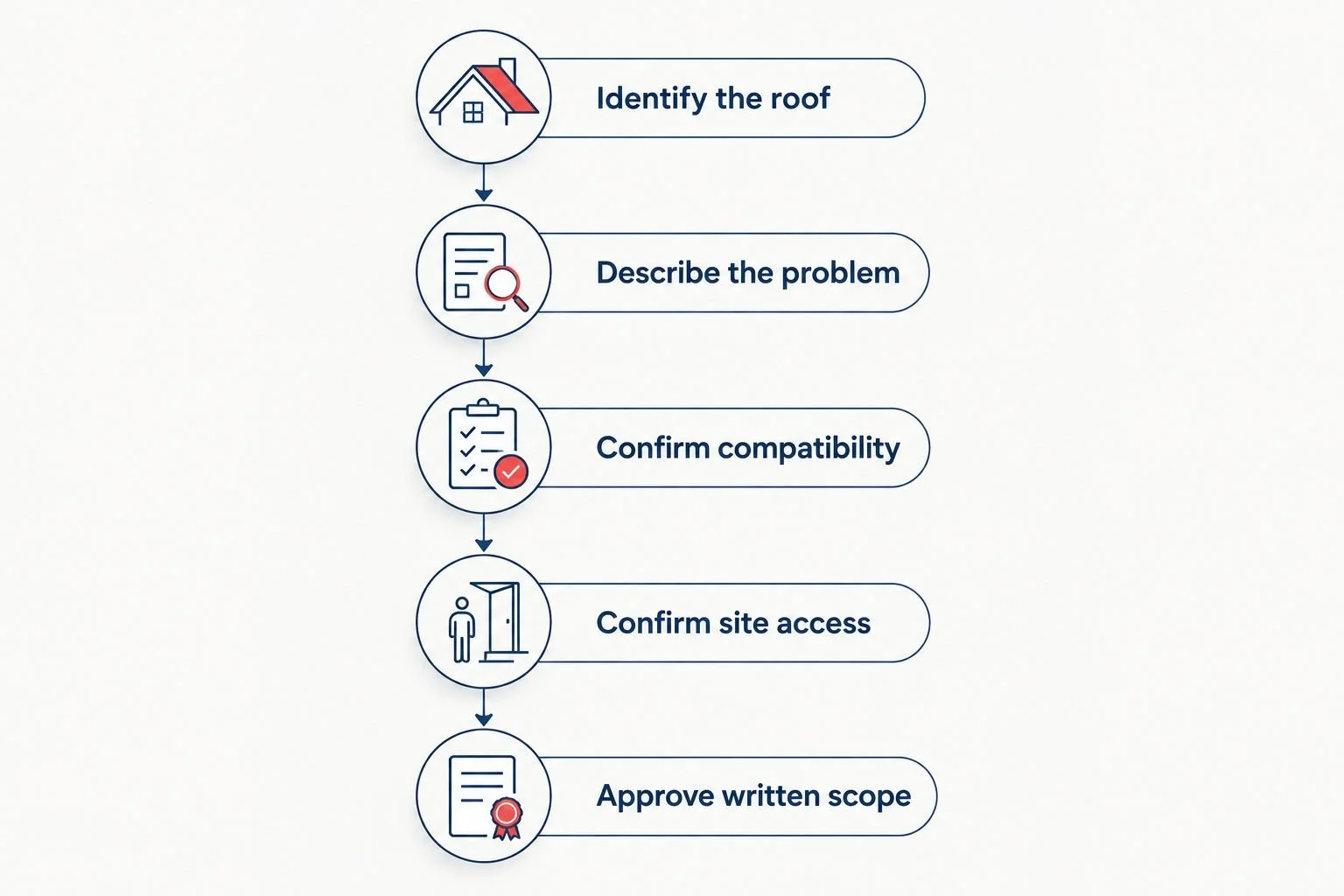
Confirm roof compatibility and site access before approving the work.
Keep your 2026 quote and the agreed product details with your RV maintenance records. That record is more useful for the next appointment than a receipt saying only “wash and protect.” It tells you what was actually authorized.
Mobile service in Layton: what to confirm
Trailhead-RV is a fit for Layton RV owners seeking mobile washing and detailing at their location. The veteran-owned business serves Davis, Weber, and Salt Lake Counties. Roof cleaning, roof treatments, and any related work still need explicit scope confirmation before booking.
For an RV parked in Layton or nearby Kaysville or Clearfield, give the actual service address when requesting a quote. A city name alone does not explain whether the RV is in a driveway, storage facility, or another managed property.
Confirm these practical details with the provider and property manager where applicable:
Permission for washing or detailing at the parking location.
Access around the RV and room for the provider's equipment.
Whether water or electrical access is required and who supplies it.
How washing runoff will be handled at that site.
Any gate, arrival, or access restrictions.
Appointment availability and whether a travel fee applies.
Mobile convenience removes the need to take your RV elsewhere for agreed work. It does not remove site restrictions. The mobile RV wash preparation guide offers a useful starting point for organizing access before the appointment.
What should I include in a roof-cleaning quote request?
Include the RV's location, roof material if known, the problem you want addressed, and whether you want cleaning alone or a discussion about a compatible treatment. Add the RV's make, model, and relevant care instructions so the provider can review the request.
For your 2026 request, use plain language: “My RV is parked in Layton. The roof has visible dirt, and I want to confirm the cleaning method and whether the manufacturer permits a UV treatment.” Add photos if you already have them safely available.
Ask Trailhead-RV to confirm whether the requested roof work is offered, what is included, and what access or utilities are needed. Request confirmation of availability and any travel fee rather than assuming either from the service-area description.
Request a Layton mobile-service quote
Share your roof concerns and parking details; confirm scope, access, utilities, and any travel fee.
Does every RV roof need an added UV treatment?
No. An added UV treatment is appropriate only when the roof manufacturer's instructions permit it and the proposed product matches the surface. Do not turn a general concern about sunlight into an automatic coating purchase.
Can a wash-and-wax package protect my RV roof?
A wash-and-wax package does not establish roof compatibility or UV protection by itself. Ask whether the roof is included, what product would be used there, and which instructions support that application; approval for a body panel is not approval for every RV surface.
FAQ
What's the best RV roof cleaning service for UV protection in Layton?
The best fit is a service that follows your roof manufacturer's cleaning instructions and offers a compatible UV treatment only when permitted. Confirm the actual product and roof scope before booking; a wash alone does not establish UV protection.
Does washing an RV roof prevent sun damage?
Washing removes dirt and contamination, but it does not by itself add a UV-protective layer. Follow the roof manufacturer's care instructions rather than treating a clean appearance as proof of protection.
Can I use RV body wax on a rubber roof?
Do not use RV body wax on a rubber roof unless the roof manufacturer and product instructions explicitly permit it. A product intended for the RV's body is not automatically suitable for its roof.
How often should I book RV roof cleaning?
Base the cleaning schedule on the roof manufacturer's instructions and the roof's actual condition. Do not accept a universal interval without checking those instructions and your storage conditions.
Does Trailhead-RV provide mobile service in Layton?
Trailhead-RV provides mobile RV washing and detailing in its service area, which includes Layton in Davis County. Confirm the requested roof work, appointment availability, site permission, utilities, and any travel fee before booking.
Can roof cleaning fix cracks or leaks?
Roof cleaning is not a repair for cracks, separated seams, or leaks. Describe those concerns before scheduling cosmetic work and arrange an appropriate repair assessment.
Can I book a mobile roof wash at my storage facility?
Book only after confirming that the facility permits the proposed work and that the provider can meet its access requirements. Utilities, equipment space, runoff arrangements, and appointment access also need confirmation.
One last thing
For your 2026 roof-care plan, ask one final question: “What exactly makes this treatment appropriate for my roof?” A useful answer identifies the roof material, the product, and the instructions supporting its use. A generic promise about UV protection does not answer the question.
Related guides
About the author
Seth Garecht is the author of this RV roof-care guide for owners in Layton and the surrounding mobile-service area.