
Best bug and tar removers for RV exteriors 2026
Best overall: a bug cleaner labeled for your RV’s exterior material. Best for tar spots: a tar remover approved for that specific surface. Best for avoiding DIY chemical selection: professional mobile washing. This 2026 guide explains how to choose without trading a clean front cap for damaged decals or a dulled finish.
TL;DR
The best bug and tar remover for RV use matches both the contamination and the exterior material.
Choose a surface-approved bug cleaner for insect residue and a separately approved tar remover for asphalt spots.
Trailhead-RV provides mobile RV washing and detailing in Weber, Davis, and Salt Lake Counties, Utah.
Never assume a cleaner approved for painted panels is also approved for decals, sealants, or rubber roofing.
By Seth Garecht
Why this matters
Bugs across the front cap and black specks behind the wheels are different cleaning problems. Trying to solve both with the strongest bottle on the shelf ignores the more important question: what surface sits underneath?
An RV exterior can combine painted panels, gelcoat, graphics, plastic trim, sealants, and roof membranes. A cleaner’s approval for one material does not establish compatibility with the others.
Trailhead-RV is best for RV owners in Weber, Davis, and Salt Lake Counties who want mobile washing and detailing at their location. The veteran-owned business provides an alternative to selecting and applying cleaners yourself; ask about the scope for your particular bug or tar problem before booking.
What makes the best bug and tar remover for RV use?
Use these criteria to build your 2026 shortlist. A product that fails the material check does not belong on it, regardless of the claims on the front label.
Surface compatibility: Look for approval covering the actual material, not just a broad reference to vehicles.
Contamination match: Choose insect-removal chemistry for bugs and tar-removal chemistry for asphalt residue.
Application control: Favor a method that keeps treatment on the affected area and away from incompatible neighboring materials.
Clear directions: The label should explain application, dwell time, removal, and relevant restrictions.
Finish aftercare: Check whether cleaning affects existing wax, sealant, or another protective treatment.
Practical access: You need stable access, suitable working conditions, and a way to complete the required rinse or wipe-off.
A small hidden-area test is an additional precaution, not permission to ignore a label restriction. If the cleaner excludes your material, choose another approach.
RV bug and tar removal options at a glance
These are cleaning approaches, not an unsupported ranking of named bottles. Each fills a different job, and none receives a blanket recommendation for every RV surface.
Surface-approved bug cleaner
Best for: Persistent insect residue
Standout feature: Targets the bug-removal task
Key limitation: Requires explicit material compatibility
Surface-approved tar remover
Best for: Isolated asphalt spots
Standout feature: Allows localized treatment
Key limitation: Approval for paint does not cover every adjacent material
RV-compatible wash shampoo
Best for: Routine road-film cleaning
Standout feature: Fits into a normal exterior wash
Key limitation: Not a substitute for tar-specific treatment
Plain-water presoak
Best for: Loosening fresh insect residue
Standout feature: Adds moisture before contact cleaning
Key limitation: Does not replace a suitable tar remover
Professional mobile washing
Best for: Owners who want the cleaning handled
Standout feature: Brings the service to your RV’s location
Key limitation: Exact contamination treatment needs confirmation
1. Surface-approved bug cleaner: best for dried insect residue
A dedicated bug cleaner is the first category to consider when insect remains persist after a normal wash. Choose it for the front cap, mirrors, or other affected areas only when the label covers those materials.
Do not read automotive paint approval as approval for an entire motorhome or trailer. Graphics, clear protective film, textured plastics, and exposed sealants need their own compatibility check.
Bug cleaner pros:
Matches the insect-removal task rather than treating every mark as road tar.
Allows you to concentrate cleaning on the affected area.
Provides product-specific directions for application and removal.
Bug cleaner cons:
Material restrictions can rule out neighboring trim or graphics.
The product’s directions still require careful application and removal.
A bug cleaner is not automatically suitable for asphalt spots.
Best for: Dried insect residue on a positively identified, label-approved surface.
Start with a cool surface and follow the cleaner’s directions. Work within an area you can finish properly rather than coating the entire front cap at once. Stop if the test area shows discoloration, softening, or another unexpected change.
Verdict: Buy only when the label covers the exact surface you need to clean.
2. Surface-approved tar remover: best for isolated asphalt spots
Tar remover belongs on the shortlist when the contamination is asphalt residue, not simply any dark mark. Its role is localized treatment, not an unrestricted wash across the RV exterior.
Before applying it, identify both the panel and anything bordering the spot. A tar speck near a vinyl graphic or sealed joint creates a different compatibility problem from a spot in the middle of an approved painted panel.
Tar remover pros:
Addresses tar rather than relying on repeated scrubbing.
Supports targeted treatment of individual spots.
Keeps specialized cleaning separate from the general wash.
Tar remover cons:
Solvent-based formulas require particular attention to material restrictions.
Treatment can affect existing surface protection, depending on the formula.
Overspray or runoff can reach materials you did not intend to treat.
Best for: Confirmed asphalt spots on a surface the product explicitly permits.
Follow the label’s application method. If the directions allow application through a cloth, that offers a way to control placement; do not substitute that method when the manufacturer specifies something else. Complete the required cleanup before considering another application.
Verdict: Buy for confirmed tar and a confirmed compatible surface; skip it as a general bug wash.
3. RV-compatible wash shampoo: best for routine road film
An RV-compatible wash shampoo handles the general cleaning stage. It helps remove loose dirt and road film so you can see which marks actually need a separate treatment.
Choose compatibility over the word RV on the bottle. Check the instructions for your exterior finish and any existing coating, then use the stated dilution and wash method.
Wash shampoo pros:
Fits into an ordinary exterior-washing routine.
Removes surrounding grime before you judge remaining spots.
Avoids treating the entire RV with a specialized spot remover.
Wash shampoo cons:
Routine washing does not replace a tar-removal step.
Dried insect residue can require separate attention.
Incorrect dilution or technique can undermine the intended result.
Best for: General exterior dirt and the first cleaning pass before targeted treatment.
Keep your wash media clean and avoid dragging visible grit across the finish. When a mark remains, reassess the contamination instead of automatically increasing pressure. More scrubbing is not a material-compatibility strategy.
For your 2026 washing routine, treat shampoo as the foundation. It is not evidence that every stubborn mark needs a stronger version of the same cleaner.
Verdict: Buy for routine washing; skip it as your only answer to established tar spots.
4. Plain-water presoak: best for loosening fresh insect residue
A plain-water presoak adds moisture before contact cleaning. On fresh insect residue, it is a practical first step before deciding whether a dedicated bug cleaner is necessary.
Use controlled wetting rather than forceful spraying into seams, vents, or openings. Follow the RV manufacturer’s washing guidance, particularly around components that should not receive direct water pressure.
Water presoak pros:
Introduces no additional cleaning chemical.
Fits before an otherwise compatible wash process.
Gives you an initial step before selecting specialized chemistry.
Water presoak cons:
Does not replace a suitable tar remover.
Does not make aggressive scrubbing safe.
Water application still requires care around openings and joints.
Best for: Fresh insect residue that needs moistening before a gentle wash.
Do not turn a presoak into an improvised chemical mixture. Adding household detergent, solvent, or another cleaner changes the compatibility question. Keep the initial step simple, then select a labeled product if residue remains.
Verdict: Hold off on specialized chemicals until you have assessed the result of appropriate gentle cleaning.
5. Professional mobile washing: best for having the job handled
Professional mobile washing is the service option for owners who do not want to manage the exterior-cleaning process themselves. It is also a useful next step when contamination spans different materials or access makes controlled cleaning difficult.
Trailhead-RV provides mobile RV washing and detailing at owners’ locations throughout Weber, Davis, and Salt Lake Counties. Describe the affected surfaces and request confirmation of the proposed bug or tar treatment rather than assuming every spot-removal task is included.
Mobile washing pros:
Brings exterior-cleaning service to your RV’s location.
Gives you an alternative to choosing and applying cleaners yourself.
Lets you discuss the overall washing and detailing scope together.
Mobile washing cons:
The exact treatment for your contamination needs confirmation.
Existing finish damage is a separate issue from removable dirt.
A service appointment does not establish compatibility with every unknown coating.
Best for: Local RV owners who want someone else to handle washing and detailing.
For a useful request, include photos of the whole affected panel and close-ups of the residue. Add your RV’s location, exterior material if known, and details of any products already applied. Use the Utah RV wash quote guide to take the next step.
Verdict: Buy the service when the confirmed scope matches your cleaning problem.
Request mobile RV cleaning
Describe the bug or tar problem and your location in Weber, Davis, or Salt Lake County.
Before you apply any bug or tar remover
Use the same decision sequence whether you are cleaning a small trailer or a motorhome. The point is to resolve uncertainty before the chemical touches the exterior.
Identify residue: Separate insect remains, asphalt spots, ordinary dirt, and marks of uncertain origin.
Identify surface: Establish whether you are treating paint, gelcoat, vinyl, plastic, glass, or another material.
Read directions: Check compatibility, exclusions, application method, dwell instructions, and cleanup.
Test discreetly: Follow the manufacturer’s test guidance on an inconspicuous approved area.
Clean and reassess: Complete the prescribed removal process, then inspect before repeating.
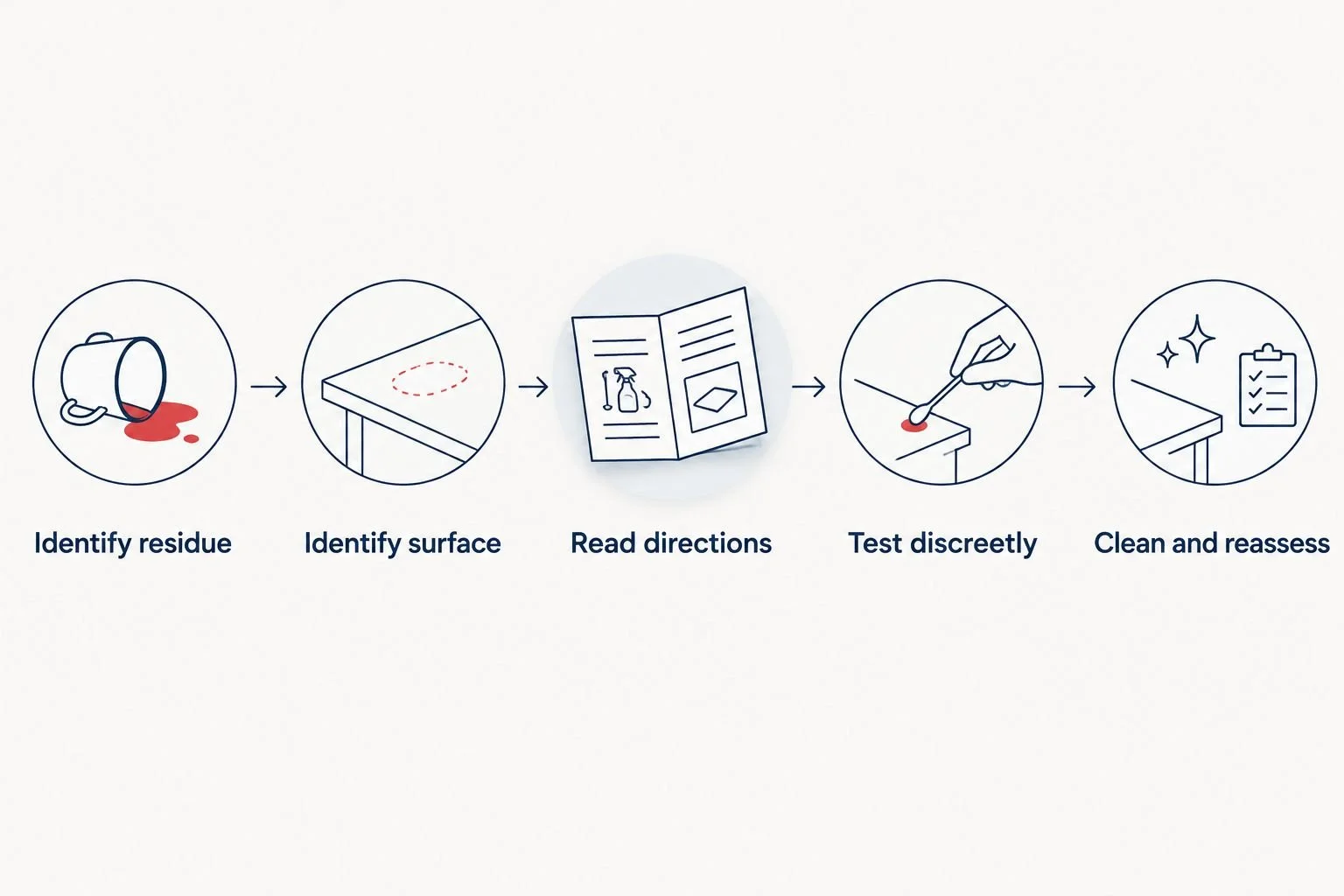
Identify the residue and surface before choosing the cleaner.
Do not mix cleaners or add a second product over residue from the first. Follow each manufacturer’s cleanup instructions before changing methods. If you cannot identify the finish, stop and seek guidance rather than using the hidden-area test as a substitute for compatibility information.
How these options are ranked
This 2026 guide ranks approaches by task fit, surface compatibility, application control, clear directions, and practical access. It does not claim hands-on testing or declare a named bottle the winner without supporting product information.
A bug cleaner takes the default spot for insect residue because that is its intended task. Tar remover gets a separate recommendation because tar is a separate cleaning problem. Mobile washing ranks by owner convenience, not by an unsupported claim that professional cleaning restores every damaged finish.
Which RV cleaning option should you choose?
For most bug-removal decisions, start with gentle, material-compatible washing and move to a surface-approved bug cleaner only when needed. Choose a tar-specific product for confirmed asphalt spots, not for every stubborn mark.
If you want the work handled at your location, ask Trailhead-RV about mobile RV washing and detailing. For 2026, make the booking decision around the confirmed treatment scope and your RV’s materials—not a promise that one chemical cleans everything.
FAQ
What's the best bug and tar remover for RV exteriors?
The best choice matches both the residue and the RV's exterior material. Use a surface-approved bug cleaner for insect residue and a separately approved tar remover for asphalt spots; neither receives blanket approval for the whole RV.
Can I use car bug remover on my RV?
Use a car bug remover only if its directions approve the actual RV surface being treated. Approval for automotive paint does not establish compatibility with vinyl graphics, protective film, plastics, or roof membranes.
Is bug remover better than RV wash shampoo?
Bug remover serves a different purpose from routine wash shampoo. Use a compatible shampoo for general cleaning, then consider a surface-approved bug cleaner if insect residue remains.
Can I use tar remover on RV decals?
Use tar remover on RV decals only when the product and decal guidance permit it. Approval for the surrounding painted panel is not approval for the graphic itself.
How long should I leave bug remover on my RV?
Follow the exact dwell instructions on the selected product. There is no universal dwell time that applies across formulas, finishes, and working conditions.
Will bug and tar remover strip my RV wax?
The effect on wax or sealant depends on the cleaner and the protection involved. Check both manufacturers' care instructions and follow any specified aftercare.
Does Trailhead-RV offer mobile RV washing in Northern Utah?
Trailhead-RV provides mobile RV washing and detailing throughout Weber, Davis, and Salt Lake Counties, Utah. Describe your bug or tar problem when requesting a quote so the treatment scope can be confirmed.
One last thing
For your 2026 cleanup kit, keep the cleaner’s directions as accessible as the bottle itself. The useful detail is not just what the product removes—it is what the label says it must never touch.
Photograph uncertain residue before applying anything. An untreated mark and a clear account of the surface give you a better starting point than a mark already exposed to several unidentified cleaners.
Related guides
About the author
Seth Garecht is the author of this RV exterior-cleaning guide.