
RV tank cleaning cost benchmarks by tank configuration 2026
Choosing between a single and a double tank cleaning comes down to how many tanks you need serviced and how often. Trailhead RV Wash & Service sells four tank cleaning options in 2026: Single, Double, Tank Care Plus and Year-Round. Current prices are confirmed at quote time, so this page benchmarks the options by what each covers, not by dollar figures that go stale.
By Seth Garecht, Trailhead RV Wash & Service
TL;DR
RV tank cleaning cost single vs double depends on tank count: Single covers one tank, Double covers two.
Trailhead RV offers four tank options in 2026: Single, Double, Tank Care Plus and Year-Round.
Pick Double if both black and gray tanks show sensor or odor problems.
Pick a plan if you camp often and want tanks maintained on a schedule.
Service is mobile across Weber, Davis and Salt Lake Counties, Utah.
Why this matters in 2026
Sensors stuck on Full. Odors after dumping. A black tank that never reads empty. These are the symptoms that send RV owners shopping for a tank cleaning, and the first question is always the same: what does it cost, and do I need one tank done or two?
The honest answer to the cost question is that a price quoted on a web page is only useful on the day it was written. Tank cleaning rates change, and rates from another city do not carry over to Utah. What does not change is the structure of the options. That structure is what you can benchmark, and it is what decides your final bill.
Short answer: a Single service cleans one tank, a Double service cleans two, and the two plans (Tank Care Plus and Year-Round) spread the work across the season. For the exact current rate in your county, request a quote from Trailhead RV Wash & Service.
The benchmark table: tank cleaning options compared
This table compares the four options Trailhead RV offers in 2026 on the dimensions that decide cost: how many tanks are covered, how the service is billed, and who it fits.
Single
Tanks covered: One tank
Billing style: One-time visit
Best for: A single problem tank, such as a black tank with a stuck sensor
Double
Tanks covered: Two tanks
Billing style: One-time visit
Best for: Black and gray tanks that both smell or misread
Tank Care Plus
Tanks covered: Ongoing tank care
Billing style: Annual plan
Best for: Owners who camp several times a season and want a set schedule
Year-Round
Tanks covered: Ongoing tank care
Billing style: Monthly plan
Best for: Full-timers and frequent travelers who use their tanks all year
The table has no dollar column on purpose. Prices are confirmed at quote time so the number you see is the number that applies to your rig, location and visit date.
What the table says: where each option wins and loses
Single is the narrowest option and the lowest-commitment entry point. It wins when one tank is the problem. It loses when you clean the black tank, then find the gray tank is the source of the smell two weeks later and have to book a second visit.
Double is the better fit when both tanks are in play. Owners who dump both tanks on every trip usually build up residue in both. Cleaning them in one visit means one trip fee instead of two stops.
The plans, Tank Care Plus and Year-Round, trade a one-time job for a recurring one. They win for owners who would otherwise let tanks drift until sensors fail again. They lose for the owner who camps twice a year and stores the rig the rest of the time.
Verdict: if you are unsure, a Double visit answers more questions than a Single one, because it clears both tanks and shows you which one was actually causing the trouble.
How the data was built, and what it cannot tell you
The table is built from Trailhead RV's own service structure for 2026: tank count, billing style and intended use. It reflects options offered in Weber, Davis and Salt Lake Counties, Utah.
One limitation matters. It does not show prices, visit length or results per rig. Tank size, how long residue has been building and how accessible the dump valve is all change the job, and none of that can be benchmarked without inspecting the RV. Treat the table as a map of options, not a quote.
Why tank count is the main cost driver
A holding tank is not just a bucket. Waste, toilet paper, soap and grease coat the walls and the sensor probes over time. When the probes are coated, the monitor panel reads Full when the tank is half empty, or never reads empty at all.
That is why cost scales with tanks serviced. Each tank has its own walls, its own sensors and its own dump path. Cleaning two tanks is roughly two jobs of the same kind, which is why the Double option exists as its own line item rather than as a discount on Single.
Black tank versus gray tank
Black tank: toilet waste. The usual source of odor and sensor trouble.
Gray tank: sink and shower water. Grease and soap film build up and can smell once the tank sits warm.
Both together: the typical case for a rig that has not had tank service in a full season.
If your only complaint is a sensor reading, start by checking what is causing the false reading. The guide on tank treatments for sensor false readings covers when a treatment is enough and when a professional cleaning is the next step.
Do-it-yourself flushing versus a professional visit
A campground rinser or a wand flush moves loose material out. It does not reliably remove stuck-on residue from the tank walls or the sensor probes. Many owners flush, see the sensors still misreading, and conclude the sensors are broken, when the probes are simply coated.
A professional visit uses a hydro-jet through the dump valve to reach walls and sensors. That is the difference between the two, and the reason the service exists. The full comparison is in this guide on black tank flushing versus professional cleaning.
Treatments help between cleanings. They do not replace one. For odor in particular, see the guide to black tank treatments for odor control.
How to use these benchmarks
Count your problem tanks. One problem tank points to Single. Two points to Double.
Count your trips. A few trips a season points to a one-time visit. Frequent or full-time use points to Tank Care Plus or Year-Round.
Ask for the current rate. Quote the exact option you want, with your RV type and location, so the figure is current.
Choose by cause, not by price alone. A cheaper Single visit that leaves the second tank untouched can cost more once you book again.
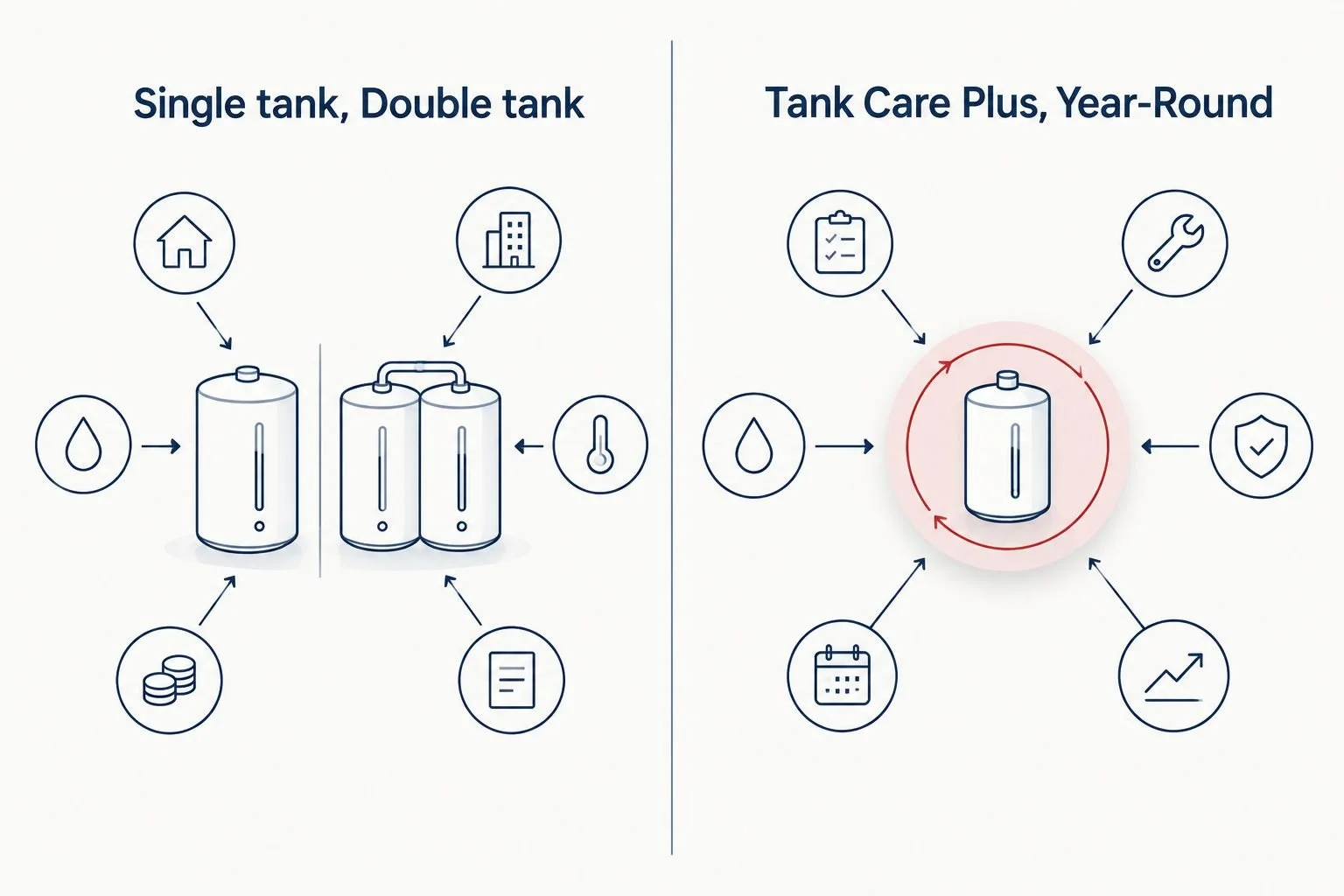
One-time visits fix a current problem; plans prevent the next one.
The split above is the simplest way to decide. One-time visits solve the problem you have today. Plans keep it from coming back.
What mobile service changes
Trailhead RV is veteran-owned and comes to your location in Weber, Davis and Salt Lake Counties. You do not tow the rig to a shop or wait in a service bay. That matters for tank work, because a full tank is the last thing you want to haul across town.
Prepare the rig before the visit: park with clear access to the dump valve, and leave a path for the technician. The checklist is in the guide on preparing for a mobile RV wash in Northern Utah.
Pros and cons of each option
Single
Pro: lowest commitment, fixes one known problem.
Con: leaves the other tank untouched. You may need a second visit.
Verdict: Buy when only one tank misbehaves.
Double
Pro: clears both tanks in one visit.
Con: more than you need if only one tank has a problem.
Verdict: Buy when you have not had tank service in a full season.
Tank Care Plus
Pro: scheduled care helps stop buildup before sensors fail.
Con: an annual commitment is wasted on a rig that rarely leaves storage.
Verdict: Buy if you camp across most of a season.
Year-Round
Pro: monthly billing fits owners who use the rig all year.
Con: more than a weekend camper needs.
Verdict: Buy if you live in the RV or travel in every season. Skip it if the rig sits.
Get your current tank cleaning rate
Tell us your tank setup and county. We quote the exact option you need.
FAQ
What is the difference between single and double RV tank cleaning?
Single cleans one tank. Double cleans two. Choose Double when both your black and gray tanks smell or misread.
How much does RV tank cleaning cost in Utah in 2026?
The rate depends on the option you choose and your rig. Trailhead RV confirms current pricing at quote time instead of publishing figures that go stale.
Is a double tank cleaning worth it over a single?
Yes, when both tanks have gone a season without service. One visit covers both and shows which tank was causing the problem.
Does Trailhead RV come to my location?
Yes. Trailhead RV is a mobile service covering Weber, Davis and Salt Lake Counties in Utah.
Can a tank treatment replace a professional cleaning?
No. Treatments help between cleanings, but they do not remove stuck-on residue from tank walls and sensor probes.
Which option fits a full-time RV owner?
Year-Round fits owners who use their tanks in every season. Tank Care Plus fits owners who camp across most of a season.
One last thing
If your sensors misread right after a dump, the tank is probably not full. The probes are coated. Cleaning the tank walls fixes the reading, which is why a sensor complaint is one of the most common reasons to book a service in 2026. Start with a quote at Trailhead RV Wash & Service and name your symptoms.
About the author
Seth Garecht writes for Trailhead RV Wash & Service, a veteran-owned mobile RV wash, detailing and tank cleaning service serving Weber, Davis and Salt Lake Counties in Utah.