
Best water spot removers for RV exteriors 2026
Best for confirmed mineral deposits: a remover explicitly approved for your RV’s finish; best for fresh residue: RV wash shampoo. This 2026 guide explains when those options fit, when glass needs separate treatment, and when to request mobile washing or detailing from Trailhead-RV.
TL;DR
The best water spot remover for RV exteriors matches the affected surface, not just the stain.
Choose RV wash shampoo for fresh residue before moving to a mineral-removal product.
Use glass-specific water spot remover only where the label permits; protect neighboring finishes.
Trailhead-RV offers mobile RV washing and detailing in Weber, Davis, and Salt Lake Counties, Utah.
By Seth Garecht
Why this matters
You wash the RV, let it dry, and the white rings are still there. More soap is not automatically the answer: the marks might be mineral deposits, leftover wash residue, or damage that cleaning alone cannot remove.
Your RV also has several surfaces close together. A product suitable for a window is not automatically suitable for the decal underneath it, the painted panel beside it, or the seal around it.
Choose the surface first and the remover second. That rule matters more than a strong-acid claim, a dramatic demonstration, or the word RV on a bottle.
This guide ranks treatment categories by the problem they address rather than naming an unsupported bottle winner. You get a practical way to narrow the choice without treating every mark as the same problem.
What makes the best water spot remover for RV exteriors?
For your 2026 cleanup, use these criteria before choosing a treatment:
Surface approval: The label must cover the actual surface, including any coating or film over it.
Problem match: Fresh wash residue, mineral deposits, and etched marks require different responses.
Neighboring-material compatibility: Check instructions for decals, seals, trim, and nearby metal before allowing contact or runoff.
Controlled application: Look for instructions you can follow on a cool surface without letting the product dry unexpectedly.
Clear stopping point: A useful treatment has defined directions, not an open-ended instruction to keep scrubbing.
A cleaner does not become suitable for the entire RV because it worked on one window. Likewise, a finish-safe product still needs a small, inconspicuous test before broader use.
Water spot treatments at a glance
Finish-approved mineral remover
Best for: Confirmed mineral rings on an approved exterior finish
Standout feature: Targets deposits rather than general dirt
Key limitation: Approval varies by surface and coating
RV wash shampoo
Best for: Fresh residue and the first cleaning pass
Standout feature: Cleans the surface before stronger treatment
Key limitation: Does not address every mineral deposit or etched mark
Glass-specific water spot remover
Best for: Deposits on approved exterior glass
Standout feature: Addresses a defined glass-cleaning problem
Key limitation: Glass approval does not establish compatibility with adjacent materials
Finish-approved polish
Best for: Persistent marks after deposits are removed
Standout feature: Addresses the finish rather than dissolving deposits
Key limitation: Abrasive correction removes material and needs careful control
Professional exterior detailing
Best for: Owners who need help identifying the problem
Standout feature: Moves the decision beyond choosing a bottle
Key limitation: Scope and suitability need confirmation before booking
The table is a decision guide, not a claim that every RV needs every treatment. Stop when the least aggressive suitable approach resolves the problem.
1. Finish-approved mineral remover: best for mineral rings
A mineral remover is the relevant category when dried water has left deposits on an otherwise clean surface. Choose a product whose instructions explicitly cover the affected finish; do not extend glass-only approval to painted or fiberglass panels.
A gelcoat surface, a painted surface, and an applied protective coating are not interchangeable. Confirm what you have before treating a large area.
Mineral remover pros:
Addresses mineral deposits rather than only loose dirt.
Allows localized treatment instead of coating the entire RV.
Provides a nonabrasive treatment route when the approved product is nonabrasive.
Mineral remover cons:
Surface approval can exclude nearby materials.
Dissolving deposits does not repair etching beneath them.
Application and rinse requirements differ between products.
Best for: Visible mineral rings on a surface covered by the product’s instructions.
Follow the specified application, dwell, removal, and rinse directions exactly. If those directions are unclear, choose another product or ask the manufacturer before use.
Verdict: Buy only after confirming approval for the exact finish.
2. RV wash shampoo: best for fresh residue
RV wash shampoo belongs first when you have not yet established what the marks are. Washing removes general dirt and gives you a cleaner surface to examine; it also avoids treating loose contamination as a polishing problem.
Choose a shampoo approved for the surfaces you intend to wash. Follow its dilution and rinsing instructions rather than making the mixture stronger to attack stubborn spots.
RV wash shampoo pros:
Provides a sensible first cleaning step.
Removes loose dirt before targeted treatment.
Helps distinguish remaining marks from ordinary wash residue.
RV wash shampoo cons:
General washing does not resolve every mineral deposit.
Incomplete rinsing can leave product residue.
It cannot restore a finish damaged by etching.
Best for: Recently formed marks, uncertain residue, and routine exterior washing.
Work in manageable sections so you can rinse and dry as directed. Do not judge the remaining spots while the panel is wet; inspect the clean, dry surface.
Verdict: Buy as the first cleaning step, not as a guaranteed mineral-removal treatment.
3. Glass-specific water spot remover: best for exterior glass deposits
Exterior windows need their own compatibility check. A glass-specific remover can fit mineral deposits on approved glass, but the window assembly also includes seals, trim, and sometimes applied films or coatings.
Check the window manufacturer’s care instructions alongside the cleaner’s label. Do not assume that a product for household shower glass is suitable for every RV window.
Glass-specific remover pros:
Keeps the treatment focused on the affected glass.
Offers directions written for a defined surface category.
Avoids assuming a body-panel cleaner also suits windows.
Glass-specific remover cons:
Some window treatments require separate care instructions.
Runoff can reach materials outside the product’s approval.
A deposit remover does not necessarily correct etched glass.
Best for: Confirmed deposits on exterior glass explicitly covered by the instructions.
Keep application controlled and follow the stated precautions for adjacent materials. If the window’s coating or film is unknown, pause rather than testing a strong cleaner in a visible area.
Verdict: Buy for approved glass only; skip whole-RV application.
4. Finish-approved polish: best for marks left after cleaning
A polish serves a different purpose from a deposit remover. Abrasive polishing changes the surface by removing material, so it belongs after cleaning and diagnosis—not as the automatic response to white rings.
Persistent dullness also deserves a separate assessment. The guide to RV washing, waxing, and dull exterior finishes covers that broader appearance problem.
Finish-approved polish pros:
Provides a correction route when cleaning is no longer the issue.
Supports localized work when the finish permits it.
Separates surface correction from deposit removal.
Finish-approved polish cons:
Abrasive correction removes finish material.
Decals, edges, and unfamiliar coatings complicate the work.
Repeated passes without a diagnosis risk unnecessary abrasion.
Best for: Persistent marks assessed as suitable for finish correction.
Do not choose a more aggressive compound simply because a mineral remover failed. Failure can mean the diagnosis was wrong, the finish is damaged, or the treatment was unsuitable.
Verdict: Hold until the deposits are removed and the remaining defect is identified.
5. Professional exterior detailing: best for uncertain finishes
Professional help fits when you cannot identify the surface, the marks remain after appropriate cleaning, or you do not want to manage the exterior work yourself. Describe the problem before requesting a service rather than booking on the assumption that every spot will wash off.
Trailhead-RV is for RV owners in Weber, Davis, and Salt Lake Counties who want mobile washing and detailing at their location. The business is veteran-owned; water-spot treatment scope should be confirmed with the quote.
Professional exterior detailing pros:
Gives you a route to discuss the finish before choosing treatment.
Moves the work beyond buying another cleaner.
Offers a mobile service option for owners in the stated Utah service area.
Professional exterior detailing cons:
A wash and a corrective detailing service are different scopes.
Existing surface damage is not the same as removable residue.
You need to confirm what the requested service includes.
Best for: Owners who want mobile help or need to clarify the treatment before proceeding.
Verdict: Buy only after the quote identifies the agreed work; do not assume spot correction is included.
Check these surfaces before using a remover
Start your 2026 treatment decision by separating the exterior into 4 surface groups:
Paint or gelcoat: Identify the finish and any protective coating.
Exterior glass: Check for films, coatings, and window-specific care restrictions.
Decals and graphics: Keep cleaner compatibility separate from the panel underneath.
Metal and trim: Check the material and finish rather than treating all brightwork alike.
Record which group has the spots. A streak crossing glass, a decal, and a panel requires more care than an isolated mark on one known surface.
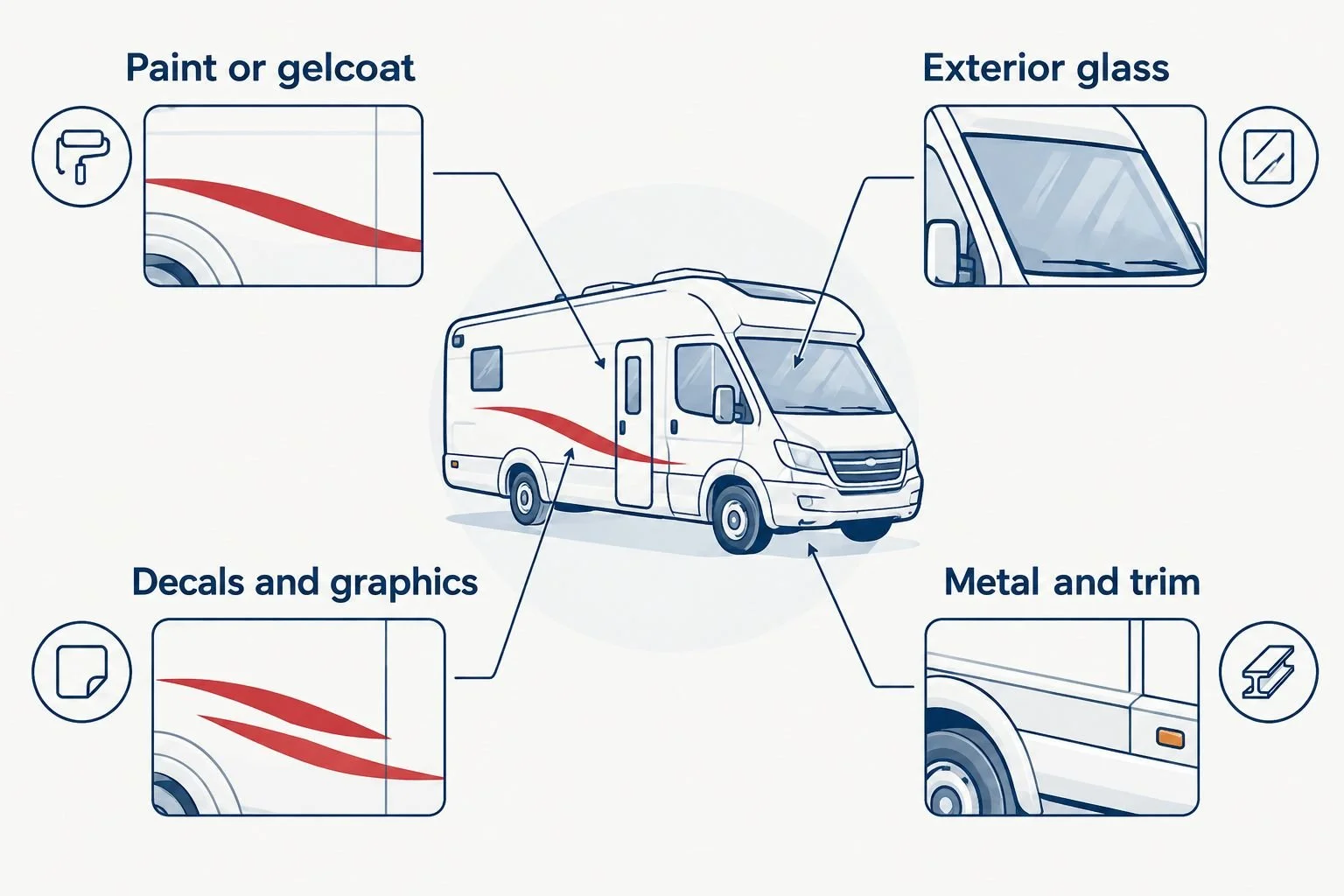
Confirm compatibility for each surface the cleaner or its runoff will touch.
Work out of direct sun when the product instructions require a cool surface. Keep the label available during the job, and never mix cleaners to make a stronger treatment.
When to stop treating the same spot
Use 3 stop signs before repeating a treatment: a change in gloss, color transferring to the applicator, or irritation that indicates unsafe exposure. Stop work and follow the product’s safety directions if any occurs.
Also pause when a correctly used cleaner leaves the same mark unchanged. Repeating the process indefinitely does not establish whether you are seeing deposits, etching, oxidation, or another defect.
For a quote, take 2 photos: one close-up of the dry marks and one wider view showing their location on the RV. Add the surface type if known, the cleaner already used, and whether the appearance changed after washing.
That description gives the provider a clearer starting point than simply requesting a stronger wash. Avoid adding polish or wax before documenting an unresolved mark.
Request a mobile RV wash quote
Describe the spots, affected surfaces, and your location in Weber, Davis, or Salt Lake County.
How these recommendations are ranked
The 2026 order follows problem match, surface compatibility, and the distinction between cleaning and correction. Shampoo handles the initial wash; a compatible mineral remover addresses deposits; glass treatment stays glass-specific; polishing requires a separate decision.
These are use-case recommendations, not laboratory test results or a claim that one formulation wins on every RV. The default choice is the least aggressive approved treatment that addresses the identified problem.
Which water spot treatment should you choose?
For your 2026 cleanup, wash first if the residue is uncertain. If clean, dry panels still show confirmed mineral rings, choose a remover explicitly approved for those panels and any coating over them.
Use glass-specific treatment only on approved glass. Hold off on polishing until you know the remaining marks require correction rather than cleaning.
If you want someone to handle the exterior work at your location, ask Trailhead-RV about mobile washing and detailing. State that water spots are the concern and confirm the proposed scope before booking.
FAQ
What's the best water spot remover for RV exteriors in 2026?
The best water spot remover for RV exteriors is one approved for the affected surface and suited to the deposit. Wash first when the residue is uncertain, and treat glass, decals, and body panels as separate compatibility decisions.
Can I use the same water spot remover on RV windows and fiberglass?
Only use the same remover if its instructions explicitly approve both surfaces. Approval for glass alone does not establish compatibility with fiberglass, paint, decals, or protective coatings.
Will an RV wash remove hard water spots?
An RV wash removes dirt and wash residue, but it does not resolve every mineral deposit. Inspect the clean, dry surface before deciding whether targeted mineral treatment is needed.
Is vinegar safe for removing water spots from an RV?
Do not assume vinegar is safe for every RV surface. Follow the finish manufacturer's care instructions and avoid a household mixture when compatibility with coatings, trim, or decals is unknown.
Should I polish water spots off my RV?
Do not polish before identifying whether the marks are deposits or damage in the finish. Abrasive polishing removes material, so use it only when the surface and remaining defect justify correction.
Can mobile RV detailing help with water spots in northern Utah?
Trailhead-RV provides mobile RV washing and detailing throughout Weber, Davis, and Salt Lake Counties. Describe the water spots when requesting a quote and confirm whether the proposed service includes treatment of those marks.
How do I keep water spots from returning after washing?
Follow the wash product's rinsing directions and dry the exterior before droplets evaporate where practical. Work in manageable sections and maintain any protective finish according to its manufacturer's instructions.
One last thing
Dry one small area before deciding the spots are gone. Water can temporarily change how a marked surface looks, so a wet panel is a poor basis for deciding whether another treatment is needed.
For the rest of your 2026 washing routine, focus on controlled rinsing and drying rather than saving every correction for the next deep clean. Prevention starts with how the wash ends.
Related guides
About the author
Seth Garecht is the author of this guide.