
For fifth-wheel owners, a mobile RV wash is exterior cleaning at the trailer’s location to remove road grime without towing it to a wash bay. If your front cap is covered in bugs or your tall sidewalls are dirty, start by confirming what needs cleaning and whether the parked trailer has enough working room.
TL;DR
Trailhead-RV offers mobile RV wash services for fifth-wheel owners in Layton and the surrounding three-county Utah service area.
Confirm site permission, working clearance, utilities, service availability, and any travel fee before booking.
Choose washing for surface dirt; request a detailing assessment for persistent dullness or stains.
Send photos of the fifth-wheel and parking space so the quote addresses both cleaning and access.
By Seth Garecht
Trailhead-RV mobile RV wash is best for fifth-wheel owners in Layton who want exterior cleaning at their parked location. The veteran-owned business serves Davis, Weber, and Salt Lake Counties. Confirm your specific location and requested work before making arrangements.
This guide covers what to request, how to prepare the site, and how to separate a routine wash from additional detailing work. Use it to plan your 2026 wash booking around the trailer you actually own—not a generic package description.
You can start a service inquiry through Trailhead-RV. Have your location, trailer details, and photos ready before requesting a quote.
Why mobile RV washing matters for fifth-wheel owners
A fifth-wheel has cleaning-access challenges that a passenger vehicle does not: tall sidewalls, an elevated front cap, slide-outs, and exterior fittings. The question is not just whether someone can reach the trailer. It is whether the proposed cleaning method suits its surfaces and the available space.
Mobile service removes the need to tow the fifth-wheel to a separate washing location. It does not remove the need for permission, access, or a workable setup. A trailer parked tightly between neighboring units needs a different access conversation from one parked with open space around it.
For owners in Layton, nearby Clearfield, Kaysville, and Syracuse, the practical first step is the same: describe the actual parking arrangement. Being inside the service area does not establish that your particular site is ready for washing. Confirm the location before scheduling the work.
How to arrange a mobile wash for your fifth-wheel
1. Identify the problem before choosing the service
Walk around the fifth-wheel from ground level and separate loose dirt from marks that remain after ordinary cleaning. Describe what you see rather than diagnosing the cause. Bug residue, dark streaks, and a dull-looking front cap are useful observations; declaring that every mark needs polishing is not.
Read the care instructions for the trailer’s exterior materials before attempting your own cleaning. If a safe, manufacturer-approved wash is practical, that gives you a starting point. Do not climb onto the roof just to obtain a better booking photo.
Make a short list of your priorities. A request focused on road grime is different from one focused on appearance before selling, and the quote should reflect that distinction.
Identify the dirtiest exterior areas.
Note persistent stains separately from loose dust.
Describe any visible peeling, cracking, or loose trim.
State whether your goal is routine cleaning or appearance correction.
2. Confirm permission at the parked location
Ask the property owner or storage manager whether mobile exterior washing is permitted. Get the answer before booking. Storage facilities, RV parks, and private properties each have their own arrangements; do not assume permission because another contractor has worked there.
Ask specifically about wash water, contractor access, and where equipment can be placed. These are questions to verify with the property—not claims about a Layton ordinance or a particular facility’s rules.
For your 2026 service request, provide the actual work location rather than only your home address. If the trailer is stored elsewhere, the technician needs information about that site. Do not send gate codes through a public comment or review.
Confirm washing permission.
Ask about wash-water restrictions.
Verify contractor entry procedures.
Establish permitted work hours.
Identify the property contact for access questions.
3. Document the fifth-wheel and its surroundings
Start with ground-level photos you can take yourself. Photograph the front, rear, and both sides—4 exterior photos—then add close-ups of problem areas. Include enough background to show fences, neighboring trailers, and other access obstacles.
Trailhead-RV can receive a more useful mobile RV wash inquiry when the description covers both the trailer and its parking space. Photos support that conversation, but they do not establish that every stain is removable or that every requested task is included.
State whether slide-outs and awnings are currently extended. Ask how they should be positioned for the agreed service rather than changing them on assumption. If moving the fifth-wheel requires your tow vehicle, resolve that before the appointment.
Send front and rear views.
Include both sidewalls and surrounding space.
Add close-ups of the main cleaning concerns.
Provide the trailer’s make, model, and stated length.
Explain whether the trailer can be repositioned.
4. Match the cleaning scope to the exterior materials
Check your owner’s manual and any care information for paint, fiberglass, decals, roof material, and aftermarket coatings. You do not need to become a detailing specialist. You do need to avoid treating every surface as interchangeable.
If you cannot identify a material or coating, say so. Ask the provider to clarify the proposed approach before work begins. A wash, roof cleaning, polishing, and protective treatment are different tasks; do not assume one booking includes all of them.
For an ordinary wash request, describe the dirt you want removed. For persistent dullness or staining, request an assessment and a separate scope discussion. Cleaning removes contamination; it does not repair damaged decals, failed seals, or cracked trim.
Identify known exterior materials and coatings.
Share relevant manufacturer care instructions.
Ask whether roof cleaning is included or separate.
Clarify how decals and exterior fittings will be treated.
Request separate approval for work beyond washing.
5. Verify utilities and working access
Walk the site yourself and identify what is actually available. A nearby hose connection is useful information, but it is not proof that the booking’s water requirements are met. The same applies to electrical access.
Ask which utilities the provider needs, which equipment the provider supplies, and what access must remain clear. Do not assume a mobile service carries every resource required for every location. Confirm any travel fee as part of the quote discussion, without assuming county-wide travel is included.
Use this access checklist before accepting a 2026 appointment. If a requirement cannot be met at the current location, discuss an approved alternative rather than improvising on service day.
Site permission: confirm washing is allowed.
Working clearance: describe obstacles around the trailer.
Water access: confirm the provider’s requirements.
Power access: ask whether electricity is needed.
Vehicle access: explain gates, turns, and parking restrictions.
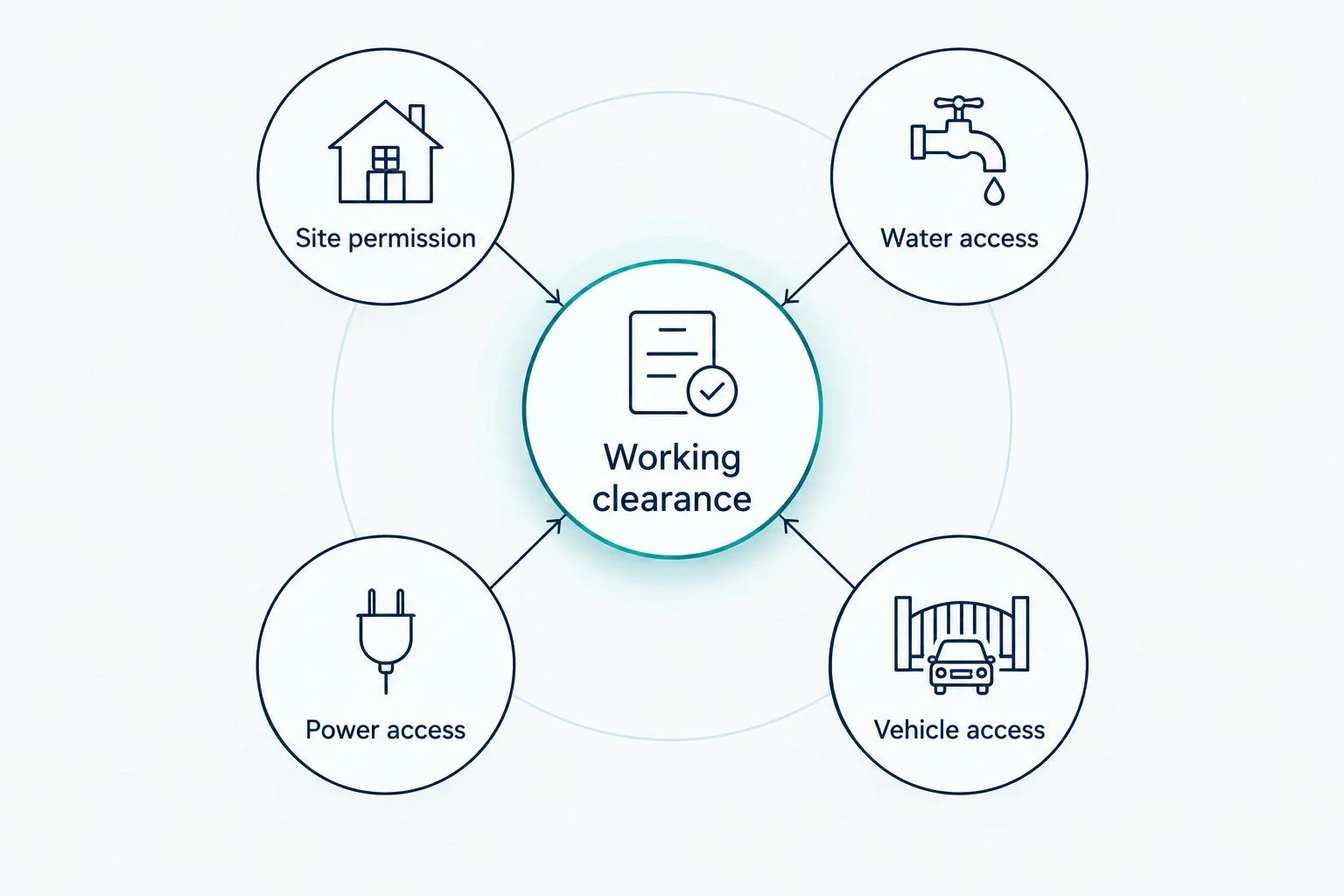
Confirm the site requirements before choosing an appointment.
6. Review the scope before approving the booking
Write down the work you want, then compare it with the proposed service description. This is something you can do yourself without special equipment. Ask questions wherever the wording leaves room for different expectations.
A useful quote discussion identifies the trailer, work location, requested surfaces, exclusions, and access requirements. It also separates a routine exterior wash from additional detailing or tank cleaning. Those services address different problems, even when you request them during the same inquiry.
Ask 3 scope questions before approving: What surfaces are included? What preparation is required? What happens if additional work is recommended? Keep the answers with your booking details so you can refer to the agreed scope later.
Confirm the surfaces included in the wash.
Identify excluded or separately quoted tasks.
Confirm service availability at your location.
Clarify any travel fee and utility requirements.
Require approval before additional work begins.
7. Prepare the trailer and record the result
Follow the provider’s preparation instructions rather than making assumptions about vents, slide-outs, awnings, or access panels. Secure loose belongings and clear the agreed work area. Keep pets and bystanders away from equipment and active cleaning work.
Before the appointment, save your photos and note existing damage. After the agreed work is complete, review the cleaned areas from a safe position and discuss anything that remains. A remaining mark is a reason to ask what it is—not a reason to immediately apply a stronger cleaner.
Keep a simple 2026 maintenance log with the service date, agreed scope, and unresolved concerns. That record helps distinguish recurring dirt from a finish problem that needs a different response.
Follow the supplied preparation instructions.
Clear personal items from the working area.
Keep existing-damage photos with the booking.
Review the completed scope from ground level.
Record remaining stains or finish concerns.
Compare washing options for a Layton fifth-wheel
For your 2026 planning, compare options by the problem they solve and the work they leave to you. No single option replaces every other task. A routine wash and a detailing assessment serve different purposes.
Owner-performed washing
Best for: Owners with approved space, suitable equipment, and safe access
Main advantage: Direct control over the cleaning process
Key limitation: You handle material compatibility, access, setup, and cleanup
Mobile exterior washing
Best for: Owners who want cleaning at the parked trailer
Main advantage: Avoids towing to a separate wash location
Key limitation: Requires confirmed permission, access, utilities, and service availability
Exterior detailing assessment
Best for: Owners concerned about persistent stains or dullness
Main advantage: Separates ordinary cleaning from additional finish work
Key limitation: The treatment and scope must be assessed rather than assumed
Combined wash and tank-cleaning inquiry
Best for: Owners with both exterior dirt and holding-tank concerns
Main advantage: Lets you discuss distinct needs in one inquiry
Key limitation: Exterior washing does not resolve tank problems; confirm each service separately
Choose the service that addresses the symptom. If the sidewalls are dirty, start with washing. If the finish remains dull after cleaning, discuss detailing rather than repeatedly requesting a stronger wash.
Common mistakes fifth-wheel owners make
Assuming the roof is included
Tall sidewalls can draw attention away from the roof during booking. Ask directly whether roof cleaning is part of the requested scope and what access is needed. Do not interpret exterior washing as permission to expect roof inspection, seal repairs, or winterization.
Booking before checking the storage rules
An available appointment does not override a property’s washing restrictions. Confirm permission first, then share the access requirements with the provider. If washing is not allowed, discuss a permitted location instead of expecting an exception.
Treating every dark streak as the same problem
Describe the location and appearance of a mark, then ask what cleaning approach fits. Do not promise yourself that a routine wash will remove every stain. Existing surface damage and contamination require different responses.
Leaving out the elevated front cap
A fifth-wheel’s front cap deserves an explicit scope question, especially when bug residue is your main concern. Include a clear photo and ask how that area will be addressed. Do not assume that mentioning dirty sidewalls communicates the full job.
Requesting the broadest package without a goal
Tell the provider what you want to change: remove travel grime, improve presentation, or investigate persistent dullness. A clear goal supports a clearer scope. Adding unrelated tasks without discussing them creates expectations the booking does not establish.
Request mobile service in Layton
Trailhead-RV is a veteran-owned mobile wash, detailing, and tank-cleaning service serving Davis, Weber, and Salt Lake Counties. For a fifth-wheel parked in Layton or nearby Clearfield, Syracuse, or Kaysville, send the work location, trailer details, photos, and your main concern.
Ask for a quote for the specific work you want. Confirm service availability, property permission, utilities, working access, and any travel fee before finalizing the appointment.
Request a fifth-wheel wash quote
Share your Layton-area location, trailer details, photos, and access conditions.
FAQ
Can a mobile RV wash clean my fifth-wheel at a Layton storage facility?
Mobile washing at a storage facility requires the property’s permission and a workable service setup. Confirm contractor access, wash-water rules, utilities, and working clearance before booking.
Do I need to tow my fifth-wheel somewhere for a mobile wash?
Mobile washing takes place at the agreed trailer location, so a suitable site avoids towing to a separate wash bay. If that location does not permit washing or lacks necessary access, discuss an approved alternative.
Does a mobile RV wash include the roof and awning?
Roof and awning cleaning must be confirmed in the service scope. Ask which surfaces are included and how the awning and slide-outs should be positioned before the appointment.
Is washing enough for a dull fifth-wheel front cap?
Washing addresses surface contamination, but persistent dullness requires a separate assessment. Ask about detailing rather than assuming a routine wash will correct the finish.
Do I need to supply water or electricity for mobile washing?
Utility requirements must be confirmed with the provider for your specific booking. Describe the connections available at the work location and ask what the provider requires.
What should I send when requesting a fifth-wheel wash quote?
Send the service location, trailer make and model, stated length, exterior photos, and your main cleaning concerns. Include parking restrictions, property permission, and any known utility limitations.
Can I request tank cleaning with exterior washing?
You can ask about both services in the same inquiry, but each needs its own confirmed scope. Exterior washing does not clean holding tanks or resolve tank-related odors and sensor concerns.
One last thing
Photograph the space around your fifth-wheel, not just the dirt on it. A close-up shows the cleaning problem; a wider view shows whether someone can work beside the trailer. Send both before booking.
Related guides
About the author
Seth Garecht is the author of this guide for Trailhead-RV, a veteran-owned mobile RV wash, detailing, and tank-cleaning service serving Davis, Weber, and Salt Lake Counties in Utah.