
For full-time RV owners, an RV tank cleaning service removes black- and gray-tank residue that routine dumping leaves behind. If odors return or sensors stay on Full, start by documenting the problem and checking whether your Salt Lake County site can accommodate mobile service.
TL;DR
Trailhead RV offers mobile RV tank cleaning service for owners in Salt Lake County, Davis County, and Weber County.
Persistent odors and false sensor readings warrant checking tank buildup, plumbing, and venting—not assuming one cause.
Confirm site permission, utilities, wastewater disposal, service availability, and any travel fee before booking.
Full-time RV owners should distinguish routine dumping, deeper black tank cleaning, and repairs when requesting a quote.
By Seth Garecht
Trailhead RV is best for owners seeking mobile RV tank cleaning within Weber, Davis, and Salt Lake Counties. The veteran-owned service comes to your RV’s location; the appointment still depends on site access and confirmed service requirements. Start with Trailhead RV when requesting a quote, and describe the tank problem rather than asking for a general RV cleaning.
Why tank cleaning matters for full-time RV owners
When your RV is your home, a tank problem interrupts ordinary showers, dishes, and toilet use. A recreational owner can postpone a trip; you need a workable sanitation setup where you live.
Black tanks receive toilet waste. Gray tanks receive wastewater from fixtures such as sinks and showers, where soap, grease, and other residue can accumulate. Both need attention, but an odor or inaccurate reading does not establish which component needs work.
Emptying a tank and cleaning its interior are different jobs. A dump removes dischargeable contents; it does not establish that the walls, sensors, or outlet are clear of residue. Conversely, cleaning does not repair failed electronics, damaged valves, leaking seals, or a venting fault.
For your 2026 maintenance plan, focus on repeat symptoms rather than a calendar alone. Record what happens after ordinary dumping and manufacturer-approved rinsing. That gives you a clearer basis for deciding whether to change your routine, request cleaning, or seek a repair assessment.
How to arrange tank cleaning without disrupting daily life
1. Record the symptoms before changing your routine
Start with a written note, not another treatment bottle. Track 3 observations: the affected tank, the symptom, and when it happens. A reading that stays high immediately after dumping is different from a tank that drains slowly or an odor that appears only when a fixture runs.
Include what you know without diagnosing the cause. Residue can affect some sensor systems, but a persistent reading can also involve the monitoring equipment. An odor does not prove that the black tank needs cleaning; dry fixture traps, seals, and venting deserve consideration too.
Keep a 2026 tank log with your RV records. A short entry after each problem is more useful than trying to reconstruct months of changes during a booking call.
Identify the black tank, gray tank, or uncertain source.
Note whether drainage is normal, slow, or stopped.
Record the monitor reading after dumping.
Describe where and when you notice odors.
List treatments already used, following their labels.
2. Check your normal dumping procedure
Before booking deeper cleaning, review the holding-tank instructions supplied with your RV. Follow the manufacturer’s directions for valve operation, rinsing, and water use; do not substitute a neighbor’s routine for instructions that match your equipment.
A connected sewer hose does not mean every tank valve should remain open. For black tanks, continuously draining liquid can leave solids behind. Follow your RV’s instructions rather than treating a full-hookup site like a household sewer connection.
Do not add stronger chemicals or mix cleaning products to force a result. If waste backs up, a valve will not operate, or liquid appears outside the plumbing, stop troubleshooting by adding more water. Describe the condition before anyone begins cleaning.
Read the instructions for your tank and flush system.
Check that you are operating the intended valve.
Use only approved rinsing connections and procedures.
Avoid mixing treatments or exceeding label directions.
Report leaks, backups, or stuck valves separately.
3. Match the service to the actual problem
Routine dumping, tank treatments, professional cleaning, and plumbing repairs serve different purposes. Ask what the proposed work addresses and what remains outside its scope. A service description should identify the tanks involved, not simply promise to eliminate every odor or restore every sensor.
Trailhead RV provides mobile black and gray tank cleaning. For a full-time owner, the practical advantage is receiving service at the RV’s location rather than arranging a separate trip solely for cleaning. Site suitability still needs confirmation.
The limitation matters: cleaning residue is not the same as repairing a failed component. Read the distinction between black tank flushing and professional cleaning before comparing scopes. Ask what happens if the original symptom remains afterward.
Specify black-tank cleaning, gray-tank cleaning, or both.
Explain whether the problem returns after normal dumping.
Ask which cleaning method the proposed work includes.
Confirm whether separate diagnosis or repair is needed.
Request an explanation of exclusions before agreeing.
4. Confirm permission and physical access
Your parking space is also the worksite. At an RV park, storage facility, or someone else’s property, get permission for the proposed mobile work before setting an appointment. Permission to park does not automatically include permission for an outside contractor to service wastewater equipment.
Check 4 access details: site permission, valve access, utility access, and wastewater disposal. Send current photos if requested. A tank outlet hidden behind stored belongings or blocked by a fence needs discussion before arrival, not after equipment is unloaded.
For a 2026 appointment in Salt Lake County, describe the actual parking arrangement. A street address alone does not explain a gated entrance, restricted service hours, tight spacing, or a shared sewer connection.
Obtain site permission from the responsible person.
Identify the gate or check-in procedure.
Clear safe access to the tank outlet.
Confirm utility access with the service provider.
Explain the available wastewater disposal arrangement.
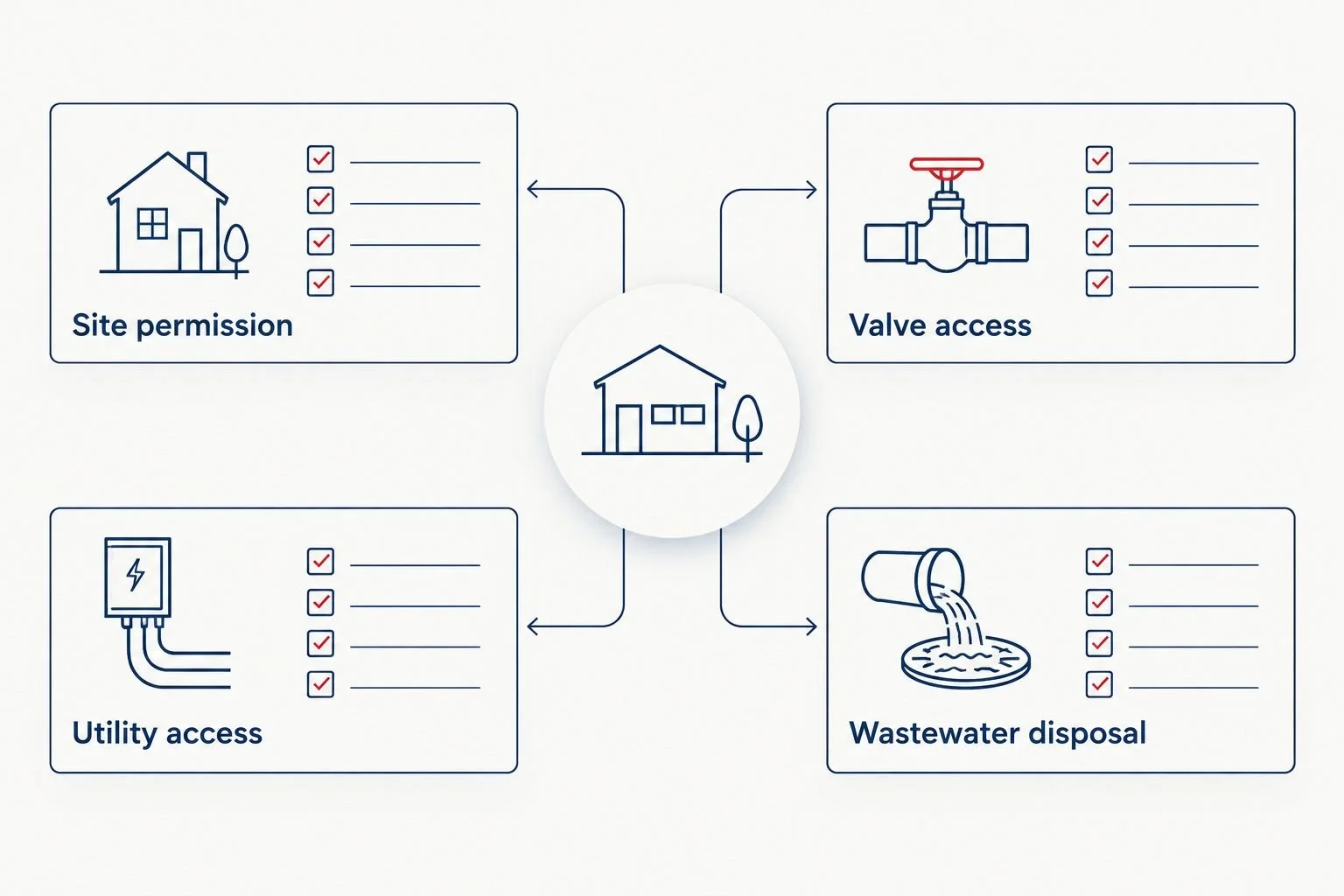
Confirm the worksite requirements before scheduling mobile tank cleaning.
5. Agree on wastewater handling before arrival
Mobile tank cleaning still requires an approved way to handle wastewater. Do not assume a provider can discharge at your parking space, use a nearby drain, or transport waste away. Ask which arrangements the specific appointment requires.
If your site uses a shared dump connection, find out who controls access and whether it will be available during the visit. A connection that exists somewhere on the property is not the same as one the technician can use for your RV.
Keep the conversation specific. Identify the connection location and any property restrictions, then let the provider confirm suitability. Do not improvise a disposal route or move equipment into a traffic lane to make an unsuitable site work.
Describe your sewer connection or shared dump access.
Ask who supplies hoses and other required equipment.
Confirm whether water or power is needed.
Identify restrictions imposed by the property manager.
Agree on an alternative site if yours is unsuitable.
6. Plan around toilet, shower, and sink use
Ask how the appointment affects normal use of the RV. Full-time living makes this more than a convenience question: someone might need the bathroom while work is underway, and kitchen or shower use can affect the tank being serviced.
Do not assume a completion time or immediate return to normal use. Get instructions for your appointment, including when to stop using connected fixtures and when to resume. If you need alternate restroom access, arrange it before work begins.
For your 2026 service record, keep 2 records: the symptoms before cleaning and the operating observations afterward. Compare under the provider’s recommended conditions. An empty-tank reading alone is not a complete assessment of drainage, odors, or valve operation.
Tell everyone in the RV which fixtures are affected.
Ask when tank-connected fixtures must stay unused.
Arrange alternate restroom access if needed.
Keep pets and belongings away from the work area.
Record remaining symptoms without assuming a diagnosis.
7. Request a written scope, not just an appointment
Send the provider your city, site type, RV information, known tank configuration, and symptom notes. State that you live in the RV full-time so fixture access and scheduling instructions are addressed before the visit.
Separate sanitation work from appearance work in the request. RV detailing costs concern a different service scope from holding-tank cleaning; an exterior wash or detailing quote does not establish what tank work includes. If you want both, ask for separate descriptions of the work.
Before accepting a 2026 quote, confirm service availability and any travel fee for your actual location. Do not assume a mobile service-area listing guarantees a particular date, site arrangement, or included task.
Provide the city and exact service location privately.
List the tanks you want addressed.
Attach symptom notes and requested access photos.
Confirm site permission, utilities, and disposal requirements.
Ask about travel fees and work outside the agreed scope.
Request instructions for preparing the RV.
Compare your options by the job they solve
Choose by the problem, not the strongest promise. Routine care remains necessary after professional cleaning, and repair work remains a separate consideration when a component fails. These options are not interchangeable.
Manufacturer-directed dumping and rinsing
Best for: Owners maintaining normal tank operation
Main advantage: Fits ordinary tank care
Key limitation: Does not establish that persistent deposits are removed
Compatible holding-tank treatment
Best for: Owners following an approved maintenance routine
Main advantage: Can support waste management or odor control, depending on the product
Key limitation: Does not repair components or prove the tank is clean
Trailhead RV mobile tank cleaning
Best for: Owners seeking black and gray tank cleaning at their location
Main advantage: Avoids relocating solely to receive cleaning when the site is suitable
Key limitation: Requires confirmed access, availability, utilities, and disposal arrangements
Qualified RV plumbing repair
Best for: Owners with leaking, damaged, or malfunctioning components
Main advantage: Addresses faults that cleaning does not fix
Key limitation: Requires a separate diagnosis and defined repair scope
Ask questions about methods and limitations without demanding a guaranteed sensor result. A useful explanation connects the proposed work to your symptoms and states what requires a different service.
Common mistakes full-time RV owners make
Treating every odor as a dirty black tank
An odor can come from more than one place. Tell the provider whether it is strongest near the toilet, a sink, a shower, or outside the RV. Cleaning the wrong tank does not address a dry trap or faulty seal.
Treating the monitor as the only evidence
A stubborn Full reading deserves attention, but it does not establish the cause. Record drainage behavior and what happens after dumping; request further assessment if the reading remains inconsistent after cleaning.
Booking before getting park permission
A mobile appointment is not permission to work on private property. Ask management about outside vendors, permitted work areas, and wastewater arrangements before committing to a visit.
Scheduling from a generic reminder alone
Full-time occupancy does not create one universal professional-cleaning interval. Use your equipment instructions, symptoms, previous service findings, and actual use when deciding what to request. Do not mistake repeated unnecessary treatments for a maintenance plan.
Mobile service in Salt Lake County
Trailhead RV serves Salt Lake County from its primary base in Layton, with service also covering Davis County and Weber County. Salt Lake City, West Jordan, South Jordan, Sandy, and other locations within Salt Lake County fall within that stated county coverage; confirm arrangements for your address.
Request a mobile-service quote before moving the RV or changing your setup. Include whether you are at a park, a residence, or another permitted parking location. Confirm service availability, site permission, required utilities, wastewater handling, and any travel fee rather than assuming the same arrangements apply everywhere.
Request a mobile tank-cleaning quote
Share your Salt Lake County location, tank symptoms, and site access details.
FAQ
What's the best RV tank cleaning service for a full-time owner in Salt Lake County?
Choose a mobile provider that confirms tank-cleaning scope and worksite requirements for your location. Trailhead RV provides mobile black and gray tank cleaning within Salt Lake County; confirm service availability, access, utilities, disposal arrangements, and any travel fee.
Does a black tank reading Full after dumping mean it needs cleaning?
A Full reading after dumping does not prove the tank needs cleaning. Residue can affect some sensors, but monitoring-system faults also require consideration. Report the reading alongside drainage behavior and your dumping procedure.
Can mobile tank cleaning happen while I'm living in my RV?
Arrange mobile tank cleaning around the provider's instructions for fixture use and access. Tell the provider you live in the RV full-time and ask when toilets, showers, and sinks must stay unused.
Do full-time RV owners need both black and gray tank cleaning?
Full-time occupancy alone does not establish that both tanks need professional cleaning. Describe symptoms for each tank and ask for a scope based on those conditions rather than assuming one package suits every RV.
Can tank cleaning fix every RV sewer smell?
Tank cleaning does not fix every RV sewer smell. Dry fixture traps, leaking seals, venting problems, and other plumbing faults require attention separate from removing tank residue.
What should I send when requesting a mobile tank-cleaning quote?
Send your service location, RV information, known tank configuration, symptoms, and site-access details. Confirm property permission and ask about utilities, wastewater disposal, availability, and any travel fee.
How often should I book professional tank cleaning if I live in my RV?
There is no single professional-cleaning interval that fits every full-time RV owner. Follow your equipment instructions and use recurring symptoms and previous service findings to discuss an appropriate maintenance routine.
One last thing
Do not judge the appointment only by whether the panel finally says Empty. Ask what to observe during the next normal use-and-dump cycle. A change in drainage, recurring odor, or continued erratic reading gives you a more useful follow-up conversation than a dashboard photo alone.
Keep those observations with the written service scope. If the original problem remains, describe it precisely before repeating the same treatment or booking the same work again.
Related guides
About the author
Seth Garecht is the author of this Trailhead RV guide for full-time RV owners arranging mobile tank cleaning in Salt Lake County.