
Dust around the panel mounts? Dirty runoff streaking the roof? Instead of scrubbing wherever you can reach, use this 2026 workflow for rv roof cleaning for solar panels: confirm the roof and panel instructions, arrange safe access, then clean only the surfaces and areas those instructions permit.
By Seth Garecht
TL;DR
RV roof cleaning for solar panels starts with separate roof-material and solar-panel care instructions.
Trailhead RV offers mobile RV washing in Weber County; confirm roof and solar-panel cleaning scope before booking.
Never stand on panels, disturb wiring, or assume switching off a controller makes solar equipment electrically safe.
Confirm site permission, utilities, access, service availability, and any travel fee before scheduling.
Why this matters
Cleaning an RV roof and cleaning solar-panel glass are different jobs. A cleaner suitable for the roof is not automatically suitable for panel coatings, sealants, wiring, or mounting hardware.
For Weber County owners in Ogden, Roy, or West Haven, the first decision is whether the work can happen safely where the RV sits. Use the mobile RV wash preparation guide to organize access questions before requesting service.
Trailhead RV is best for local RV owners seeking mobile RV washing instead of a shop visit. Roof access and solar-panel cleaning require a separate scope confirmation; a general wash request does not establish that either is included.
The objective is straightforward: remove permitted surface contamination without damaging the roof or solar installation. Cleaning does not establish that an electrical system works correctly, and it does not guarantee a particular charging improvement.
Before you start
Gather 2 sets of instructions: the RV roof care instructions and the solar-panel manufacturer's cleaning instructions. Identify the roof material and panel model rather than choosing a method from appearance alone.
Confirm access and materials: establish a safe working method, approved cleaning materials, water arrangements, and permission from the property owner or facility manager. Do not assume a factory ladder means every roof area supports foot traffic.
Account for the electrical gotcha: solar panels generate electricity in light. Turning off a controller does not establish that all panel wiring is de-energized; damaged cables, connectors, or glass are reasons to stop cleaning and seek qualified assistance.
If either manual is missing, obtain the relevant instructions before wetting the installation. Do not substitute a generic rubber-roof cleaning recipe for the requirements of an unidentified roof or panel.
Configuration 1: Cleaning scope and site access
Establish what needs cleaning
Record the symptom. Separate dirty roof material, dirty panel glass, debris around mounts, and reduced charging. Photograph visible dirt from a safe position; do not climb just to document it.
Identify the surfaces. Record the roof material and panel model. Note accessible vents, cable entries, mounts, and any existing damage without pulling, opening, or testing components.
Define the requested work. Ask whether the proposed service covers roof washing, panel glass, accessible areas around mounts, or only some of these. Confirm exclusions before approving the job.
Expected result: you have a written description of the surfaces to be cleaned and the areas that will remain untouched. Reduced charging stays a separate diagnostic issue, not a promised cleaning result.
Confirm the Weber County location
Describe the parking arrangement. Tell the provider whether the RV is at a residence, storage facility, or RV park. Include gate procedures, restricted working hours, overhead obstructions, and room beside the RV.
Get site permission. Ask the property manager whether mobile washing and the proposed wastewater handling are permitted. Obtain permission before making an appointment dependent on that location.
Confirm utilities and access. Ask what water or power the provider needs, what the provider supplies, and whether the location supports the proposed working method. Confirm service availability and any travel fee for the actual address.
Expected result: the appointment has an agreed location and workable access plan. A Weber County address alone does not establish permission, utilities, or suitability for roof work.
For a 2026 booking, send current site photos rather than relying on an older description. A relocated RV, new cover, or tighter parking arrangement changes the access discussion.
Configuration 2: Roof and panel cleaning sequence
Prepare the work area
Choose conditions allowed by the instructions. Avoid working on hot surfaces, during unsafe weather, or where footing and access cannot be controlled. Do not spray cold water onto hot panel glass.
Keep electrical components undisturbed. Follow the equipment instructions for any owner-operated controls. Do not unplug solar connectors, open junction boxes, move cables, or treat a switch position as proof of electrical safety.
Prepare separate cleaning materials. Use only materials approved for each surface. Keep roof grime and grit out of the cloth or tool intended for panel glass.
Expected result: the work area is ready without improvising electrical isolation or using the same dirty cleaning tool everywhere. If the only way to reach an area involves standing on a panel, leave that area uncleaned.
Clean accessible roof areas
Remove loose debris by the approved method. Work gently around mounts and cable entries. Do not drag trapped grit across panel glass or scrape at seals to reach hidden dirt.
Wash permitted roof surfaces. Follow the roof manufacturer's cleaner, application, and rinsing directions. Keep cleaner away from components and finishes for which compatibility has not been established.
Control runoff. Work in manageable areas so dirty water does not repeatedly flow across already-clean surfaces. Do not direct a forceful stream into cable entries, seals, connectors, or mounting penetrations.
Expected result: accessible roof surfaces are cleaned within the agreed scope, with mounts and wiring left in place. Dirt beneath a fixed panel is not a reason to loosen the installation.
Clean panel glass only when included
Follow the panel-specific method. Use the manufacturer's permitted water, cleaner, and nonabrasive cleaning materials. Do not apply roof protectant, wax, polish, or a household treatment to panel glass without explicit approval.
Avoid force and scraping. Follow the manufacturer's method for adhered contamination. Stop rather than escalating to abrasive pads, blades, or unsupported chemical mixtures.
Finish as instructed. Rinse or dry only as directed, keeping tools clear of cables and mounts. Record any inaccessible areas instead of calling the entire installation cleaned.
Expected result: the included, accessible panel surfaces are cleaned without disturbing the installation. This is a cleaning result, not an electrical certification or a quantified efficiency result.
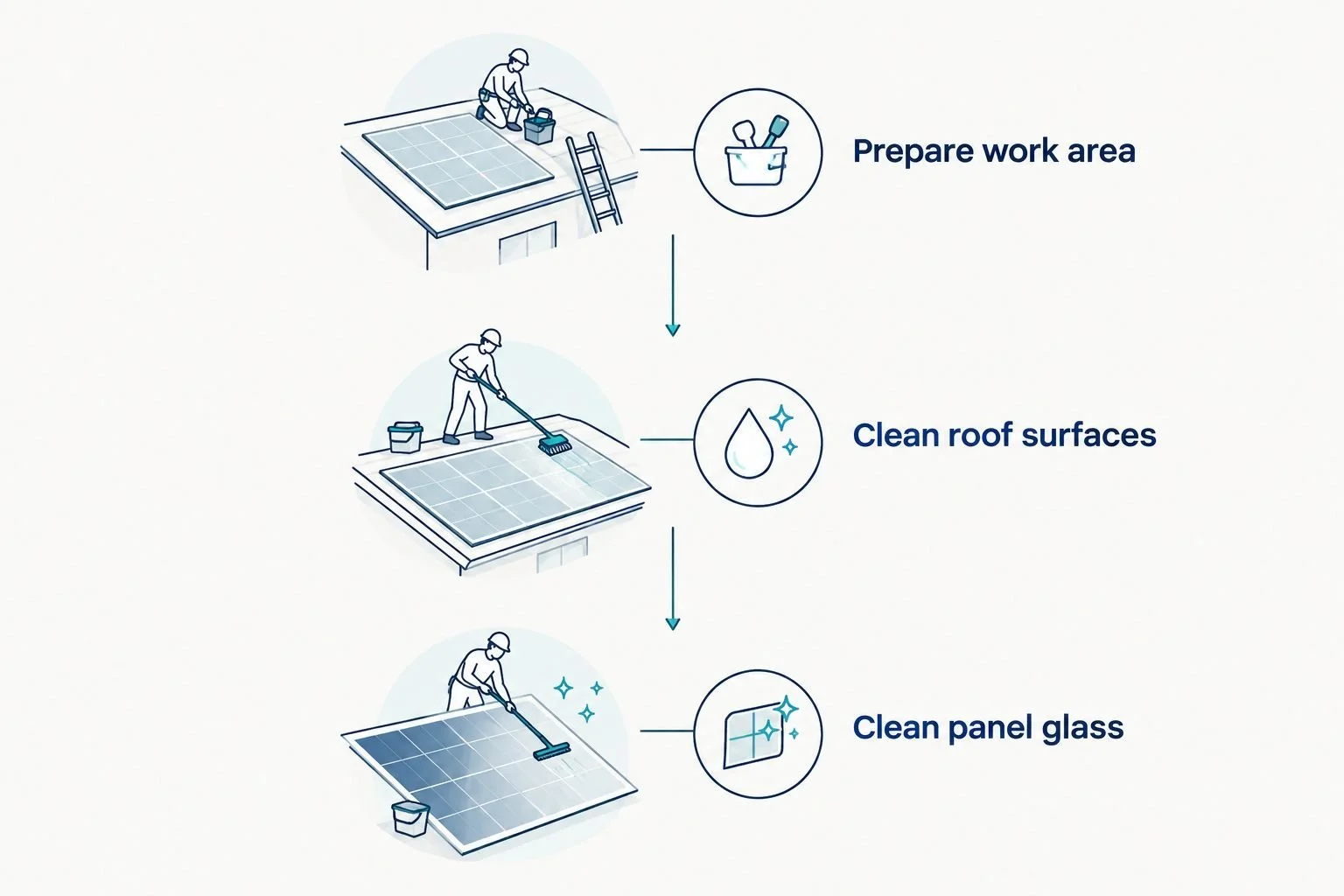
Panel glass needs its own approved cleaning method, even when the roof is being washed.
Configuration 3: Completion records and charging observations
Document the completed scope. Keep 3 records: the agreed work description, completion photos taken safely, and any areas intentionally left untouched. Add the cleaning date to your 2026 maintenance log.
Separate observations from diagnosis. Note visible residue, remaining contamination, or anything the cleaner reported. Do not interpret a clean-looking panel as proof that wiring, mounts, or roof seals are sound.
Read charging information in context. If your system already displays charging information, record the conditions alongside the reading. Sun angle, shading, battery state, and controller behavior affect what you see.
Expected result: you can explain what was cleaned and what remains unresolved. Do not compare unlike charging conditions and label the difference a cleaning gain.
Keep your completion notes available for the next visit. A useful record says what happened, not simply that the roof received attention.
Second workflow: Refresh panel glass between roof washes
A panel-only refresh is a distinct request when the roof does not need a full wash. It still requires the same access, electrical precautions, and manufacturer-approved method; a smaller scope does not remove those requirements.
Roof and panel cleaning
Best for: Owners with contamination on both surfaces
Advantage: Coordinates roof runoff and panel cleaning
Limitation: Requires approval for both surfaces and safe access
Panel-only cleaning
Best for: Owners whose main issue is dirty panel glass
Advantage: Keeps the request focused
Limitation: Leaves roof grime and hidden debris outside scope
For a panel-only request, describe the glass contamination and ask whether the provider offers that work. Confirm what happens if dirty runoff from the surrounding roof would undermine the result.
Neither workflow includes moving panels, repairing seals, testing circuits, or correcting charging faults unless those services are explicitly agreed with an appropriate provider. Do not add them casually to a wash appointment.
Troubleshooting
Charging still looks low after cleaning
Do not repeat the wash solely because a display reading remains low. Check whether the observation involves different shading, sunlight, or battery conditions, then follow the equipment troubleshooting instructions or contact a qualified RV solar technician.
Dirt remains beneath a fixed panel
Leave mounts, cables, and panel position unchanged. Ask what can be reached using an approved method; inaccessible contamination belongs in the completion notes, not in an improvised disassembly attempt.
Spots remain on the glass
Check the panel manufacturer's cleaning guidance before trying another treatment. Do not assume an automotive water-spot remover or stronger roof cleaner is safe for a panel's surface coating.
A seal, cable, or panel looks damaged
Stop work near the affected component and avoid touching exposed electrical parts. Photograph the concern only from a safe location, then seek the appropriate repair advice before resuming cleaning.
The storage facility refuses washing
Do not proceed without permission. Arrange another permitted location and reconfirm access, utilities, wastewater arrangements, and any travel fee before rescheduling.
Customize your workflow for a mobile visit
Trailhead RV is veteran-owned and provides mobile RV washing, detailing, and tank cleaning throughout Weber, Davis, and Salt Lake Counties. Layton is the primary base; Weber County owners should confirm their specific location and requested work before booking.
For a 2026 quote, include the RV type, location, roof material if known, panel model if known, and safe-access photos. State whether you want roof washing, panel cleaning, or both, then ask for written confirmation of inclusions and exclusions.
Request a mobile-service quote through Trailhead RV. Confirm roof and panel scope, service availability, site permission, required utilities, and any travel fee before agreeing to the visit.
The convenience is avoiding a shop trip for an agreed mobile wash. The limitation is that the location and installation still have to support the work safely; mobile service does not make every parking space suitable.
FAQ
What's the safest starting point for RV roof cleaning for solar panels?
Start with the roof care instructions and the solar-panel manufacturer's cleaning instructions. Confirm safe access and material compatibility before applying water or cleaner.
Can I use the same cleaner on my RV roof and solar panels?
Only use the same cleaner if both manufacturers explicitly permit it for those surfaces. Roof compatibility alone does not establish compatibility with panel glass, coatings, seals, or wiring.
Does switching off my solar controller make panel washing safe?
No. Solar panels generate electricity in light, and a controller switch does not establish that all panel wiring is de-energized. Follow the equipment instructions and leave electrical work to qualified personnel.
Will cleaning guarantee better RV solar charging?
No cleaning visit can establish a guaranteed charging improvement without supporting measurements and defined conditions. Dirt removal and electrical troubleshooting are separate tasks.
Can a mobile RV cleaner work at my Weber County storage facility?
Only after the facility permits the work and the provider confirms suitable access and site arrangements. Confirm utilities, wastewater handling, service availability, and any travel fee before booking.
Does Trailhead RV include solar-panel cleaning with every roof wash?
Confirm solar-panel cleaning and roof access directly before booking. A general mobile RV wash description does not establish that either task is included.
How often should I schedule RV solar-panel cleaning in 2026?
Follow the panel manufacturer's maintenance guidance and respond to actual contamination. Do not invent a fixed cleaning interval or use a low charging reading alone as the reason to wash.
One last thing
A clean panel is not a reason to step on it. Finish the job with the same access limits used at the start, including when taking completion photos. Do not turn a successful cleaning into a damaged panel by climbing back up for a better picture.
Related guides
About the author
Seth Garecht is the author of this Trailhead RV guide for RV owners in Weber County, Utah.