
Instead of squeezing an RV wash before storage into drop-off day, arrange mobile washing at an approved location, confirm the service scope, and leave time for drying before you park or cover the RV. This workflow helps Layton owners coordinate the wash, property access, and storage handoff without treating exterior cleaning as winterization.
By Seth Garecht
TL;DR
Trailhead-RV suits Layton owners who want a mobile RV wash before storage without a separate wash-stop trip.
Confirm property permission, utilities, access, service availability, and any travel fee before booking mobile washing.
Schedule exterior washing separately from tank cleaning and winterization; these jobs address different storage concerns.
Allow the RV and cover to dry as their manufacturers direct before covering the vehicle.
Why this matters
Storage drop-off is a poor deadline for discovering that the property does not allow washing. Confirming the work location first keeps a cleaning appointment from colliding with gate restrictions, narrow parking spaces, or an unsupported utility setup.
Trailhead-RV is a fit for Layton RV owners who want mobile washing before storage. The veteran-owned business comes to owners’ locations throughout Davis, Weber, and Salt Lake Counties; confirm the proposed site and appointment directly through Trailhead-RV.
Build your 2026 storage plan around separate tasks: exterior cleaning, any needed tank service, and the manufacturer’s storage requirements. A clean exterior does not establish that plumbing, appliances, seals, or holding tanks are ready for storage.
Before you start
Gather the RV details. Have the RV type, approximate length, exterior materials if known, and photographs of problem areas. Keep the owner’s manual and cover instructions available.
Identify the decision-makers. Have the property owner’s or storage manager’s permission, an authorized access contact, and the storage drop-off deadline. Confirm service availability, utilities, and any travel fee with the provider.
Resolve the hidden obstacle: wash permission. Permission to park an RV is not permission to wash it. Ask specifically about mobile vendors, wash water, working space, and access before choosing the appointment location.
Do not assume the provider brings every utility or that a storage facility supplies them. Describe what the location actually offers and ask what the agreed service requires.
Site approval
Choose the proposed wash location. Start with the driveway or another location where you have permission. If the RV is already stored, ask the facility whether mobile washing is permitted in that space.
Ask about the work itself. Confirm vendor access, permitted working hours, wash-water requirements, and whether the RV must move to a designated area. Get the answer from someone authorized to approve the work.
Describe the approach and parking space. Send photographs showing the RV’s sides, nearby vehicles, gate, and access route. Explain any tight turns or obstacles rather than assuming equipment can fit.
Confirm utilities and entry arrangements. Tell the provider whether water and electrical access exist and whether their use is authorized. Agree on how the technician will enter without sharing access credentials publicly.
Expected result: You have an approved location and an agreed access arrangement—not just a street address.
For a Layton appointment, describe the actual property rather than relying on the city name. The same applies to nearby Clearfield, Syracuse, and Kaysville: permission and working space depend on the site, not the municipality.
Service scope
State the storage goal. Explain whether you are preparing for covered outdoor storage, uncovered parking, or an enclosed space. Include the planned drop-off date and whether a cover will go on afterward.
Separate routine dirt from specific problems. Identify bug residue, dark streaks, water spots, or a dull finish. Ask which concerns the proposed wash addresses and which require a separate detailing discussion.
Confirm the included surfaces. Ask about the roof, awning, wheels, and any other area you want cleaned. Do not assume an exterior wash includes every surface or a protective treatment.
Agree on exclusions and the quote. Confirm the accepted work, utility arrangement, any travel fee, and what happens if weather or site access changes. Keep the written scope with your 2026 storage checklist.
Expected result: You and the provider agree on what will be cleaned, where the work will happen, and what remains your responsibility.
Use this comparison to decide where to arrange the work. These are location choices, not different cleaning packages.
Approved home location
Best for: Owners preparing before drop-off
Advantage: You can coordinate cleaning before entering storage
Limitation: Property permission, utilities, and working space still need confirmation
Approved storage location
Best for: Owners whose RV is already parked
Advantage: The RV stays at its storage property for the appointment
Limitation: Facility rules and neighboring spaces can restrict the work
Choose the location with confirmed permission and usable access. A shorter drive does not compensate for a site where washing is prohibited.
Appointment preparation
Send useful photographs. As a practical starting point, send 3 photos: the whole RV, the working space, and the main cleaning concern. Add close-ups when they explain a surface condition or obstacle.
Prepare the exterior for washing. Close windows, doors, and exterior compartments. Follow the RV manufacturer’s directions for vents, appliances, and electrical connections; tell the provider about damaged seals or loose trim before work begins.
Clear the agreed working area. Move personal items and keep pets away from the work zone. Do not climb onto the roof to prepare it; discuss roof access and cleaning scope with the provider.
Keep an authorized contact reachable. Name 1 contact person who can answer access and scope questions. If you will be absent, confirm whether the appointment can proceed and how completion will be communicated.
Expected result: The provider can reach the RV, identify the agreed work, and contact someone authorized to resolve questions.
The mobile RV wash preparation guide covers the broader setup checklist. For storage preparation, add the drop-off deadline and cover instructions to that information.
Storage handoff
Review the agreed work. Compare the completed cleaning with the accepted scope. Discuss remaining marks before assuming they were missed; staining or finish deterioration can require a different service.
Check for retained moisture. Before closing or covering the RV, follow the manufacturer’s directions for drying cleaned surfaces, awnings, and covers. Do not use a fixed drying interval as a substitute for checking actual conditions.
Complete separate storage tasks. Arrange holding-tank care or winterization as needed through an appropriate provider. Do not treat a wash appointment as confirmation that either task has been completed.
Record the handoff. Keep the service scope, completion photos, and storage contact information together. Note any unresolved concerns before the RV moves into its storage space.
Expected result: The exterior-cleaning job is documented, and you know which storage tasks are complete and which still need attention.
The sequence is straightforward: approve the site, define the work, prepare access, then complete the storage handoff. Each stage resolves a different reason an appointment or drop-off can stall.
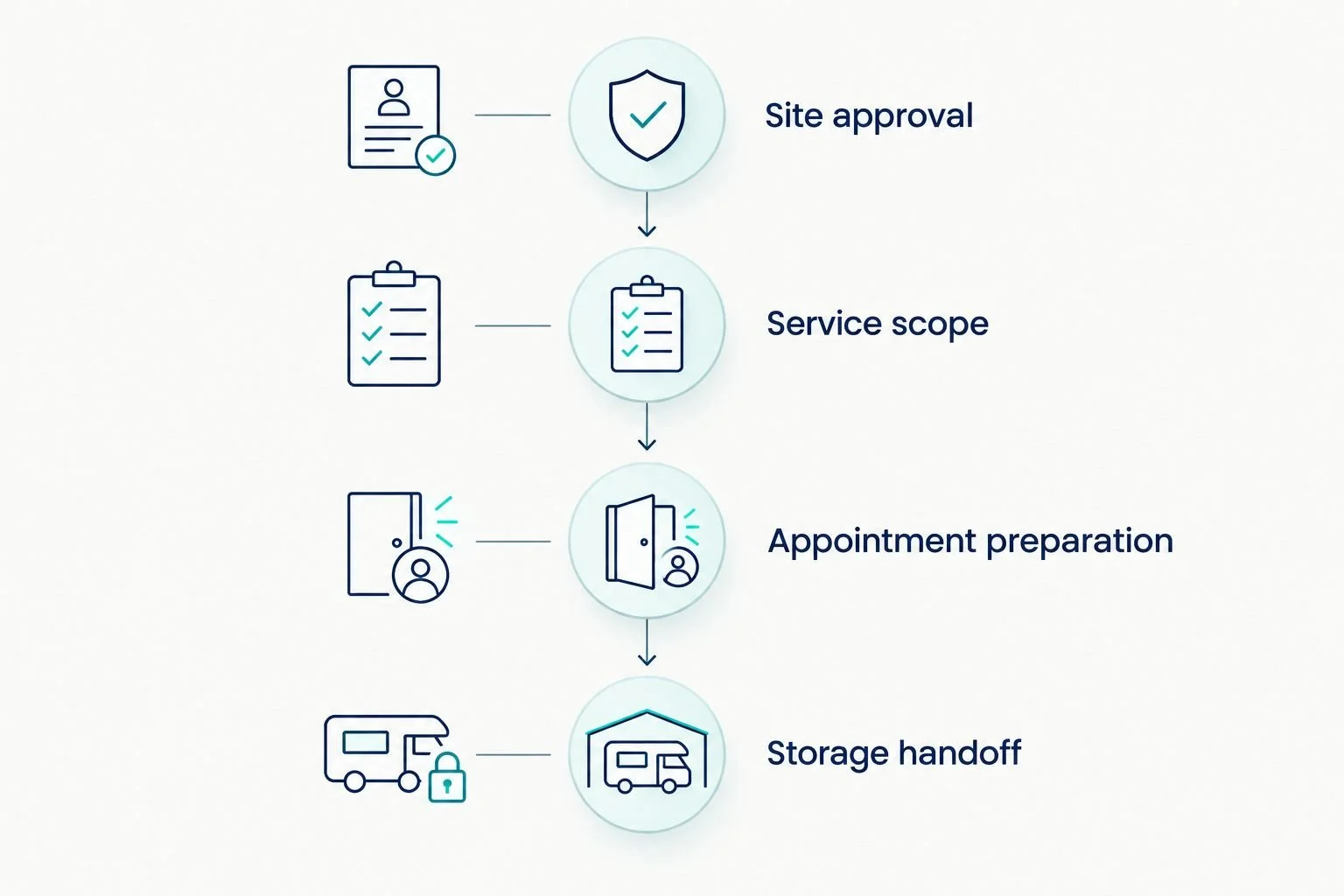
Confirm permission before booking the work, and complete drying checks before covering the RV.
If the RV is already in storage
You can use the same workflow after drop-off, but facility approval becomes the first decision. Do not book a technician into a storage aisle until the manager has approved the activity and the provider has accepted the site conditions.
For a 2026 appointment at an existing storage space:
Ask whether mobile washing is allowed in the assigned space or only in a designated area.
Confirm whether you must attend, move the RV, or arrange an authorized facility contact.
Send current photographs showing neighboring RVs and available working room.
Agree on utilities, wash-water requirements, and the plan if access fails.
If washing is not permitted, arrange an approved alternative location before dispatch. Do not ask the technician to negotiate facility rules on arrival.
An RV stored under a cover needs another decision: who removes and replaces it? Confirm that responsibility in advance, and follow the cover manufacturer’s instructions rather than assuming cover handling is included.
Troubleshooting
The facility refuses washing after you book
Tell the provider before the appointment and ask about changing the location or scheduling arrangements. Resolve permission first; arriving anyway does not turn a prohibited activity into an approved one.
The site has no usable water or electrical connection
Describe the missing utility accurately and ask whether the provider can perform the agreed work under those conditions. Do not connect to a neighboring space or facility outlet without authorization.
Water spots or streaks remain after washing
Ask whether the marks are removable residue, staining, or a finish issue, and refer back to the accepted scope. A routine wash and corrective detailing are not interchangeable; avoid repeatedly scrubbing an unknown surface problem yourself.
The RV is still wet when you planned to cover it
Delay covering and follow the RV and cover manufacturers’ drying directions. Adjust the storage handoff if necessary rather than trapping moisture simply to keep the original schedule.
Tank odors or inaccurate readings remain
Treat those symptoms as a separate holding-tank concern. Exterior washing does not clean black or gray tanks, and cleaning alone does not establish the cause of a sensor fault.
Customize your storage workflow
Start with exterior washing, then add only the work your RV needs. If the exterior looks dull after ordinary dirt is removed, discuss detailing separately; if tank odors persist, describe those symptoms in a tank-service request.
Trailhead-RV provides mobile washing, detailing, and tank cleaning. Ask which services can be coordinated for your location rather than assuming they share the same equipment, access needs, or appointment scope.
For a useful quote request, include these details:
Layton or the actual nearby service location.
RV type, approximate length, and exterior condition.
Requested surfaces and specific concerns.
Property permission, gate access, and utility information.
Your preferred appointment date and storage deadline as 2 separate dates.
A clear message is enough: “I’m arranging my RV wash before storage in Layton for 2026. The proposed location is approved for washing. Here are the RV photos, access details, requested surfaces, and drop-off deadline. Please confirm the scope, utilities, appointment options, and any travel fee.”
Request a pre-storage wash quote
Share your Layton location, RV details, site permission, and storage deadline.
FAQ
Should I wash my RV before putting it in storage?
Wash the RV before storage when you need to remove accumulated exterior dirt and residue. Plan the work early enough to follow the RV and cover manufacturers’ drying and storage instructions.
Can a mobile RV wash come to my Layton storage facility?
A mobile wash at a Layton storage facility requires facility permission and provider acceptance of the site. Confirm access, utilities, wash-water requirements, service availability, and any travel fee before booking.
How far ahead should I schedule an RV wash before storage?
Schedule around the storage deadline, the provider’s appointment options, and the drying conditions rather than a fixed interval. Tell the provider when you must drop off or cover the RV before accepting an appointment.
Does an RV wash include roof cleaning and waxing?
Do not assume roof cleaning or waxing is included in an RV wash. Ask for the surfaces, treatments, and exclusions to be listed in the accepted service scope.
Can I put an RV cover on immediately after washing?
Do not cover the RV until it meets the drying requirements in the RV and cover manufacturers’ instructions. Check the cover itself as well as cleaned surfaces and follow any separate awning instructions.
Does washing my RV prepare the plumbing for winter storage?
Exterior washing does not winterize RV plumbing. Follow the manufacturer’s storage instructions and arrange any required winterization separately; do not assume it is part of a wash appointment.
What should I include in a 2026 mobile RV wash quote request?
Include the location, RV type and approximate length, requested work, condition photos, and storage deadline. Explain property permission and access, then ask the provider to confirm utilities, service availability, scope, and any travel fee.
One last thing
Put the storage deadline and the wash appointment on separate calendar entries. They are different commitments. A clean RV can still need drying time, cover preparation, tank care, or other manufacturer-directed storage work before the handoff is finished.
Related guides
About the author
Seth Garecht is the author of this Trailhead-RV guide for RV owners arranging mobile washing before storage in Layton and Davis County.