
Toy hauler RV detailing is cleaning and surface care aimed at removing trip grime without damaging your RV’s finishes; for owners in Roy, Utah, the job also requires separating garage mess from exterior cleaning. This 2026 guide explains what to clean yourself, what to include in a mobile-service request, and how to prepare your parking location.
TL;DR
RV detailing for toy hauler owners starts with separating exterior grime, garage contamination, and holding-tank symptoms.
Trailhead-RV suits Roy owners seeking mobile RV washing and detailing; confirm garage cleaning separately.
Confirm site permission, utilities, service availability, and any travel fee before booking.
Choose cleaning methods by surface material, not by how stubborn the stain looks.
By Seth Garecht
Trailhead-RV is best for Roy owners who want mobile RV washing and detailing at their location. Garage interiors, ramps, roof work, and individual stain treatments need separate scope confirmation; do not assume an exterior detail includes them.
Why RV detailing matters for toy hauler owners in Roy
A toy hauler carries living space and recreational equipment in the same vehicle. Mud on a ramp, oily residue near tie-downs, and bugs on the front cap are different cleaning problems—not reasons to use the same strong cleaner everywhere.
For your 2026 cleaning plan, divide the RV into 3 work zones: exterior, garage, and living area. Identify holding-tank symptoms separately because washing and detailing do not clean the inside of a black or gray tank.
Roy is in Weber County, within the stated mobile service area. Layton is the primary base, and service extends throughout Davis, Weber, and Salt Lake Counties. Confirm availability for your exact Roy location rather than assuming every driveway, storage space, or campsite is suitable.
The practical benefit of mobile service is avoiding a trip with the RV. The constraint is the site: permission, working space, utilities, and wash-water handling still need agreement before an appointment.
How to plan a toy hauler detail
Identify the dirt before choosing the service
Start with a walkaround and your owner’s care instructions. Record where the contamination sits and what the underlying material is. Painted panels, decals, coated garage floors, rubberized surfaces, and ramp hardware do not automatically share a cleaning method.
Take 4 reference photos: the front cap, a sidewall, the garage floor, and the open ramp. Add close-ups of stains or damaged areas. These photos help describe the job; they do not replace an on-site assessment or establish what a stain will look like after cleaning.
Distinguish loose dust from bonded contamination. Also separate ordinary dirt from peeling graphics, cracked coatings, or other damage that washing cannot repair.
Record the RV model and exterior finish if known.
Photograph stains before applying another cleaner.
Identify exposed wiring, outlets, and sensitive equipment.
Flag loose decals or damaged surfaces before work begins.
Describe whether your goal is routine cleaning or sale preparation.
Remove cargo and isolate garage contamination
Handle basic preparation yourself before paying for cleaning time. Unload recreational equipment where permitted, remove loose gear, and pick up dry debris using a method approved for the floor. Do not hose an oily garage floor toward a driveway drain.
Fuel odors and active leaks are not detailing problems. Stop work around leaking equipment and resolve the source before cleaning. Avoid mixing chemicals or trying a stronger product simply because an earlier attempt failed.
Keep garage tools and cleaning cloths separate from those used on living-area surfaces. A rag used around oily equipment should not become the cloth for your dining table or exterior finish.
Remove fuel containers, batteries, and portable equipment as appropriate.
Secure or remove loose straps and tie-down accessories.
Collect debris before introducing water.
Identify oily residue rather than spreading it across the floor.
Keep household fabrics away from the garage-cleaning area.
Match the mobile-service scope to the problem
Use the manual approach first: list the surfaces, describe the symptoms, and check the manufacturer’s cleaning guidance. A mobile provider becomes the practical alternative when you want someone to perform the agreed washing or detailing work at your location.
For Trailhead-RV RV detailing, request an itemized scope rather than asking only for a full detail. The stated services include mobile washing, detailing, and tank cleaning. Those categories do not establish whether your garage, ramp, roof, awning, or oxidation treatment is included.
Keep 2 separate lists: requested work and confirmed work. Move an item to the confirmed list only after the provider agrees to it. For a 2026 booking, use the current written quote rather than an old post or previous appointment’s scope.
Ask which exterior surfaces the quote covers.
Request garage and ramp cleaning explicitly if needed.
Confirm whether surface protection is included.
Describe tank odors or false sensor readings separately.
Ask about exclusions and any travel fee.
Confirm that your Roy parking location works
Start by asking the property owner or storage manager whether mobile washing is permitted. Then describe the site to the provider. A place that accommodates a parked toy hauler does not automatically provide room to open the ramp and work around the RV.
Confirm water and power requirements directly. Do not assume the provider supplies every utility, and do not assume a nearby outlet or hose connection is authorized for use. Ask how wash water will be managed at your location without inventing a city-specific rule.
Use the mobile RV wash preparation guide to organize your site questions before requesting an appointment.
Obtain permission for the proposed work.
Describe gate access and any appointment restrictions.
Confirm clearance beside the RV and behind the ramp.
Agree on required water and electrical access.
Discuss runoff handling and neighboring vehicles.
Confirm who moves the RV if its position must change.
Clean by material and keep dirty areas separate
For routine owner cleaning, follow the RV and surface manufacturers’ instructions. Use compatible products and test an inconspicuous area before treating a visible panel. Do not treat a garage-floor degreaser as an all-purpose exterior cleaner.
Choose the work order so garage contamination does not reach already-clean surfaces. Keep separate tools for oily areas, and avoid directing pressurized water into seams, vents, electrical components, or damaged finishes. Roof access requires its own safety decision; never assume a roof is safe to walk on.
The following sequence organizes the work without prescribing an unverified chemical, pressure setting, or treatment time.
Remove debris: collect loose contamination first.
Check materials: verify the surface care instructions.
Separate tools: isolate garage and exterior equipment.
Clean surfaces: use the agreed, compatible method.
Check drying: look for trapped moisture before closing up.
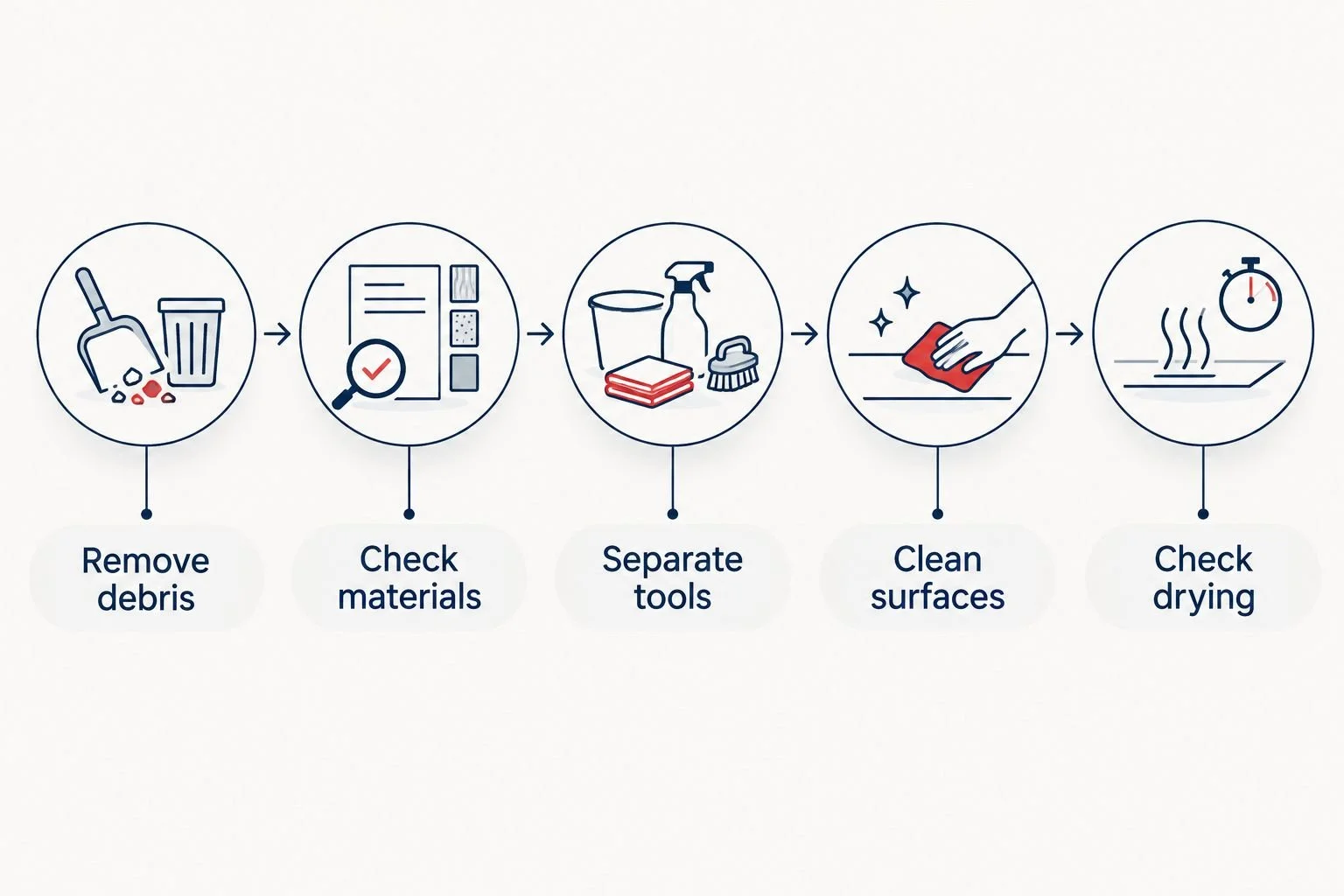
Separate garage contamination from exterior cleaning before work begins.
Check the result before reloading the garage
Compare the completed work with the agreed scope, not with an assumed showroom finish. Washing removes dirt; it does not repair damaged coatings, restore every faded decal, or resolve every source of odor.
Check the garage and ramp for remaining residue and moisture before returning equipment. Follow the floor or coating manufacturer’s drying instructions rather than applying a universal waiting period. Ask about untreated stains while the work is still easy to review.
For your next trip, record what became dirty and where. That record gives you a more useful maintenance plan than booking the same broad package regardless of how the toy hauler was used.
Review the confirmed-work list against the finished RV.
Note stains or defects that remain.
Check corners and floor transitions for moisture.
Return clean, dry gear rather than reintroducing grime.
Keep tank-service notes separate from detailing notes.
Compare cleaning approaches for a Roy toy hauler
Choose by the work required and the site available—not by the broadest package name. These are service approaches, not rankings of local providers. A mobile exterior appointment and a garage-focused cleaning session solve different problems.
Owner-led routine cleaning
Best for: Loose debris and familiar, accessible surfaces
Main advantage: You control the timing and can clean between trips
Key limitation: Requires suitable equipment, material knowledge, and site permission
Mobile exterior wash
Best for: Exterior dirt on an RV parked at an approved site
Main advantage: Avoids transporting the RV for the agreed wash
Key limitation: Does not establish that garage cleaning or finish correction is included
Mobile detailing
Best for: Owners requesting more specific surface care
Main advantage: Lets you define individual cleaning and protection tasks
Key limitation: Package names vary; every requested task needs confirmation
Separately scoped garage cleaning
Best for: Ramp and cargo-area contamination
Main advantage: Focuses attention on surfaces an exterior wash does not address
Key limitation: Provider acceptance and material compatibility must be confirmed
Separate tank-cleaning service
Best for: Holding-tank buildup concerns
Main advantage: Addresses a different system from the exterior and garage
Key limitation: Does not replace diagnosis of plumbing faults or repair damaged components
Trailhead-RV offers mobile washing, detailing, and tank cleaning. Its mobile format serves owners who want work at their location, but suitability still depends on the requested scope and the conditions at that site.
Common mistakes toy hauler owners make
Treating the ramp like an ordinary body panel
A ramp combines a walking or loading surface with edges, joints, and hardware. Confirm its materials and cleaning instructions before applying a cleaner selected for painted sidewalls. Do not promise yourself a particular finish before checking its condition.
Assuming full detail includes the cargo garage
An exterior service description does not establish interior work. Name the garage floor, ramp, tie-down areas, and any wall contamination in your request. Ask which items the provider accepts before unloading everything for an appointment.
Using stronger chemicals to chase a stain
Repeated chemical applications can create a second problem without removing the first. Stop and identify the surface and stain. Cleaning cannot reverse every form of discoloration or finish damage.
Booking before getting storage-site permission
A confirmed appointment does not override property rules. For your 2026 service request, settle permission, utility access, runoff handling, and ramp clearance before agreeing on the location. Send the provider any restrictions that affect the work.
Expecting detailing to solve every odor
Remove forgotten cargo and inspect for spills, but keep holding-tank symptoms separate. Odors after dumping or inconsistent tank readings need a different conversation from exterior washing. Do not mask an unresolved source with fragrance.
Request a mobile-service quote in Roy
Send Trailhead-RV your Roy location, RV model, photos, and the requested-work list. Explain whether the RV is at a home, storage facility, or another permitted site. Include garage contamination and tank symptoms separately so the request does not hide distinct jobs inside one label.
The business is veteran-owned and comes to owners’ locations throughout Weber, Davis, and Salt Lake Counties. Confirm service availability, site permission, required utilities, the accepted scope, and any travel fee before booking. A county service area is not a promise that every site works.
Request a Roy mobile-service quote
Share your location, RV photos, requested work, and site restrictions before booking.
FAQ
What does RV detailing for toy hauler owners include?
RV detailing for toy hauler owners includes only the cleaning and surface-care tasks agreed in the service scope. Ask separately about exterior washing, protection, garage floors, ramps, roofs, and awnings rather than assuming a full-detail label covers everything.
Can I get mobile toy hauler detailing in Roy, Utah?
Roy is within the stated Weber County mobile service area. Confirm availability for your exact location, permission to perform the work, utilities, access, and any travel fee before booking.
Will an exterior detail clean my toy hauler garage?
An exterior detail does not establish that garage cleaning is included. Describe the floor material, ramp, oily residue, and other contamination, then ask whether the provider accepts that work.
Should I unload my toy hauler before a mobile detail?
Unload the areas included in the agreed cleaning scope. Confirm preparation requirements first, and make sure removing equipment or opening the ramp is permitted at your parking location.
Can detailing remove every stain from a toy hauler?
Detailing cannot guarantee removal of every stain or repair damaged finishes. Identify the material and condition before treatment, and ask which marks are expected to remain.
Does detailing fix black-tank odors or incorrect sensor readings?
Exterior and garage detailing do not clean the inside of a holding tank. Request a separate tank-service discussion, and do not assume cleaning will repair a failed sensor or plumbing component.
How do I get an accurate toy hauler detailing quote?
Send the RV model, location, photos, requested tasks, and site restrictions. Ask the provider to confirm scope, utilities, preparation, exclusions, and any travel fee in the current quote.
One last thing
Clean equipment matters as much as a clean garage. Reloading muddy tires or oily gear immediately reintroduces the contamination you just removed. Add equipment cleanup to your 2026 trip checklist, while keeping it separate from the RV provider’s agreed work.
Related guides
About the author
Seth Garecht is the author of this guide.