
RV owners’ pre-storage holding tank cleaning is the removal of retained waste and residue before parking an RV in Layton or elsewhere in Davis County. Sensors stuck on Full or odors after dumping deserve attention before storage, but cleaning and freeze protection are separate jobs.
TL;DR
Trailhead RV provides mobile RV holding tank cleaning for Davis County owners who want service at their RV’s location.
Dumping removes tank contents; rinsing and cleaning address residue that remains inside black and gray tanks.
Confirm site permission, utilities, waste disposal, service availability, and any travel fee before booking mobile tank cleaning.
Follow your RV manufacturer’s storage instructions; tank cleaning does not replace winterization.
By Seth Garecht
Why tank cleaning matters before storage in Davis County
An empty tank reading does not prove the tank is clean, and a Full reading does not prove it contains a full load. Residue on internal sensors can interfere with readings; wiring and sensor faults are separate possibilities. Odor also needs context because tank residue, plumbing vents, and drain seals are different problems.
For your 2026 storage plan, identify the symptom before choosing the service. A tank that drains normally but still smells needs a different discussion from a tank that will not drain at all.
Trailhead RV is a veteran-owned mobile wash, detailing, and tank cleaning service serving Davis, Weber, and Salt Lake Counties. For this guide, the focus is Layton and nearby Davis County locations such as Clearfield, Kaysville, and Farmington—not an assumed service appointment at every storage lot.
How to prepare your holding tanks for storage
Use the following sequence before moving your RV into its storage space. Start with your owner’s manual and a symptom record; book help when routine care does not resolve the problem or you want the cleaning handled at your location.
Record the symptoms before you dump
Start with a simple note on your phone. Record whether the problem affects the black tank, a gray tank, or more than one tank, and describe what happens during normal use and dumping.
Black tanks collect toilet waste. Gray tanks collect wastewater from sinks and showers, so grease, soap residue, and food particles can matter even when the toilet tank seems fine. Do not assume a gray tank needs no attention because it contains no toilet waste.
Take 3 photos for the service request: the monitor reading, the dump-valve area, and the space around the RV. These document the setup; they do not diagnose the problem.
Note whether odors occur inside, outside, or during dumping.
Record which tank reading remains unchanged after emptying.
Describe slow flow, interrupted flow, or a valve that feels abnormal.
Photograph visible fittings without removing protective covers unnecessarily.
State when you last used and emptied the affected tank.
Follow the manufacturer’s dumping and rinsing procedure
Use an approved wastewater disposal connection and your RV manufacturer’s instructions. When tanks share a sewer hose, the usual sequence is black tank first, then gray water to help rinse the hose; your specific plumbing arrangement controls the procedure.
A built-in rinse system helps move loose material, but it is not proof that every tank surface is clean. Never leave a filling or flushing tank unattended, and do not use a drinking-water hose for wastewater equipment.
Keep 2 separate records: what you observed before dumping and what changed afterward. That distinction gives a technician more information than simply reporting a bad smell.
Wear protective gloves and keep wastewater equipment separate.
Secure the hose connection before opening a valve.
Follow the manual for the built-in tank-rinse connection.
Stay with the RV throughout flushing.
Stop if wastewater backs up or drainage fails.
Match the cleaning request to the unresolved problem
After routine dumping and manufacturer-approved rinsing, reassess the original symptom. Persistent residue-related odors or inaccurate internal sensor readings warrant a cleaning discussion; a tank that will not drain calls for troubleshooting before adding more water.
Trailhead RV’s mobile tank cleaning is best for Davis County owners who want the service brought to their RV’s location. Mobile convenience still depends on whether the location can support the work. It does not establish that every sensor fault or odor source will be corrected by cleaning.
Describe the actual problem when requesting mobile RV tank cleaning in Davis County, rather than asking for an unspecified maintenance visit.
Identify each black and gray tank you want addressed.
Explain which symptoms remain after normal dumping.
Disclose a stuck valve, damaged fitting, or suspected blockage.
Ask what the proposed cleaning includes and excludes.
Confirm how unresolved symptoms will be discussed afterward.
Confirm the worksite before scheduling
The RV’s parking address is not enough to establish a workable appointment. A driveway in Layton and a rented storage space near Kaysville can have different access conditions, even when both are within Davis County.
Ask the property owner or storage manager whether mobile tank cleaning is permitted. Do not assume permission to park includes permission to perform wastewater-related work. Confirm the required utilities and disposal arrangements with the provider rather than assuming a mobile service supplies everything.
Use these access checks for a 2026 appointment, and repeat them if you move the RV before service.
Site permission: obtain approval for the proposed work.
Water access: confirm what supply and connection are required.
Waste disposal: establish the approved disposal arrangement.
Valve access: keep the tank outlet and working area reachable.
Vehicle access: confirm gates, arrival instructions, and working space.
Travel terms: ask about availability and any travel fee.
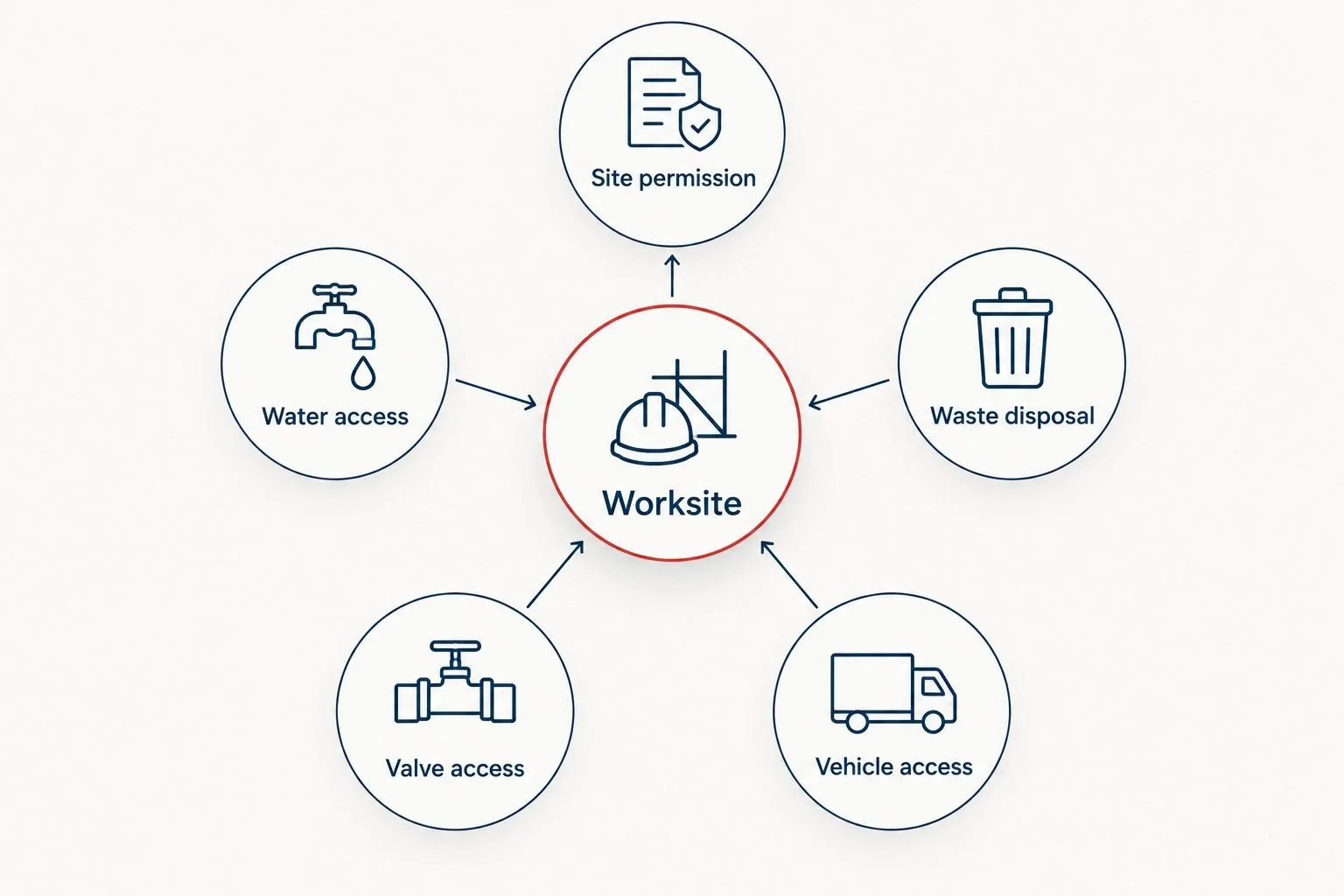
Confirm the worksite before setting an appointment.
Request a quote that describes your RV
Send the symptom notes and photos with the RV’s make, model, and tank configuration if known. If you do not know how many gray tanks your RV has, say so; guessing can create a mismatch between the requested work and the actual setup.
A useful quote request separates tank cleaning from exterior washing or detailing. Ask for each service you want, but do not treat a general maintenance request as confirmation that unrelated work is included.
For your 2026 request, give the RV’s current location and planned storage date. Ask whether the available appointment and site conditions fit that schedule before making arrangements around it.
Share the RV type and known tank configuration.
Attach the symptom notes and access photos.
Give the service location and any gate restrictions.
State the date you intend to move into storage.
Request the scope, exclusions, utility needs, and travel terms.
Request mobile tank cleaning
Share your Davis County location, tank symptoms, and access details to discuss a mobile-service quote.
Verify the result and complete storage preparation
After cleaning, compare the outcome with your original notes. Ask which tanks were addressed, whether drainage appeared normal, and what symptoms remain. A monitor reading is one observation—not a complete test of the tank or plumbing system.
Create 1 storage handoff checklist for the RV. Include the completed cleaning work, any unresolved issue, and the manufacturer’s remaining storage instructions. Keep cleaning separate from freeze protection: water can remain in plumbing components even after holding tanks have been emptied.
Do not add an arbitrary amount of water or treatment for winter storage. Follow the instructions for your RV and the products involved, particularly when freezing conditions are possible.
Record which tanks received cleaning.
Compare the monitor readings with your earlier notes.
Note any persistent odor, slow drainage, or valve problem.
Follow the manufacturer’s cold-weather storage procedure.
Keep the service record with your 2026 storage checklist.
Compare your pre-storage tank care options
Choose by the unresolved problem, not by the strongest-sounding service name. Routine dumping, rinsing, treatment, and professional cleaning serve different purposes. None is a substitute for diagnosing a damaged valve or an electrical sensor fault.
Routine dumping
Best for: Removing the wastewater currently in the tanks
Main benefit: Establishes the starting point for storage preparation
Key limitation: Does not establish that adhered residue is gone
Manufacturer-approved rinsing
Best for: Routine owner care after dumping
Main benefit: Helps move loose waste and rinse water through the tank
Key limitation: Results depend on the system and the condition inside the tank
Compatible tank treatment
Best for: Managing waste and odor during use as directed
Main benefit: Supports the purpose described on the product label
Key limitation: Does not verify cleanliness, repair sensors, or replace freeze protection
Trailhead RV mobile tank cleaning
Best for: Owners seeking on-site black and gray tank cleaning
Main benefit: Brings the service to the RV’s location
Key limitation: Requires confirmed access, permission, utilities, disposal arrangements, and service scope
Keep tank cleaning separate from seasonal protection
The distinction between cleaning and winterization matters because they address different risks. Cleaning targets waste and residue. Winterization addresses freeze protection according to the RV’s plumbing layout and manufacturer’s procedure.
A plan for RV winterizing and seasonal care should keep wastewater cleaning, plumbing freeze protection, and exterior care as separate tasks. Finishing one does not establish that the others are complete, and an exterior coating does not protect water left inside plumbing.
For a Davis County owner storing an RV away from home, this separation also makes booking clearer. Tell each provider exactly what work you need and ask for confirmation of scope. Do not assume a tank-cleaning appointment includes winterization, plumbing repair, roof work, or an inspection.
Before moving the RV, verify where any remaining work will happen. A service permitted at your driveway is not automatically permitted inside a storage facility.
Common mistakes RV owners make before storage
Treating a Full reading as a complete diagnosis
A false reading can involve residue on internal sensors, but cleaning is not an electrical repair. Report whether the reading changes during filling and emptying, and disclose any existing monitor problem. Persistent inaccurate readings need further diagnosis rather than a promise that repeated cleaning will fix them.
Ignoring the gray tanks
Kitchen and shower wastewater leaves residue too. If you request only black-tank cleaning while describing sink odors, the requested scope and the symptom do not match. Identify where the odor occurs and ask whether the relevant gray tank is included.
Booking before getting storage-site permission
A confirmed date does not override the property owner’s rules. Obtain permission and clarify access before arranging a visit to a rented space in Clearfield, Farmington, or another Davis County location. If the site cannot support the work, discuss a suitable alternative location before moving the RV.
Assuming an empty tank is winterized
Emptying a holding tank does not establish that supply lines, traps, valves, pumps, or other plumbing components are protected from freezing. Follow the RV manufacturer’s complete storage procedure. Avoid generic advice about leaving water in tanks when the RV will face freezing conditions.
Using odor treatment to postpone a drainage problem
A treatment product is not a substitute for evaluating a tank that will not empty. Stop adding water when drainage fails and describe the problem to the service provider. A suspected blockage needs a clear plan before routine rinsing or cleaning proceeds.
FAQ
Do I need RV holding tank cleaning before storage if I already dumped?
Dumping removes wastewater but does not prove that residue is gone. If odors, inaccurate internal sensor readings, or recurring buildup remain after normal care, discuss cleaning before storage.
Can mobile tank cleaning happen at my Layton storage space?
It depends on property permission and whether the site supports the work. Confirm access, required utilities, approved waste disposal, service availability, and any travel fee before booking.
Does professional tank cleaning fix sensors stuck on Full?
Cleaning can address residue affecting internal tank sensors, but it does not repair wiring or failed sensor components. Describe the reading before service and ask what further diagnosis is needed if it persists.
Should I clean the gray tank before storing my RV?
Include the gray tank in your pre-storage assessment because soap, grease, and other residue can remain after dumping. Explain any sink or shower odors and confirm which tanks the cleaning request covers.
Is holding tank cleaning the same as winterizing an RV?
No. Holding tank cleaning addresses waste and residue, while winterization addresses freeze protection; follow the manufacturer’s procedure and confirm any separately requested service scope.
How do I request a mobile tank-cleaning quote in Davis County?
Send Trailhead RV your RV’s location, known tank configuration, symptoms, and photos of the dump-valve area and access space. Ask for confirmation of scope, site requirements, availability, and any travel fee.
What should I do if the black tank will not drain?
Stop adding water or continuing a rinse when the tank will not drain. Tell the provider about the drainage failure before arranging routine cleaning, and do not force a resistant valve.
One last thing
Take the monitor photo before you empty the tanks, not just afterward. Comparing both readings gives you a clearer record of the symptom and helps separate an unchanged display from a tank that actually failed to drain. Keep that record through your first trip after storage.
Related guides
About the author
Seth Garecht is the author of this Trailhead RV guide for RV owners preparing for storage in Davis County.