
RV park managers’ tank cleaning is the coordination of RV holding-tank cleaning with the aim of resolving guest waste-system complaints without disrupting park operations. For managers in Weber County, that means separating an individual RV problem from a shared sewer problem, securing owner permission, and confirming access before a mobile visit.
By Seth Garecht
TL;DR
RV tank cleaning for RV park managers starts with identifying whether the problem belongs to the RV or park sewer.
Trailhead-RV provides mobile RV tank cleaning in Weber County; confirm availability, access, utilities, and any travel fee.
Document black and gray tank symptoms separately; cleaning does not guarantee a sensor repair.
Get owner authorization and park permission before arranging service at an occupied campsite.
Why tank cleaning matters for Weber County RV park managers
Sensors stuck on Full? Odors after dumping? Those complaints need a clear response, but they do not establish the cause. A tank reading, a slow discharge, and an overflowing park connection are different problems.
Trailhead-RV mobile RV tank cleaning fits Weber County park managers who need service at parked RVs. The veteran-owned business serves Weber, Davis, and Salt Lake Counties, with Layton as its primary base. Managers arranging a visit in Ogden, Roy, or West Haven can start with Trailhead-RV and confirm the specific location and requested work.
For your 2026 operating checklist, keep responsibility clear: the owner authorizes work on the RV, the park approves activity on its property, and the provider confirms the service requirements. Do not treat one permission as a substitute for another.
How to coordinate RV tank cleaning at your park
1. Record the complaint before choosing a service
Start with a short conversation and a written incident note. Ask what happened, which tank is involved, and whether the complaint began before or after dumping. Record observations rather than diagnosing the problem from the office.
Black tanks collect toilet waste; gray tanks collect wastewater from fixtures such as sinks and showers. An RV can have more than one gray tank, so ask the owner to identify the actual configuration rather than assuming a standard layout.
Use the same intake format throughout 2026. Consistent notes help the next staff member understand what has already been checked without asking the guest to start again.
Record the campsite and owner’s contact details.
Identify each affected tank and its reported symptoms.
Note the last dumping attempt and what the owner observed.
Ask about visible leaks, backups, or damaged connections.
Request 3 photos: the monitor, discharge connection, and access route.
2. Separate the RV problem from the park connection
Check the scope before asking anyone to open valves or disconnect hoses. A problem reported by one owner needs different triage from wastewater backing up at several sites. Multiple affected sites warrant attention to shared infrastructure, not an automatic tank-cleaning appointment.
Keep staff within their training and responsibilities. Do not ask an employee to loosen a suspect fitting to test a theory. If wastewater is escaping, keep guests away from the affected area and follow the park’s response procedure.
Tank cleaning addresses holding-tank deposits; it is not a substitute for sewer-line repair. Tell the provider about any uncertainty before booking.
Ask whether nearby occupied sites report similar symptoms.
Distinguish a monitor reading from an observed drainage problem.
Record where any backup or discharge is visible.
Flag suspected park-side problems for the appropriate contractor.
Avoid opening connections while the fault remains unclear.
3. Match the service to the actual complaint
Review the owner’s operating manual first. Routine dumping and manufacturer-directed rinsing belong in normal owner care; persistent symptoms justify discussing professional cleaning or a separate repair assessment. Do not have staff improvise chemical combinations or force a blockage through unfamiliar plumbing.
The distinction between black tank flushing and professional cleaning helps explain why repeating a routine rinse is not the same request as arranging a cleaning service.
Trailhead-RV offers mobile black and gray tank cleaning. Ask the provider to confirm the proposed work for the reported symptoms rather than promising the guest a particular result.
Identify whether black, gray, or both tank systems need attention.
Describe any cleaning or treatments already attempted.
Disclose known valve, hose, or connection problems.
Ask what the proposed cleaning includes and excludes.
Keep sensor repair and damaged-component repair separate from cleaning.
4. Confirm permission and physical access
Walk the access route yourself before scheduling. An RV that fits a campsite does not automatically leave enough working room beside its discharge connection. Parked vehicles, stored belongings, fences, and neighboring rigs can restrict access.
For a Weber County appointment, provide the actual park location and site details, not just an Ogden-area description. Confirm gate procedures, permitted work periods, and the route the provider should use. These are property-specific arrangements, not countywide rules.
Keep 2 contacts on the booking: the owner who can authorize RV work and the park representative who can answer site-access questions. Confirm who will be present or reachable during the visit.
Owner authorization: identify who can approve work on the RV.
Park permission: confirm outside-provider rules with management.
Access route: describe gates, turns, parking, and working space.
Utility requirements: ask what water or power arrangements are needed.
Disposal access: confirm the approved discharge arrangement with the provider.
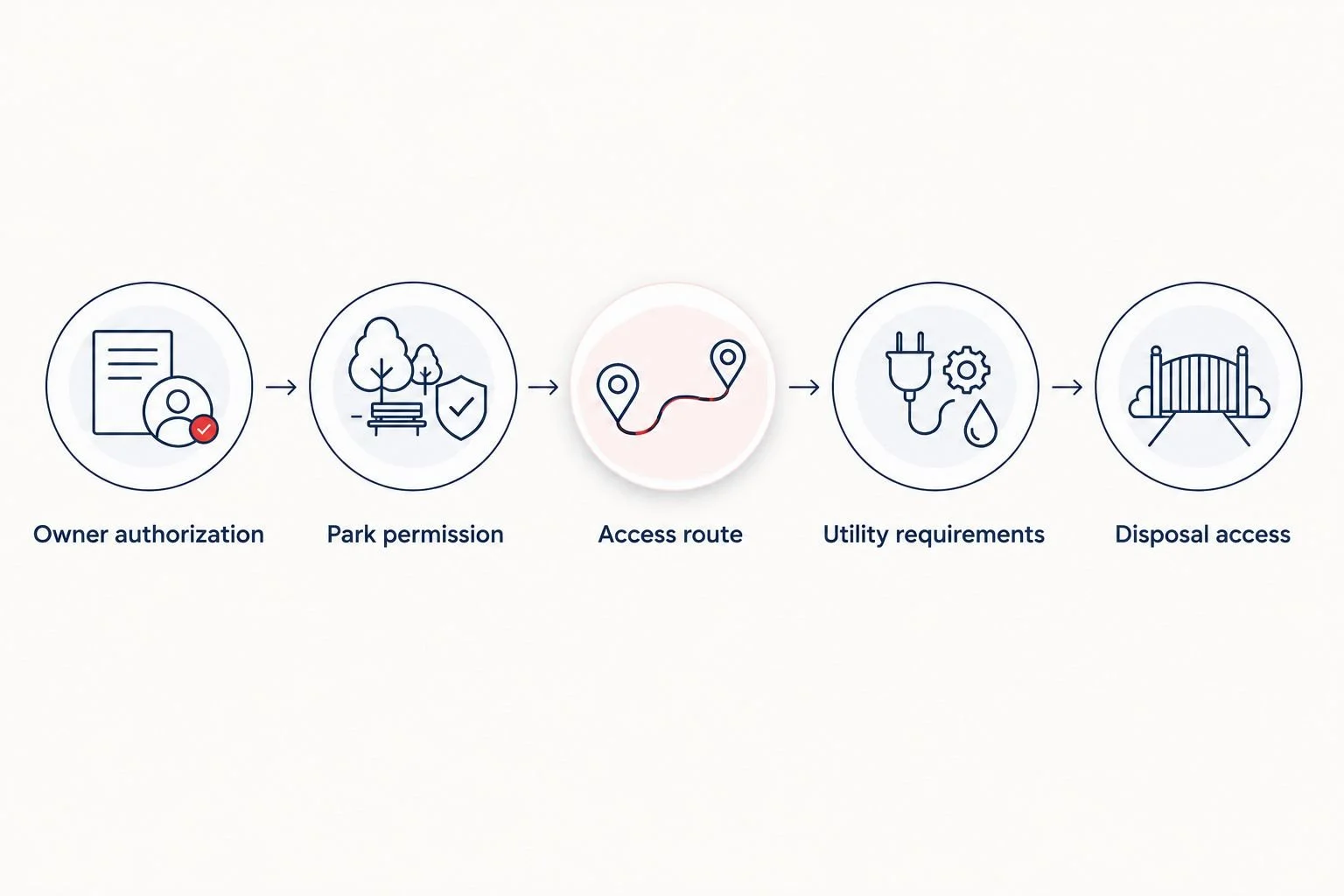
Resolve access and permission questions before confirming the visit.
5. Request a defined scope before scheduling
Send the complaint notes and access details together. A request for tank cleaning is more actionable when it identifies the affected RV, tank configuration, and symptoms. A vague request to fix a smell leaves too much unresolved.
Ask Trailhead-RV to confirm availability for the specific Weber County site, required utilities, any travel fee, and the proposed scope. Mobile service means the business comes to the RV’s location; it does not establish that every campsite is suitable for the work.
If several owners want appointments, ask whether the provider can coordinate them. Do not advertise a group-service day until the provider and participating owners have agreed to the arrangements.
Describe 1 RV completely before adding other requests.
Separate required work from optional work.
Ask whether all affected tanks are included in the scope.
Confirm owner payment responsibility and authorization.
Request instructions for preparing the RV and site.
6. Coordinate the visit without blocking park operations
Choose a proposed work period around the park’s actual access conditions, then confirm it with the owner and provider. Do not promise a completion time before the provider has reviewed the job. Tank configuration, access, and the reported problem need to be understood first.
For your 2026 service calendar, distinguish a requested appointment from a confirmed appointment. Staff should know which status applies before directing a guest to move vehicles or remain at the campsite.
Keep the working area clear without taking over the technical work. The provider should direct service preparation; park staff should handle property access and guest communication.
Share arrival instructions with the owner and provider.
Keep access to neighboring sites and park facilities open.
Identify who can approve a change in scope.
Keep pets and bystanders away from the work area.
Confirm how staff will receive completion or follow-up information.
7. Close the job with observations, not promises
Ask what work was completed, what was observed, and what remains unresolved. Record the owner’s reported symptoms separately from the provider’s findings. That distinction matters if the guest reports the same problem later.
A cleaner tank does not prove that a sensor, valve, vent, or park sewer connection is working correctly. If a symptom remains, ask what the appropriate next assessment is rather than declaring the cleaning unsuccessful or requesting an automatic repeat.
Add the outcome to the same 2026 incident record. Keep owner information limited to what staff need for service coordination and follow the park’s privacy practices.
Record the tanks serviced and the completed scope.
Note symptoms that remain after the visit.
Capture the provider’s operating or follow-up instructions.
Identify whether repair or park-side assessment is still needed.
Tell the owner whom to contact about an unresolved issue.
Compare responses by problem, not by convenience
The right response depends on where the problem sits. Routine owner care, mobile tank cleaning, and park-side plumbing work serve different purposes. None replaces the others.
Owner-directed dumping and rinsing
Best for: Routine care covered by the RV manual
Main advantage: Keeps normal operation with the owner
Key limitation: Does not establish the cause of persistent symptoms
Mobile RV tank cleaning
Best for: Holding-tank cleaning at an approved campsite
Main advantage: Avoids moving the RV to another service location
Key limitation: Access must be confirmed; cleaning is not a guaranteed sensor or component repair
RV repair assessment
Best for: Suspected faults in RV valves, vents, sensors, or plumbing
Main advantage: Addresses component and system diagnosis
Key limitation: A separate scope from tank cleaning
Park-side drain assessment
Best for: Suspected restrictions or backups in shared infrastructure
Main advantage: Focuses on the park connection or sewer system
Key limitation: Does not clean deposits inside an individual RV tank
Approve the scope before approving the visit. Comparing drain cleaning costs only makes sense after identifying the affected pipe and proposed removal method; an RV holding-tank cleaning quote and a park sewer-line quote describe different work.
Use the same boundary when communicating with guests. If a park-side restriction is suspected, explain who is assessing it. If an owner’s tank needs cleaning, explain what permission and access are required. Do not present either service as a complete answer before the cause is established.
Common mistakes RV park managers make
Treating a Full reading as a confirmed blockage
A monitor reading is a symptom, not a diagnosis. Ask about actual drainage and recent dumping before choosing the response. Keep electrical or sensor assessment separate if cleaning does not resolve the reading.
Booking work without the owner’s authorization
Permission to enter the park does not authorize work on a guest’s RV. Identify the approving owner and explain who is responsible for the service request before the provider arrives.
Assuming a sewer hookup guarantees service access
A hookup does not establish adequate working space, utility suitability, or permission for the proposed procedure. Send connection and access photos, then let the provider confirm requirements.
Promising the whole park can be serviced together
Several interested owners do not equal a confirmed group appointment. Tank configurations, scope, access, and scheduling need individual confirmation. Avoid announcing a service date before those details are settled.
Request a mobile-service quote in Weber County
Send Trailhead-RV the park’s location, campsite identifier, owner contact, tank configuration, symptoms, and access photos. State that the request is for mobile RV tank cleaning at an occupied park and describe any shared-dump or gate restrictions.
Confirm service availability, site permission, required utilities, and any travel fee before booking. If the owner is not available during the visit, settle authorization and access arrangements in advance rather than leaving those decisions to front-desk staff.
Request mobile tank cleaning
Share your Weber County location, tank symptoms, and access details to request a quote.
FAQ
Can a mobile provider clean an RV tank at an occupied campsite?
A mobile visit requires confirmed site permission, access, utilities, and an approved discharge arrangement. Send the provider the campsite details before booking; an occupied site is not automatically suitable for service.
Does a tank sensor stuck on Full mean the tank is blocked?
No, a Full reading alone does not establish a blockage. Record drainage behavior and recent dumping history, then discuss cleaning or further assessment based on the full complaint.
Should a park manager arrange black and gray tank cleaning together?
Ask for a scope covering the tanks that need attention rather than assuming both are included. Identify the actual tank configuration and report black and gray symptoms separately.
Can RV tank cleaning fix the park’s sewer line?
No, RV holding-tank cleaning and park sewer-line work address different systems. Suspected shared-infrastructure problems need a separate assessment.
Does Trailhead-RV serve RV parks in Weber County?
Trailhead-RV provides mobile RV tank cleaning throughout Weber County, within its three-county Utah service area. Confirm availability for the specific park, access requirements, utilities, and any travel fee before scheduling.
Can several RV owners book service on the same day?
Ask the provider to confirm whether coordinated appointments are possible. Each owner’s authorization, tank configuration, scope, and site access still need to be established.
What should an RV park record after a 2026 tank-cleaning visit?
Record the completed scope, tanks serviced, remaining symptoms, and follow-up instructions. Keep reported complaints separate from confirmed findings so later staff can understand the outcome.
One last thing
Ask where the symptom occurs before asking who can clean it. An odor inside the RV, a misleading monitor reading, and wastewater rising at a park connection should not enter your 2026 service log as the same problem. That distinction helps you request the right work without promising an outcome the provider has not assessed.
Related guides
About the author
Seth Garecht is the author of this guide for RV park managers coordinating mobile tank cleaning in Weber County, Utah.