
Weak hot water before storage? For RV tankless water heater descaling before winterizing, complete any manufacturer-required descaling and flushing first, then follow the heater’s separate freeze-protection instructions; reversing that order can mean reopening a system already prepared for storage.
By Seth Garecht | 2026 Layton RV storage guide
TL;DR
RV tankless water heater descaling before winterizing requires the exact heater manual, not a generic flushing recipe.
Descaling removes mineral deposits; winterizing addresses freeze protection. Neither procedure replaces the other.
Trailhead-rv serves Layton owners needing mobile RV washing and tank cleaning; confirm heater-service scope before booking.
Confirm site permission, utilities, service availability, and any travel fee before arranging mobile work.
Why this matters
A clean heater is not automatically a winterized heater. Descaling addresses mineral deposits inside the water-heating circuit. Winterization addresses water that can freeze inside the heater and connected plumbing.
Treat these as 2 separate procedures on your 2026 storage checklist. The correct valve positions, approved cleaning solution, flushing method, and freeze-protection procedure depend on the installed heater—not just the RV’s make.
For the wider storage sequence, read why winterize your RV in Utah. This guide focuses on the handoff between heater cleaning and winterization, with Layton owners’ mobile-service access needs in mind.
Manufacturer-directed descaling
Best for: A heater due for mineral-deposit maintenance
What it addresses: Mineral deposits in the water-heating circuit
What it does not establish: That the heater is protected against freezing
Manufacturer-directed winterization
Best for: An RV entering freezing storage conditions
What it addresses: Water remaining in freeze-sensitive components
What it does not establish: That the heater’s mineral deposits have been removed
Descaling adds a cleaning and flushing task before storage. Winterization requires its own checks afterward. Combining them into one undocumented task makes it harder to know whether either was completed correctly.
Before you start
Identify the equipment. Gather the exact heater model, its operating and maintenance manual, the RV plumbing instructions, and any records of previous modifications. Take 3 photos: the model label, accessible plumbing connections, and current valve positions.
Confirm the materials and worksite. Use only the cleaning agent, equipment, protective gear, and disposal method permitted by the applicable instructions. Arrange access to the heater, approved water and power sources where needed, and a permitted place to collect or dispose of used solution.
Check the non-obvious trap. Do not assume every tankless heater accepts antifreeze through its heating circuit or supports a recirculating descaling setup. Find the model-specific descaling and winterization procedures before disconnecting anything. If either procedure is unclear, stop and request qualified service.
For a mobile visit at a Layton storage lot, permission matters as much as equipment access. Ask the property manager whether the proposed work is allowed, where the technician can park, and how wastewater must be handled. A nearby hose bib is not permission to use it.
Heater identification and worksite setup
Establish the approved procedure
Match the model label to the manual. Read the installed heater’s identification label rather than relying on an RV sales listing. Confirm that the manual covers the installed model and any relevant configuration.
Locate both maintenance procedures. Find the descaling instructions and the winterization instructions. Record whether the manufacturer calls for draining, bypassing, antifreeze, compressed air, or another specified method; do not substitute a method from a different heater.
Check the plumbing layout. Identify the connections and valves referenced by the instructions. If the physical layout differs from the diagram, resolve that difference before turning valves or attaching equipment.
Confirm safe shutdown. Follow the manufacturer’s instructions for shutting down the heater, allowing it to cool, isolating the appropriate supplies, and relieving pressure. Never open a hot or pressurized connection.
Expected result: You can identify the heater, explain its approved maintenance sequence, and match each required connection to the actual plumbing. If you cannot, the next step is service—not a trial run.
Confirm the Layton worksite
Before a 2026 mobile appointment, give the provider the RV’s actual location and access instructions. Explain whether it is in a driveway, campground, or gated storage facility, and whether the heater’s service side faces a fence or another RV.
Ask these questions before agreeing to the visit:
Does the property permit this specific work?
Who supplies any required water and electricity?
How will cleaning solution and rinse water be contained and handled?
Does the provider perform this exact heater procedure?
Are service availability and any travel fee confirmed?
Expected result: The provider has enough information to confirm scope and access without assuming that every Layton storage space supports wet maintenance.
Descaling and rinse completion
Follow the heater’s cleaning procedure
Inspect the accessible work area before setup. Look for visible leaks, damaged connections, or anything that prevents safe access. Report problems rather than treating descaling as a repair for every hot-water symptom.
Prepare only the approved cleaning arrangement. Use the connections, solution, concentration, and equipment specified for the heater. Do not improvise a circulation loop because a video shows one on a different model.
Perform the specified cleaning cycle. Follow the manufacturer’s contact time, circulation requirements, and operating restrictions. Do not fire the heater during cleaning unless its instructions explicitly require that operation.
Complete the required rinse. Follow the specified flushing procedure and handle the discharged liquid according to the product instructions and site requirements. Clear-looking water alone does not prove that the rinse procedure is complete.
Restore the specified configuration. Reconnect components and position valves as instructed. Perform any required leak and operating checks before beginning the separate storage procedure.
Expected result: The approved descaling and rinse steps are complete, cleaning equipment is removed, and the heater is ready for the next manufacturer-directed task.
Do not invent a universal cleaner recipe. Heater materials and approved maintenance methods differ. A household acid, stronger mixture, or longer soak is not automatically an acceptable substitute.
Keep the completion record specific: identify the heater model, the procedure followed, the cleaning agent used, and any unresolved symptom. “Flushed heater” is too vague to distinguish a freshwater rinse from a completed descaling procedure.
Winterization handoff and storage record
Complete the separate freeze-protection procedure
Finish any required operating check first. If the maintenance instructions require checking the heater with water flowing, complete that check before the final winterization. Reintroducing water afterward changes the storage condition.
Follow the heater’s winterization instructions. Use its specified shutdown, draining, bypass, antifreeze, or compressed-air procedure as applicable. Never infer air-pressure limits or antifreeze routing from general RV advice.
Coordinate the rest of the RV plumbing. The heater procedure does not automatically address faucets, toilets, exterior showers, filters, pumps, or other water-connected equipment. Follow the RV instructions and each applicable component manual.
Document the final configuration. Keep 1 written handoff with the completion date, valve positions, unresolved issues, and restart instructions. Attach photographs where they help explain the setup.
Expected result: The heater and RV plumbing have each received their applicable storage procedure, and the next person knows the final configuration.
The useful sequence is simple: identify the equipment, complete approved cleaning, finish the rinse, then perform winterization. Your 2026 record should show where one procedure ended and the next began.
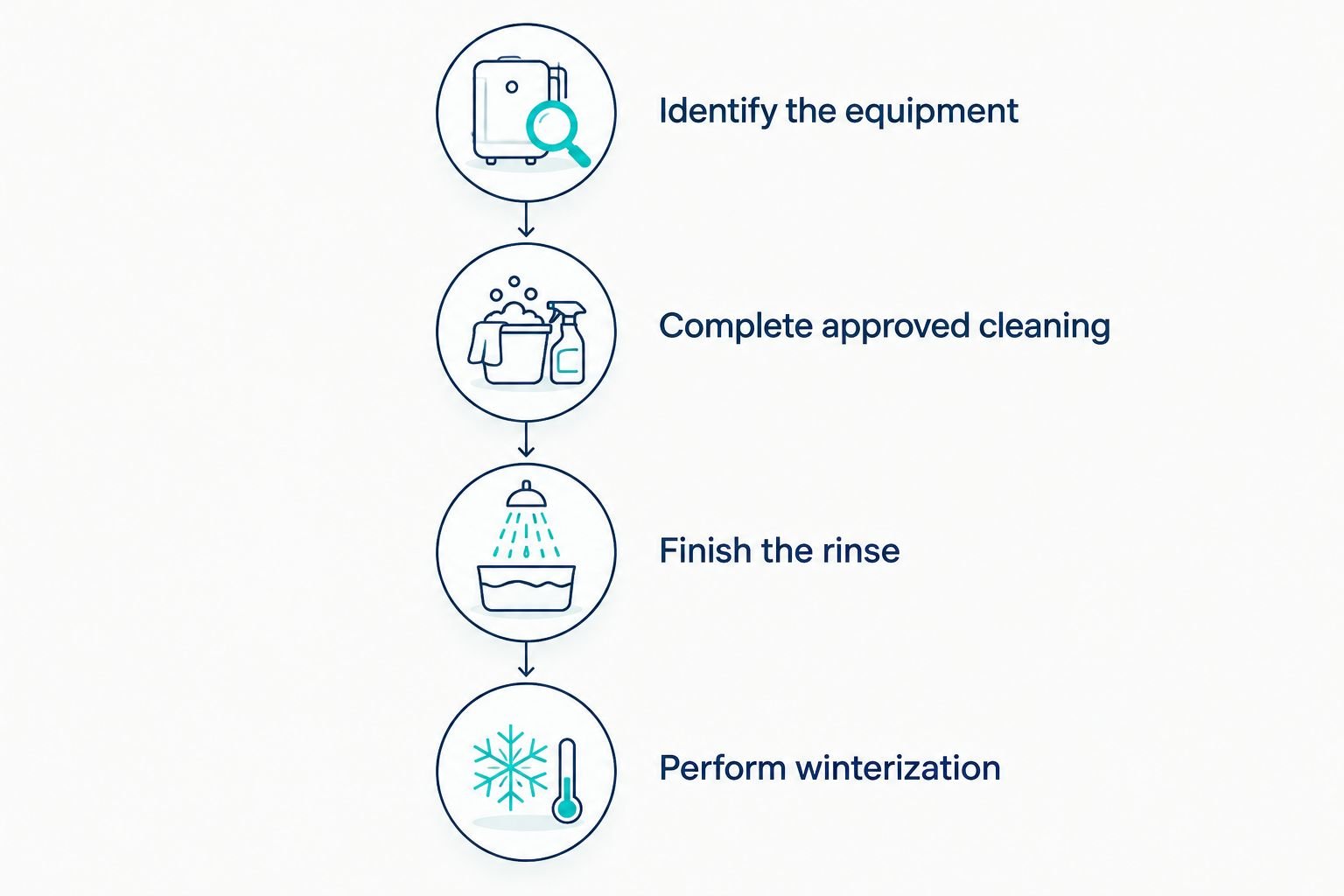
Finish cleaning and rinsing before completing the heater’s separate winterization procedure.
A storage tag can help prevent an accidental restart, but it does not replace the manual. State that the RV is winterized and direct the next user to the written restart instructions before operating water-connected equipment.
If the RV is already winterized
Do not reconnect water just to fit descaling into the calendar. First check whether the heater’s maintenance instructions call for descaling now and whether a qualified provider recommends reopening the system.
If cleaning requires introducing water, plan for the affected winterization steps to be completed again afterward. That includes connected plumbing disturbed during the work, not just the heater’s accessible drain point.
For an already-winterized RV in Layton, tell the provider exactly what was done: which procedure was followed, whether antifreeze was used, and whether any plumbing has been reopened. Do not describe the system simply as “empty.”
This variant suits owners who discover overdue maintenance after preparing for storage. Its drawback is repeat setup and freeze-protection work. Unless maintenance or a diagnosed problem requires immediate attention, agree on timing with the heater-service provider rather than reopening the system without a complete plan.
Troubleshooting
You cannot find descaling instructions
Confirm the exact model and contact the heater manufacturer or a qualified service provider. Do not assume a missing procedure means a generic pump-and-bucket method is approved. Keep the heater safely shut down while the method is clarified.
Water flow remains weak after cleaning
Descaling does not establish the cause of every flow problem. Check the manual’s troubleshooting sequence for supply, filters, strainers, and other applicable components. Do not repeat chemical cleaning at a stronger concentration to compensate for an undiagnosed restriction.
Hot water still fluctuates
Record when the problem occurs, which fixtures are affected, and any displayed fault code. Use the exact code in the model’s troubleshooting instructions. Persistent temperature problems require diagnosis; they are not proof that another cleaning cycle is needed.
A connection leaks after reassembly
Stop the procedure and follow the equipment’s safe shutdown instructions. Have the connection corrected before further operation or storage preparation. Do not leave a known leak for the next owner or technician to discover during spring startup.
The storage facility refuses the work
Ask the provider about a permitted alternative location before moving the RV. Confirm access, utilities, wastewater handling, scheduling, and any travel fee again for that location. Permission at one property does not transfer to another.
Customize your workflow for Layton storage
Use the heater appointment as a planning checkpoint, not permission to assume every maintenance task is included. Ask each provider to state the work being performed and what remains your responsibility.
Trailhead-rv is best for Layton RV owners seeking mobile washing, detailing, and holding-tank cleaning at their location. The veteran-owned service covers Davis, Weber, and Salt Lake Counties, including nearby Clearfield and Kaysville; confirm service availability for your address.
For heater descaling or winterization, ask Trailhead-rv to confirm the exact scope before booking. Do not treat a general maintenance request as confirmation that either procedure is included.
If odors or unreliable holding-tank readings are also on your storage list, review RV holding tank cleaning before storage. Holding tanks are separate from the water heater, so describe those symptoms separately in the quote request.
Send your RV type, Layton location, heater model, symptoms, access details, and desired work. For a 2026 mobile-service quote, also ask about site permission, utilities, wastewater handling, and any travel fee.
Request a Layton mobile-service quote
Share your location, RV details, and requested work. Confirm heater-service scope before booking.
FAQ
Should I descale my RV tankless water heater before winterizing?
Complete any manufacturer-required descaling and flushing before the final winterization procedure. Check the exact heater manual to establish whether descaling is due and which method is approved.
Does descaling winterize a tankless RV water heater?
No. Descaling addresses mineral deposits, while winterization addresses freeze protection. Complete the heater’s separate storage procedure after cleaning and rinsing.
Can I run RV antifreeze through my tankless water heater?
Use antifreeze only as directed by the exact heater’s winterization instructions. Do not assume that a method approved for another heater applies to yours.
Can I descale a heater after my RV is already winterized?
Descaling after winterization requires checking the approved procedure and planning to restore freeze protection wherever the work introduces water. Tell the provider how the RV was winterized before arranging maintenance.
Does Trailhead-rv provide heater descaling and winterization in Layton?
Confirm heater descaling and winterization scope directly before booking. Trailhead-rv provides mobile RV washing, detailing, and tank cleaning throughout Davis, Weber, and Salt Lake Counties.
Can a mobile technician work at my Layton RV storage lot?
Mobile work requires the storage property’s permission and a suitable worksite. Confirm access, utilities, wastewater handling, service availability, and any travel fee before the appointment.
What should I include in a heater-service quote request?
Include the heater model, RV type, location, symptoms, and whether the system is already winterized. Add photographs of the model label and accessible connections, and ask the provider to confirm the requested procedure.
One last thing
Record what happened after winterization, not just when it was completed. If someone reconnects water, tests a faucet, or operates the heater later, tell the person responsible for freeze protection. The latest plumbing work determines which storage checks need repeating.
Related guides
About the author
Seth Garecht is the author of this RV maintenance guide.