
Instead of washing your RV, covering it too soon, and uncovering it to damp fabric or trapped grit, arrange the wash first and leave the cover off until the RV and cover are dry. For Clinton, Utah, owners, the practical workflow is to confirm mobile-service access, clean compatible surfaces, check hidden wet spots, and fit the cover according to its instructions.
TL;DR
RV wash before cover Clinton Utah: clean first, dry completely, then secure the cover according to its instructions.
Trailhead-RV provides mobile RV washing for Clinton owners within its Davis County service area.
Confirm site permission, utilities, service availability, and any travel fee before scheduling.
A dry sidewall does not prove that roof edges, folded fabric, or the cover itself are dry.
By Seth Garecht
Why this matters
Grit left between a cover and an RV creates an avoidable contact problem when the fabric moves. Covering wet surfaces also puts the cover on before the cleaning job is finished. The stopping point is a clean, dry RV—not simply the end of the wash appointment.
Trailhead-RV is best for Clinton RV owners who want mobile washing at their RV’s location. The veteran-owned business serves Weber, Davis, and Salt Lake Counties, with Layton as its primary base. Mobile service removes the need to drive to a wash location, but the parking site still needs permission and suitable access.
For your 2026 storage plan, start with Trailhead-RV and describe the RV, its Clinton location, and your intended cover date. Confirm service availability, utilities, site permission, and any travel fee before agreeing to an appointment.
Before you start
Gather instructions: Have your RV exterior-care instructions and cover instructions available. Identify the roof material and any surface-specific cleaning restrictions; do not assume every exterior panel accepts the same treatment.
Confirm the work site: Get property-owner or storage-manager permission where required. Ask about washing, runoff, access, utilities, and whether the RV can remain uncovered while it dries.
Leave room for drying: Do not book the cover installation against the wash finish time. Water can remain around roof edges, trim, and folded fabric after the broad panels look dry; a damp cover also needs drying before use.
Take 3 photos for the quote request: the full RV, the parking approach, and the space around the RV. These pictures help explain access without assuming a technician can work comfortably wherever the RV happens to fit.
Booking and site setup
Describe the actual job. Say that you want an exterior wash before fitting a storage cover. Include the RV type, approximate size if known, roof material if known, and visible concerns such as road film, bird droppings, or sticky deposits.
State the Clinton location. Identify whether the RV sits at a home, storage facility, or another permitted property. Include gate procedures and any restrictions on appointment timing.
Confirm the service scope. Ask which surfaces the proposed wash includes. Do not assume roof cleaning, awning cleaning, stain removal, or a protective treatment comes with every exterior wash.
Resolve the utility questions. Ask what water and power access the appointment requires and who supplies them. Confirm runoff arrangements with the provider and property manager rather than assuming any paved space is suitable.
Separate washing from covering. Explain when you intend to fit the cover, but make that timing conditional on the drying checks. Do not treat a calendar deadline as proof that the RV is ready.
Expected result: You have an agreed location, permission, service scope, utility arrangement, and drying plan before the appointment begins.
Clinton is the primary location for this guide. Nearby Clearfield or Layton addresses still need their own access details; proximity does not establish permission, utilities, or appointment availability. For your 2026 booking, provide the actual work address rather than just the nearest city.
Exterior cleaning preparation
Clear the working space. Move loose belongings away from the RV and explain any obstacles that cannot move. Keep access to the entry door and required work areas clear.
Close exterior openings. Check windows, roof vents, and storage doors before washing. Follow the RV manufacturer’s instructions for appliances, vents, and other exterior equipment.
Point out existing problems. Tell the technician about loose trim, damaged seals, peeling graphics, or known leaks. This is information for planning the wash, not a substitute for a repair or inspection service.
Confirm material compatibility. Roof membranes, painted panels, decals, and acrylic surfaces need cleaning methods suited to their materials. Avoid selecting one cleaner or pressure setting for the entire RV without checking those requirements.
Keep the cover off the ground. Store it cleanly while the RV is washed. Dragging the inside of the cover across a dirty driveway puts grit back against the finish later.
Expected result: The RV is accessible, openings are closed, known concerns are communicated, and the cover remains clean while the exterior is washed.
An exterior wash does not repair failed seals or make damaged surfaces ready for storage. If you find an active leak or loose component, arrange the appropriate repair separately before concealing the area beneath a cover.
Drying checks
Do not assign a universal drying time. Shade, airflow, weather, surface details, and the cover material change the situation. Use direct checks and the manufacturer’s instructions instead of a fixed countdown.
Check the panels. Look for water beads and damp areas on accessible sidewalls. Where the care instructions permit, use a clean drying towel rather than leaving removable surface water in place.
Check the edges. Look at accessible gutter outlets, trim, compartment edges, and other places that release water after the main panels dry. Do not climb onto a wet roof to speed up the check.
Check the fabric. If an awning was cleaned or became wet, follow its instructions for drying before storage. The cover itself must also be dry; washing the RV does not solve a damp-cover problem.
Check the ground. Keep the cover’s interior away from puddles, mud, and loose debris during installation. A clean RV can be recontaminated while the cover is being unfolded.
Expected result: All 4 checks are complete, no accessible wet areas remain, and the cover is clean and dry before fitting begins.
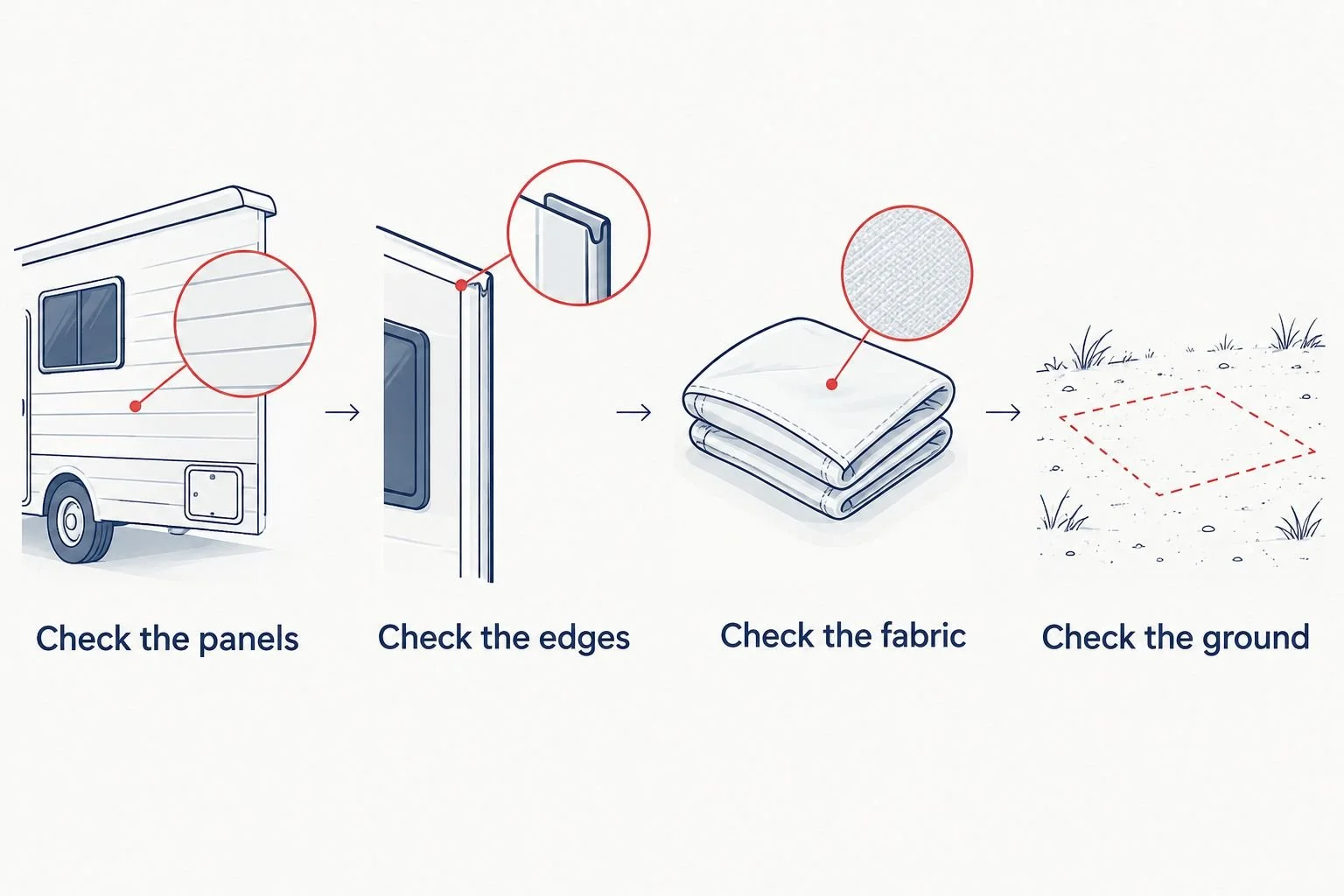
Check the places that stay wet after broad exterior panels look dry.
For a 2026 storage checklist, write down the condition you need—clean and dry—not an assumed number of drying hours. If rain rewets the RV before covering, repeat the drying checks.
Cover fitting
Confirm fit and orientation. Use the cover maker’s labels and instructions to identify the front, rear, and intended attachment points. Do not force an incorrectly sized cover around exterior equipment.
Protect contact points as directed. Follow the cover instructions for antennas, corners, ladders, and other protrusions. Do not improvise padding that traps grit or interferes with equipment.
Keep the inner surface clean. Unfold and position the cover without dragging its interior across the ground. Stop and remove debris if the fabric picks up dirt.
Secure the cover correctly. Use the specified straps and attachment method. Avoid pulling fabric so tightly that it loads fragile exterior parts.
Check doors and intended access. Confirm how you will reach the RV if needed without tearing the cover or disturbing its attachments.
Expected result: The cover sits in its intended position, its interior stays clean, and its attachments follow the manufacturer’s directions.
Cover fitting is part of your storage workflow, not a confirmed inclusion in Trailhead-RV’s mobile wash service. Ask who will install the cover and make that responsibility clear before booking.
A second workflow: wash after a trip
A post-trip wash and a pre-cover wash share the same cleaning principles, but they solve different scheduling problems. Choose the workflow based on what happens next—not just how dirty the RV looks.
Pre-cover wash
Best for: Owners preparing for covered storage
Benefit: Places cleaning and drying immediately before covering
Limitation: Requires suitable access and enough time to complete drying
Post-trip wash
Best for: Owners removing travel grime before the next use
Benefit: Separates cleanup from a later storage deadline
Limitation: Another check is needed if the RV gets dirty before covering
After a trip, remove belongings needed for cleanup and identify fresh deposits before arranging service. If the RV will remain uncovered, check its condition again before eventually fitting the cover. A wash performed earlier does not establish that the surface is still clean or dry.
For your 2026 travel schedule, make 2 decisions separately: when the RV needs cleaning and when it needs covering. Combining them works only when the site and drying conditions support both.
Cleaning versus protection
A wash removes contamination; a protective treatment is a separate surface-care decision. Choosing RV wash and wax products does not replace checking compatibility with your RV’s finish or following any application and curing instructions before covering.
Ask what treatment, if any, is proposed for your RV. Do not assume a wash includes wax, that every roof accepts the same product, or that a newly treated surface is ready for immediate cover contact.
Troubleshooting
The sidewalls are dry, but water keeps dripping
Check accessible edges, gutters, and trim rather than covering over the drips. Allow those areas to finish draining and drying, then repeat the check. Do not remove trim or seals just to release water.
Rain starts before the cover goes on
Pause the covering plan and repeat the drying checks after the weather clears. A completed wash appointment does not make a newly wet RV ready for storage. Keep the cover dry and clean while you wait.
The storage facility does not permit washing
Do not proceed without permission. Ask the provider whether another permitted location within the service area can accommodate the appointment, then confirm that location’s utilities, access, and runoff requirements. A mobile business still needs a workable site.
The cover smells musty or feels damp
Dry and clean the cover according to its own instructions before fitting it. Do not use the RV as a drying rack under a secured cover. Check the inner fabric for grit as well as moisture.
Streaks remain after the wash
Identify whether the marks are residue, mineral deposits, or a surface defect before adding more chemicals. Ask about a material-compatible correction rather than escalating to an abrasive pad or stronger cleaner. Do not hide unresolved damp residue beneath the cover.
Customize your workflow
Make the quote request specific: Clinton location, RV details, parking photos, permission status, utility access, desired wash scope, and intended cover date. The mobile RV wash preparation guide expands the access checklist before an appointment.
For 2026 storage preparation, keep tank care, exterior cleaning, repairs, and winterization as separate scope questions. An exterior wash does not establish that those other tasks are complete, and winterization is not a service inclusion to assume.
Request a Clinton RV wash quote
Share your RV details, parking access, and cover date. Confirm utilities, permission, and any travel fee.
FAQ
Should I wash my RV before putting a cover on in Clinton, Utah?
Yes—clean the exterior and let both the RV and cover dry before fitting the cover. Remove grit and follow the RV and cover manufacturers’ care instructions.
How long should my RV dry before I cover it?
Use surface checks rather than a fixed drying time. Check accessible panels, edges, fabric, and the cover itself; weather and airflow affect when those areas are dry.
Can a mobile RV wash come to my Clinton storage space?
Trailhead-RV serves Clinton within Davis County, but the specific appointment and site must be confirmed. Get storage-manager permission and confirm access, utilities, runoff arrangements, and any travel fee.
Does an RV wash include roof cleaning and cover installation?
Do not assume roof cleaning or cover installation is included. Ask which surfaces the quoted wash covers and who is responsible for fitting the cover.
Should I wax my RV before covering it?
Follow your RV finish and cover instructions rather than treating wax as a requirement for every RV. If a protective treatment is applied, follow its application and curing instructions before covering.
What if my cover is wet but my RV is dry?
Dry the cover according to its instructions before installing it. Check its inner surface for dirt so the cover does not transfer grit onto the clean RV.
What should I send when requesting a pre-cover wash quote?
Send the Clinton work location, RV details, parking photos, and intended cover date. Confirm permission, service scope, utility requirements, appointment availability, and any travel fee.
One last thing
Check the inside of the cover before checking the straps. A dirty cover can put grit back onto an RV immediately after washing. Keep it off the ground, inspect the contact surface, and postpone fitting if either the fabric or RV is wet.
Related guides
About the author
Seth Garecht writes RV care articles for Trailhead-RV, a veteran-owned mobile RV wash, detailing, and tank cleaning service serving Weber, Davis, and Salt Lake Counties in Utah.