
Clean your RV roof on the schedule specified by its roof manufacturer, and address bird droppings, sap, leaves, or other buildup between scheduled washes using approved methods. For Salt Lake County owners, the right interval depends on the roof material, storage conditions, and visible contamination—not a universal monthly rule. Cleaning does not replace leak diagnosis, seal repairs, or any separate maintenance the manufacturer requires.
TL;DR
How often should an RV roof be cleaned? Follow its manufacturer’s schedule and address contamination between washes.
Salt Lake County owners should account for outdoor storage, tree debris, and safe roof access.
Confirm roof-cleaning scope, site permission, utilities, availability, and any travel fee before booking mobile service.
By Seth Garecht
How often should an RV roof be cleaned in Salt Lake County?
Use the roof manufacturer’s maintenance schedule as your baseline, then respond to the actual condition of the roof. A clean roof stored under cover presents a different cleaning need from a roof collecting leaves beneath trees. Neither situation justifies ignoring the manufacturer’s instructions.
For your 2026 maintenance plan, start with the roof documentation rather than a generic cleaning calendar. If you cannot identify the roof material, ask the RV manufacturer before choosing a cleaner or booking work.
Use this sequence to decide whether cleaning is due:
Identify the roof. Find the roof material and its care instructions in your owner documentation.
Check the schedule. Record the manufacturer’s cleaning interval and any restrictions on methods or products.
Check the condition. Look for accumulated debris and contamination without climbing onto a roof unless access is approved and safe.
Confirm the work. Match the cleaning method to the roof and confirm what the service includes.
The mobile RV wash preparation guide is a useful next read when you are arranging access at your property or storage location.
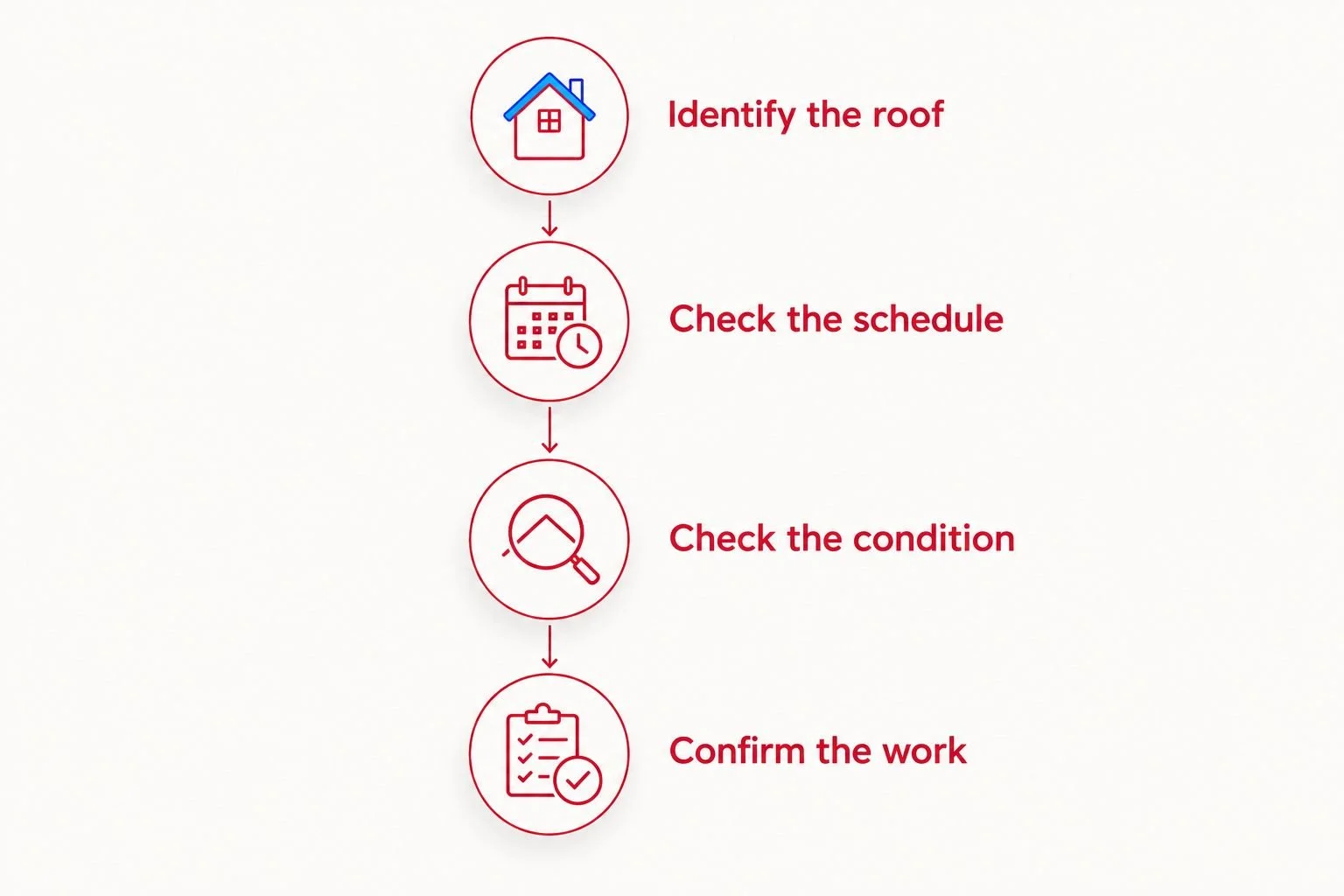
Identify the roof before choosing a cleaning method or booking the work.
Why this matters
A roof-cleaning schedule should help you remove contamination without exposing the roof to unnecessary scrubbing, unsuitable chemicals, or unsafe access. Washing more often is not automatically better if the method conflicts with the roof’s care instructions.
The roof also drains toward other exterior surfaces. Cleaning it as part of a coordinated exterior wash helps you avoid rinsing dirty water over sidewalls you have just finished cleaning.
Keep the tasks separate in your booking request. A roof wash, an exterior wash, a protective treatment, and repair work are different requests; one should not be assumed to include the others.
Match the cleaning decision to your storage conditions
Where your RV sits helps explain what collects on its roof. Use storage conditions to decide when to check for contamination, not to invent a replacement for the manufacturer’s maintenance schedule.
Covered storage
Best for: Reducing direct exposure to falling debris
Cleaning decision: Follow the roof schedule and check its condition before travel
Limitation: Cover does not establish that the roof is clean
Open outdoor parking
Best for: Owners who need an accessible parking arrangement
Cleaning decision: Check for accumulated dirt and debris between scheduled washes
Limitation: Exposure varies by the actual parking space
Parking near trees
Best for: Owners using a shaded location
Cleaning decision: Check for leaves, sap, and bird droppings
Limitation: Shade does not prevent roof contamination
Returning from a trip
Best for: Owners resetting maintenance after travel
Cleaning decision: Assess the roof before parking or covering the RV
Limitation: A trip alone does not establish that a full wash is due
Covered storage reduces some exposure; it does not cancel roof maintenance. Likewise, outdoor parking does not establish a fixed cleaning interval without knowing the roof and its condition.
For a 2026 maintenance record, note where the RV was parked, what contamination you found, and which cleaning method was used. Those observations make the next decision more useful than a calendar reminder alone.
Covered storage: follow the schedule, not appearances alone
A roof can be out of sight for much of the storage period. Do not assume it is clean because the sidewalls still look good.
Check the roof’s condition using an approved, safe viewing method before covering it or preparing for a trip. If the storage arrangement prevents access, resolve that before arranging cleaning rather than expecting a technician to work around an unsafe setup.
Outdoor storage: respond to what collects
Leaves, droppings, and sap call for different cleaning decisions than a light layer of loose dirt. Identify the contamination and check the approved removal method before scrubbing.
Do not increase chemical strength simply because a mark resists cleaning. A remaining stain is not proof that stronger chemicals or more pressure are appropriate.
Why RV roof-cleaning frequency varies
The cleaning interval depends on the roof and its exposure. These factors explain why another owner’s schedule is not automatically right for your RV:
Manufacturer instructions. The roof’s documented maintenance requirements set the starting point for your schedule.
Roof material. Cleaner compatibility and cleaning methods depend on the surface being treated.
Storage exposure. Covered parking and an open space beneath trees expose the roof to different conditions.
Visible contamination. Leaves, bird droppings, sap, and accumulated dirt create cleaning needs between scheduled washes.
Roof condition. Loose material, damaged areas, or suspected leaks require attention before routine washing proceeds.
Safe working conditions. Access, weather, footing, and the permitted work area affect when cleaning can be carried out safely.
Do not treat a weather change as proof that the roof needs washing. Check its condition. Rain also does not establish that adhered contamination has been removed.
When reviewing your 2026 schedule, separate the manufacturer’s required maintenance from additional cleaning prompted by debris. That distinction helps you explain exactly what you need when requesting a quote.
What should you check before cleaning an RV roof?
Confirm that the roof can be accessed safely before anyone climbs onto it. A ladder on the RV does not, by itself, establish the roof’s walking limits or the condition of the ladder and its attachments.
Use this checklist before starting or booking the work:
Find the roof material and approved cleaning instructions.
Check whether the manufacturer permits walking on the roof.
Identify any known leaks, damage, loose components, or previous repairs.
Explain whether the RV has roof-mounted equipment that affects access.
Confirm how nearby vehicles, belongings, and finished surfaces will be protected from wash water.
Agree on what happens if the roof cannot be cleaned safely.
Do not pressure-wash seams, openings, or roof components simply to remove a stubborn mark. Use only methods allowed by the relevant manufacturer’s instructions.
If you see a split, loose edge, or other suspected damage, pause the cleaning decision and arrange appropriate evaluation. A cleaner roof is not evidence of a watertight roof. This article does not establish that inspection or repair services are included in a mobile wash.
Can you clean an RV roof yourself?
You can clean an RV roof yourself when you have the correct instructions, compatible materials, and safe access. The benefit is control over the work; the drawback is that you remain responsible for access, surface compatibility, runoff, and avoiding damage.
Do not climb onto a roof to save a service visit if you cannot verify its walking requirements or your footing. Ground-level convenience does not make roof work safe.
If you choose mobile service, ask the same technical questions you would answer before doing the job yourself. Confirm the roof material, the proposed method, and whether roof cleaning is actually part of the quoted work.
A professional booking should make the scope clearer, not replace those questions. Neither a broad “RV wash” label nor an exterior detailing description guarantees that the roof is included.
Arrange mobile service in Salt Lake County
Trailhead-RV mobile RV wash service suits owners who want the provider to come to their RV’s location. The veteran-owned business serves Weber, Davis, and Salt Lake Counties in Utah, with Layton as its primary base.
For this roof-cleaning request, provide the actual Salt Lake County location. Whether your RV is in Salt Lake City, Murray, or Sandy, the provider needs the service address and site details—not just the nearest city name.
Mobile service avoids taking the RV to a wash location. Its limitation is that the job still depends on suitable access and permission at the place where the RV is parked.
Before booking Trailhead-RV mobile RV wash service, confirm:
Availability: Whether service can be scheduled at your location.
Roof scope: Whether roof cleaning is available for your roof material and condition.
Site permission: Whether the property or storage operator allows mobile washing.
Utilities: What water or electrical access, if any, you must provide.
Working access: Gate entry, overhead clearance, parking position, and room around the RV.
Travel fee: Whether a travel fee applies to your location.
Do not assume a storage facility permits washing because it permits maintenance visits. Ask the operator specifically about the proposed work and any wastewater-handling requirements before confirming the appointment.
What should you include in a roof-cleaning quote request?
Send enough information to distinguish a routine cleaning request from a roof-condition concern. This makes the requested work clearer without promising a result before the roof is assessed.
For your 2026 quote request, include:
Your city, service address, and whether the RV is at home or in storage.
The RV type and roof material, if known.
The last known roof-cleaning date, if recorded.
The problem you want addressed: dirt, leaves, droppings, sap, or another visible issue.
Any known leaks, damaged areas, coatings, or previous roof repairs.
Site restrictions, utility access, and the property operator’s permission requirements.
Photos taken from a safe position can help explain the request. Do not climb onto the roof solely to obtain booking photos.
Ask Trailhead-RV to confirm roof-cleaning scope, service availability, site requirements, and any travel fee before you agree to the work. If you also want the sidewalls washed, include that separately so the quote reflects both tasks.
Request a mobile wash quote
Share your Salt Lake County location, roof material, and access details; confirm scope and any travel fee.
Should you clean the roof before putting on an RV cover?
Check the roof before covering the RV, and remove contamination using the manufacturer’s approved method when needed. A cover is not a substitute for cleaning leaves or other debris already on the surface.
Follow the cover manufacturer’s preparation instructions as well. Confirm that the RV is ready to cover rather than using the cover to hide an unfinished cleaning task.
Does roof cleaning replace a protective treatment?
Roof cleaning removes contamination; it does not automatically provide a separate protective treatment. Whether a treatment is appropriate depends on the roof material and manufacturer’s instructions.
Do not assume an exterior wax or sidewall product belongs on the roof. Ask for the exact proposed treatment and verify compatibility before approving it.
FAQ
How often should an RV roof be cleaned in Salt Lake County?
Clean an RV roof according to its manufacturer’s schedule, and address contamination between scheduled washes using approved methods. Storage exposure and the roof’s actual condition help determine when additional cleaning is needed.
Should I wash my RV roof every month?
Do not adopt a monthly roof-washing schedule unless the manufacturer’s instructions or the roof’s condition supports it. Check the care requirements before increasing cleaning frequency.
Does rain clean an RV roof well enough?
Rain does not establish that an RV roof is clean. Check for adhered contamination and follow the roof manufacturer’s cleaning instructions.
Can I use the same cleaner on every RV roof?
No, you should not assume one cleaner is compatible with every RV roof. Identify the roof material and use a method approved for that surface.
Is roof cleaning included in a mobile RV wash?
Roof cleaning is not automatically included in a mobile RV wash. Confirm the quoted scope, roof compatibility, and access requirements before booking.
Can mobile RV washing be done at my storage facility?
Mobile RV washing requires the storage operator’s permission and a suitable work area. Confirm access, utility requirements, wastewater arrangements, service availability, and any travel fee before scheduling.
Does Trailhead-RV serve Salt Lake County?
Trailhead-RV provides mobile RV washing, detailing, and tank cleaning throughout Salt Lake County, Davis County, and Weber County. Confirm roof-cleaning scope and availability for your specific location before booking.
One last thing
Record the method, not just the cleaning date. For your 2026 maintenance log, save the roof material, cleaner used, and any concerns noticed during the work alongside the date.
That record helps you avoid repeating an unsuitable method and gives the next service provider useful context. Keep any repair concerns separate from the cleaning record so they do not disappear behind a completed wash appointment.
Related guides
About the author
Seth Garecht is the author of this Trailhead-RV article on RV roof-cleaning schedules and mobile-service booking considerations for Salt Lake County owners.